


The Technology Trends Defining the Next Era of Battery Recycling
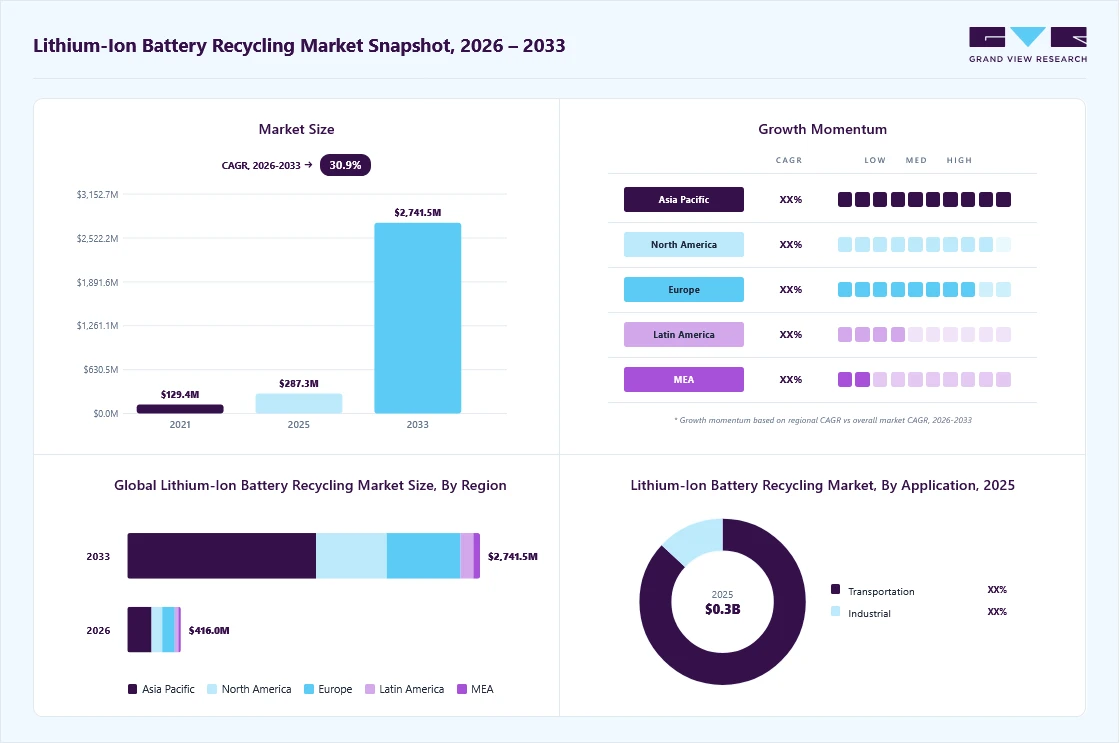
The Lithium-ion Battery Recycling Market was valued at USD 287.3 million in 2025 and is projected to grow from USD 416.0 million in 2026 to USD 2,741.5 million by 2033, registering a 30.9% CAGR from 2026 to 2033. Rising EV adoption, increasing battery waste, and the need to recover critical minerals are creating strong opportunities for recycling companies and technology providers.
Market Overview & Growth Drivers
· Electric Vehicle Surge:
The rapid expansion of electric vehicles is generating a growing stream of spent lithium-ion batteries. Transportation accounted for 70.8% of market revenue in 2025, making it the largest application segment. Rising EV adoption across passenger vehicles, buses, commercial fleets, and two- and three-wheelers is increasing demand for battery collection, dismantling, and material recovery. The transportation segment is also expected to register the fastest CAGR of 32.7% during the forecast period.
As EV manufacturing scales, recycling is becoming an increasingly important part of the battery value chain. Automakers, battery manufacturers, and recyclers are developing partnerships and take-back programs to establish more efficient collection and processing networks. This is helping create a more circular approach to battery manufacturing and end-of-life management.
· Critical Mineral Shortages:
The recovery of lithium, cobalt, nickel, manganese, copper, and aluminum is another major market driver. Recycled materials can reduce dependence on mining and help stabilize supplies of minerals required for battery manufacturing. As demand for batteries increases, recovering materials from used batteries provides manufacturers with an additional source of critical resources.
The push toward localized battery supply chains is strengthening this opportunity. Companies and governments are increasingly interested in securing critical raw materials closer to battery production facilities. Recycling plants and collection networks can therefore support both resource security and long-term supply-chain resilience.
· Stringent Government Rules:
Government policies surrounding battery waste management, extended producer responsibility, environmental protection, and circular economy practices are encouraging investment in recycling infrastructure. Growing concerns about battery disposal, pollution, and fire risks are also motivating industries to establish safer collection and processing systems.
Extended producer responsibility frameworks and corporate sustainability commitments are encouraging manufacturers to take greater responsibility for batteries throughout their lifecycle. Regulatory requirements are consequently becoming an important factor influencing recycling capacity and collection networks.
Regional and Industry Trends
· Asia-Pacific Leadership:
Asia Pacific dominated the market with a 44.1% revenue share in 2025 and is projected to record the fastest CAGR of 34.1% during the forecast period. Strong battery manufacturing, EV production, consumer electronics activity, and energy storage deployment are generating substantial volumes of end-of-life batteries.
Government initiatives focused on battery waste management, domestic material recovery, supply-chain localization, and critical mineral security are supporting new recycling capacity. Investments in collection networks and partnerships between automakers, battery manufacturers, and recycling companies are also strengthening the regional ecosystem.
· India's Rapid Expansion:
India is emerging as an important market as EV adoption and energy storage deployment increase. The country's growing focus on localized supply chains and battery waste management is creating opportunities for recycling infrastructure and material recovery. India is also included among the key countries covered in the market's regional analysis.
· Technology Focus:
Advanced recycling technologies are becoming central to industry development. Hydrometallurgical processing and direct recycling are improving material recovery opportunities, while investments in collection systems and recycling facilities are supporting greater processing capacity. Second-life battery applications can also extend battery utilization before recycling, creating additional value within the battery lifecycle.
However, the industry faces challenges including high capital requirements, complex dismantling processes, hazardous battery components, varying battery chemistries, inconsistent collection volumes, transportation restrictions, and limited standardized infrastructure. Differences in regulatory requirements and traceability frameworks can also slow the development of recycling ecosystems.
FAQs
1. How big is the lithium-ion battery recycling market?
The market was valued at USD 287.3 million in 2025, is estimated to reach USD 416.0 million in 2026, and is projected to reach USD 2,741.5 million by 2033, growing at a 30.9% CAGR from 2026 to 2033.
2. Which segment leads the lithium-ion battery recycling market?
Transportation led the application segment with a 70.8% revenue share in 2025. It is also expected to remain the fastest-growing application segment, with a projected CAGR of 32.7% during the forecast period.
Key Lithium-ion Battery Recycling Companies:
· Li-Cycle Corp.
· Redwood Materials, Inc.
· Umicore
· Glencore
About us:
Grand View Research, a market research and consulting company, provides syndicated research reports, customized research reports, and consulting services. Grand View Research database is used by the world's renowned academic institutions and Fortune 500 companies to understand the global and regional business environment. Our database features thousands of statistics and in-depth analysis on 46 industries in 25 major countries worldwide.

 English
 Arabic
 French
 Spanish
 Deutsch
 Turkish
 Dutch
Dutch
 Italiano
 Russian
 Romaian
 Portuguese (Brazil)
 Greek
Greek