


What Skills Should You Learn Before Starting a PPC Career in Noida?
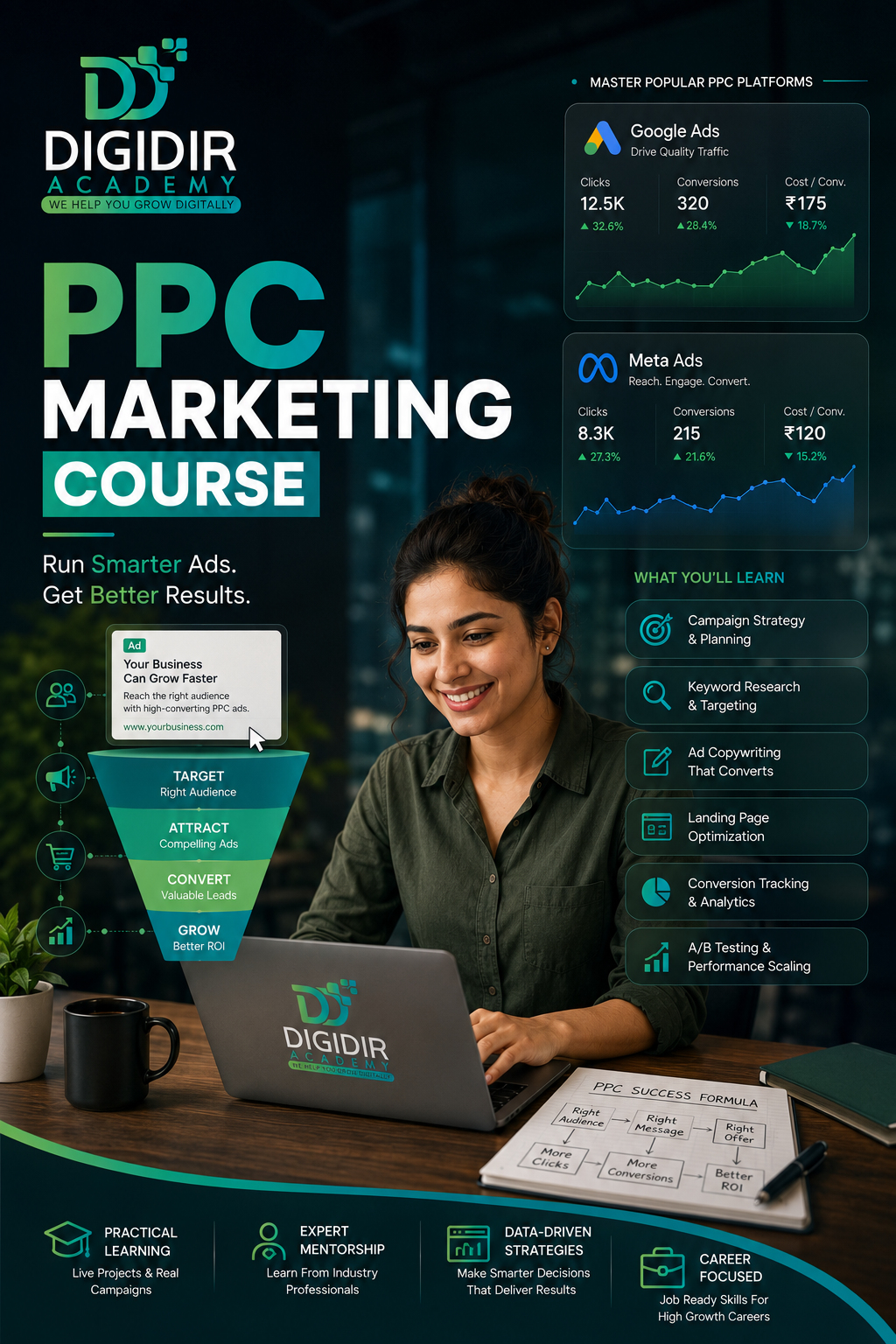
Paid advertising can provide businesses with targeted visibility, but successful PPC management involves considerably more than creating an advertisement and selecting a budget.
A PPC professional needs to understand search intent, keyword selection, campaign architecture, bidding, audiences, landing pages, conversion tracking, performance data, and ongoing optimisation.
For anyone considering a PPC course in Noida, practical skill development should therefore be a major consideration.
What Is PPC and Why Does It Require Strategy?
Pay-per-click advertising allows businesses to pay for visits or other advertising outcomes based on the platform and campaign model.
Google Ads is one of the most widely used platforms, but the underlying marketing principles extend beyond the interface.
A campaign needs a clear objective, relevant audience, appropriate targeting, compelling messaging, and a destination page that supports the desired action.
If these elements do not work together, simply increasing the advertising budget may not solve the problem.
Why Is Keyword Research Important?
Keyword research helps advertisers understand what potential customers are searching for and how closely those searches relate to a business's offering.
A professional PPC marketer considers:
-
Search intent
-
Commercial relevance
-
Competition
-
Expected cost
-
Match types
-
Negative keywords
-
Landing-page relevance
For example, a company selling a specific professional service may want to distinguish between searches from people researching the topic and searches from people actively looking for a provider.
This distinction can have a major effect on campaign efficiency.
What Should a PPC Marketing Course Teach?
A comprehensive PPC marketing course should teach learners how to plan and structure campaigns rather than simply navigate an advertising platform.
Important areas include:
-
Campaign planning
-
Keyword research
-
Search intent
-
Ad groups and campaign structure
-
Ad copy
-
Audience targeting
-
Bidding
-
Budget allocation
-
Landing pages
-
Conversion tracking
-
Remarketing
-
Performance analysis
Learners should understand how these components influence one another.
For instance, strong ad copy may generate clicks, but if the landing page does not match the promise made in the advertisement, conversions can remain low.
Why Does Conversion Tracking Matter?
Without reliable conversion tracking, advertisers may struggle to determine whether campaigns are producing business value.
A click is not necessarily a successful outcome.
Depending on the business, conversions may include purchases, calls, enquiry forms, bookings, registrations, or other valuable actions.
Learners should understand how to evaluate metrics such as:
CTR → CPC → Conversion Rate → Cost Per Conversion → ROAS
These figures should be interpreted in context rather than treated as isolated targets.
For example, a campaign with a higher cost per click may still be commercially valuable if it produces significantly more qualified customers.
How Important Is Landing-Page Optimisation?
PPC performance does not stop when someone clicks an advertisement.
The landing page must provide a logical continuation of the user's journey.
Important considerations include:
-
Message consistency
-
Clear value proposition
-
Mobile usability
-
Page speed
-
Trust signals
-
Relevant information
-
Simple calls to action
A useful PPC programme should therefore introduce learners to basic conversion rate optimisation.
Why Is Practical Campaign Analysis Essential?
The difference between theoretical PPC knowledge and professional ability often becomes clear during optimisation.
Suppose a campaign receives a large number of clicks but very few conversions. A PPC specialist should investigate possible causes.
Is the targeting too broad?
Are irrelevant searches triggering the ads?
Does the landing page match the advertisement?
Is conversion tracking functioning correctly?
Is the offer competitive?
This diagnostic process is more important than memorising platform settings.
Should PPC Learners Understand Google Ads Automation and AI?
Modern advertising platforms increasingly use automation and machine-learning systems for bidding, targeting, creative optimisation, and campaign management.
PPC professionals therefore need to understand both manual controls and automated campaign systems.
AI tools can also assist with research, ad-copy ideation, analysis, and workflow efficiency.
However, automation should not eliminate human oversight. Marketers still need to define objectives, review data, evaluate lead quality, protect budgets, and make strategic decisions.
What Should You Look for in the Best PPC Training Courses?
When comparing best PPC training courses, focus on practical outcomes rather than promotional claims.
Ask whether the programme includes:
-
Real or realistic campaign projects
-
Keyword research exercises
-
Ad-copy development
-
Conversion tracking
-
Landing-page analysis
-
Campaign optimisation
-
Performance reporting
-
Budget-management scenarios
-
Trainer feedback
A course should help learners understand why a campaign decision is made, not simply tell them where to find a particular platform setting.
Can a PPC Specialist Course Help With Career Development?
A PPC specialist course can provide a foundation for roles involving paid search, performance marketing, digital advertising, or broader digital marketing.
However, career development also requires communication and analytical skills.
A PPC specialist may need to explain why a campaign underperformed, justify a budget change, communicate results to a client, or recommend improvements to a landing page.
Therefore, learners should develop the ability to turn advertising data into business recommendations.
DigiDir Academy incorporates practical digital marketing concepts that can help learners understand how paid advertising connects with SEO, websites, conversion optimisation, and broader customer acquisition.
Common Mistakes New PPC Learners Should Avoid
Beginners often focus heavily on clicks and impressions.
These metrics are useful, but they do not necessarily indicate commercial success.
Other common mistakes include:
-
Using overly broad targeting
-
Ignoring negative keywords
-
Sending all traffic to one generic page
-
Failing to track conversions
-
Changing campaigns without enough data
-
Optimising for clicks instead of business outcomes
-
Increasing budgets before understanding performance
Learning to diagnose these issues is a core part of becoming a stronger PPC professional.
FAQs
Is a PPC course in Noida suitable for beginners?
Yes. Beginners can learn PPC from the fundamentals, provided the training progresses from campaign concepts to practical implementation and analysis.
What is taught in a PPC marketing course?
Typical topics include keyword research, campaign structure, ad creation, bidding, targeting, conversion tracking, remarketing, landing pages, and performance optimisation.
Do I need coding skills to learn PPC?
Advanced coding is generally not required. However, understanding basic website and tracking concepts can be useful.
What does a PPC specialist course prepare you for?
It can provide foundational skills for paid search, performance marketing, digital advertising, campaign management, and related digital marketing roles.
How important is Google Ads experience for a PPC career?
Practical Google Ads knowledge can be valuable because it allows learners to understand campaign setup, optimisation, reporting, and advertising workflows rather than relying solely on theoretical knowledge.
Conclusion
A successful PPC career requires more than knowing how to launch advertisements. Professionals need to understand search intent, targeting, campaign structure, landing pages, conversion tracking, analytics, and optimisation.
For learners evaluating a PPC course in Noida, practical campaign experience should be one of the most important selection criteria. The strongest foundation comes from learning how to analyse performance, identify problems, and make decisions that connect advertising activity with genuine business outcomes.

 English
 Arabic
 French
 Spanish
 Portuguese
 Deutsch
 Turkish
 Dutch
Dutch
 Russian
 Romaian
 Portuguese (Brazil)
 Greek
Greek