


BIS FMCS Certification in Delhi: How Foreign Manufacturers Can Enter the Indian Market with Confidence
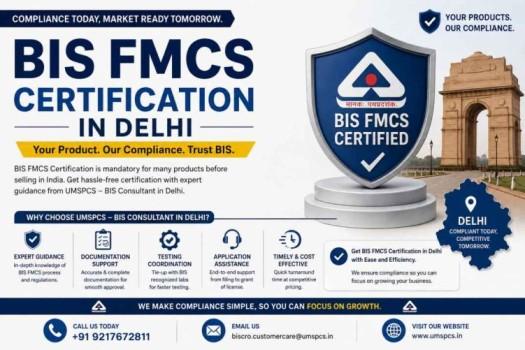
Planning to sell your products in India but unsure about BIS requirements? For foreign manufacturers, entering the Indian market can be an exciting opportunity, but regulatory compliance is one area that should never be overlooked.
If your product falls under the applicable mandatory BIS requirements, obtaining certification can be an essential part of your India market-entry strategy. This is where the BIS FMCS Certification in Delhi becomes relevant.
The Foreign Manufacturers Certification Scheme (FMCS) is designed for manufacturers located outside India who want to obtain a BIS licence for products covered under the applicable Indian Standards. The scheme allows eligible foreign manufacturers to demonstrate that their products meet Indian quality and safety requirements.
But what does the process actually involve? Who can apply? What documents are required? And how can a consultant make the process easier?
Let’s understand it step by step.
What Is BIS FMCS Certification?
BIS FMCS stands for Foreign Manufacturers Certification Scheme. It is a certification route provided by the Bureau of Indian Standards (BIS) for eligible manufacturers whose production facilities are located outside India.
Once the applicable requirements are fulfilled and the licence is granted, the manufacturer can use the BIS Standard Mark on the certified product as permitted under the relevant requirements.
For foreign businesses, FMCS can play an important role in demonstrating conformity with Indian Standards and building confidence among Indian buyers, distributors and business partners.
However, certification is not automatically required for every imported product. The manufacturer must first determine whether its particular product is covered by a mandatory BIS requirement, such as a Quality Control Order.
Why Is BIS FMCS Certification Important for Foreign Manufacturers?
Imagine preparing your first major shipment to India, only to discover that your product requires regulatory approval before it can be legally marketed.
Such situations can lead to unnecessary delays, additional costs and complications for manufacturers and importers.
Obtaining the required certification in advance can help foreign manufacturers:
-
Meet applicable Indian regulatory requirements
-
Demonstrate product conformity
-
Strengthen customer confidence
-
Support smoother market entry
-
Avoid compliance-related complications
-
Build credibility with Indian distributors and business partners
For companies planning long-term operations in India, compliance should ideally be considered before the first commercial shipment, not after a problem arises.
Who Needs BIS FMCS Certification?
FMCS is specifically intended for foreign manufacturers whose manufacturing facilities are located outside India.
A foreign manufacturer applying under FMCS must also nominate an Authorized Indian Representative (AIR) who meets the applicable BIS requirements.
The AIR serves as an important point of contact in India and can assist with communication and certification-related responsibilities.
One important point for manufacturers to remember is that an importer cannot simply apply for the FMCS licence on behalf of the foreign manufacturer. The application is made by the foreign manufacturer itself.
Read More- BIS certification consultants in Noida
How Does the BIS FMCS Certification Process Work?
The process may differ depending on the product and applicable Indian Standard, but manufacturers generally need to go through several key stages.
Step 1: Identify the Applicable Indian Standard
Everything starts with identifying the correct Indian Standard for the product.
This step is more important than it may appear. The applicable standard determines many of the subsequent requirements, including testing and quality-control conditions.
Step 2: Appoint an Authorized Indian Representative
The foreign manufacturer needs to nominate an eligible AIR in India.
Having the right representative can make communication and coordination during the certification process much easier.
Step 3: Prepare the Technical Documentation
Documentation is a major part of the application. Depending on the product, manufacturers may need to provide information about the company, manufacturing facility, product specifications, manufacturing process, quality-control system and testing arrangements.
A missing or inconsistent document can result in queries and may slow down the process.
Step 4: Arrange Product Testing
Products must generally be tested according to the applicable Indian Standard and prescribed requirements.
Manufacturers should not assume that a test report prepared against an international standard will automatically satisfy Indian requirements. The testing requirements should be reviewed before testing begins.
Step 5: Prepare for Factory Inspection
Factory inspection can be an important part of the FMCS process.
BIS may evaluate aspects such as manufacturing facilities, quality-control arrangements, testing capabilities and production practices.
This means manufacturers should make sure their facility and records are properly prepared before inspection.
Step 6: Application Evaluation and Licence
After the required documentation, testing and inspection formalities are completed, BIS evaluates the application.
If the applicable requirements are fulfilled, the BIS licence can be granted in accordance with the scheme.
What Documents Are Required?
There is no single document list that applies identically to every product. Requirements can vary according to the applicable Indian Standard.
Generally, manufacturers may need documents such as:
-
Company registration details
-
Manufacturing-unit information
-
Product specifications
-
Applicable Indian Standard
-
Manufacturing process details
-
Quality-control documentation
-
Testing arrangements and reports
-
Brand or trademark details
-
Authorized Indian Representative documents
-
Undertakings and declarations
-
Other product-specific information required by BIS
Preparing these documents correctly from the beginning can help make the application process more organized.
What Changed for FMCS Applications in 2026?
Foreign manufacturers should also be aware of an important procedural change.
BIS has moved FMCS application submission to its online Manakonline platform. BIS stated that offline or hard-copy applications were accepted only up to 31 May 2026, with online submission applicable from 1 June 2026.
For manufacturers preparing a new application, it is therefore important to follow the current online application procedure rather than relying on older documentation or application practices.
Why Work With a BIS FMCS Consultant in Delhi?
For a foreign manufacturer sitting thousands of kilometres away from India, managing every certification requirement independently can be difficult.
There may be questions about the applicable standard, documentation, testing, AIR requirements, factory inspection and application procedures.
This is where a professional BIS FMCS Consultant in Delhi can provide practical assistance.
UMSPCS can support foreign manufacturers with:
-
Understanding applicable BIS requirements
-
Documentation preparation
-
Application assistance
-
Testing coordination
-
Factory inspection preparation
-
Communication and compliance coordination
-
Guidance throughout the certification process
The objective is to make the certification journey more structured and easier to manage.
Why Choose UMSPCS?
Choosing a compliance consultant is not just about getting an application submitted. The right support should help you understand what is required, why it is required and what needs to be done next.
UMSPCS provides regulatory assistance to manufacturers seeking BIS-related certifications and approvals. From initial requirement assessment to documentation and certification coordination, the focus is on helping businesses approach Indian regulatory compliance with greater clarity.
If you are a foreign manufacturer planning to introduce a BIS-regulated product in India, getting your requirements assessed early can save considerable time and prevent avoidable compliance issues.
Read More- EPR Certification In Noida
Conclusion
Entering the Indian market can open the door to significant business opportunities, but regulatory readiness should be part of the plan from day one.
For eligible foreign manufacturers, BIS FMCS Certification in Delhi provides a structured route toward demonstrating conformity with applicable Indian Standards. From selecting the correct standard and preparing documents to product testing, factory inspection and final evaluation, each stage deserves careful attention.
Instead of waiting until your shipment or business launch is affected by compliance issues, start by understanding the requirements for your product.
Frequently Asked Questions
1. What is BIS FMCS Certification?
BIS FMCS is the Foreign Manufacturers Certification Scheme, under which eligible foreign manufacturers can obtain a BIS licence for products covered by the applicable Indian Standards.
2. Is BIS FMCS mandatory for foreign manufacturers?
Not for every product. The requirement depends on the applicable regulations, including whether the product is covered under a mandatory Quality Control Order or other compulsory BIS requirement.
3. Who can apply for FMCS certification?
Foreign manufacturers with manufacturing facilities located outside India can apply under FMCS for eligible products.
4. Is an Authorized Indian Representative required?
Yes. A foreign manufacturer applying under FMCS needs to nominate an Authorized Indian Representative who meets the applicable BIS requirements.
5. Can an Indian importer apply for the manufacturer's FMCS licence?
The FMCS application is made by the foreign manufacturer. An importer cannot simply apply for the licence on behalf of the foreign manufacturer.
6. Does FMCS involve factory inspection?
Factory inspection may form part of the certification process. BIS can assess manufacturing facilities, quality-control systems and testing arrangements as applicable to the product.
7. Can UMSPCS help with BIS FMCS Certification in Delhi?
Yes. UMSPCS can assist foreign manufacturers with requirement assessment, documentation, application coordination, testing-related activities, inspection preparation and other certification support.
8. When should a foreign manufacturer start the BIS process?
Ideally, certification requirements should be reviewed before exporting or commercially launching the product in India. Early planning gives manufacturers more time to address testing, documentation and facility-related requirements.

 English
 Arabic
 French
 Spanish
 Portuguese
 Deutsch
 Dutch
Dutch
 Italiano
 Russian
 Romaian
 Portuguese (Brazil)
 Greek
Greek