


How Can Businesses Monitor Data Quality Across Multiple Scraping Sources?
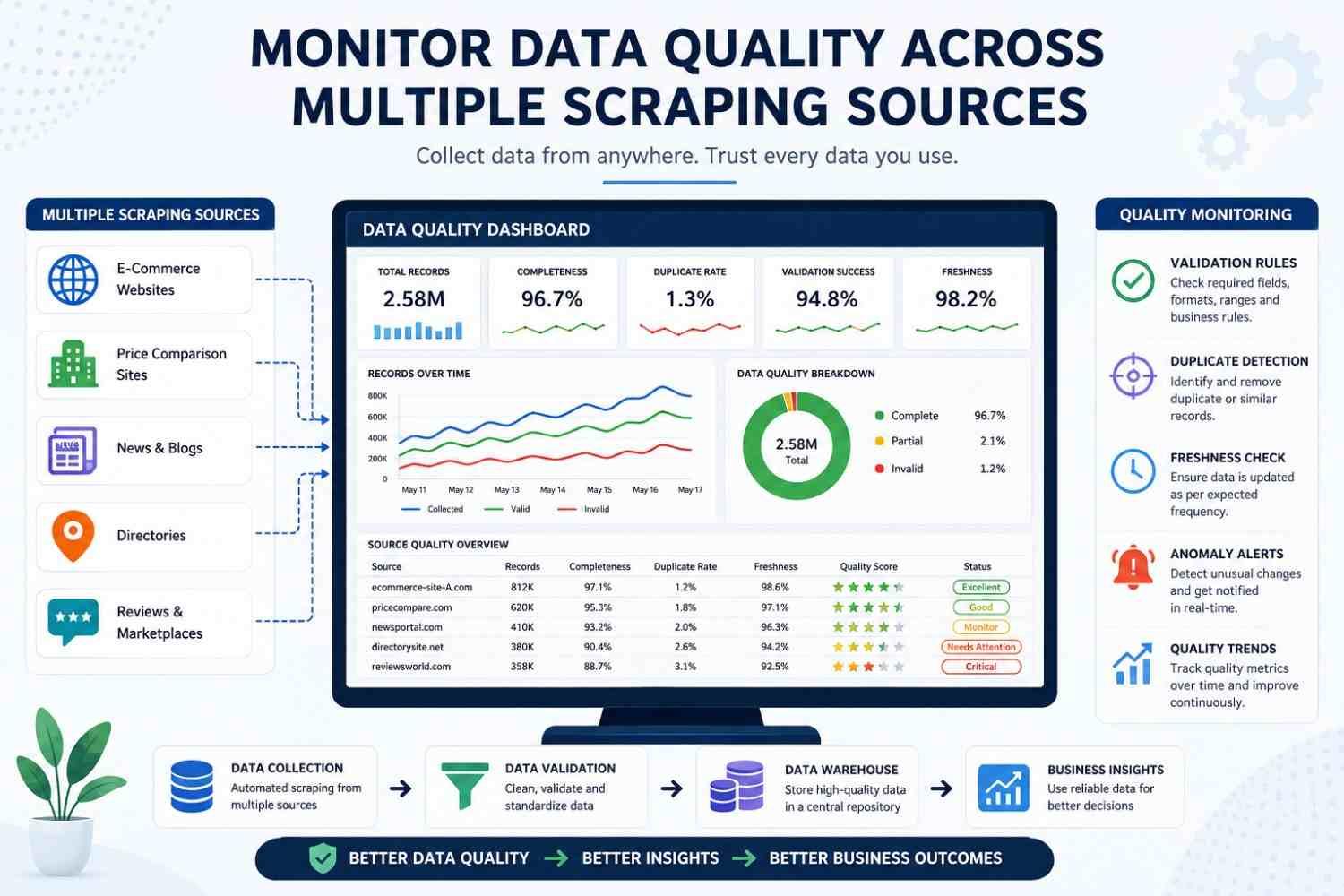
Collecting data from one website is relatively straightforward. Collecting reliable data from dozens or hundreds of websites is where things get interesting — and occasionally messy.
Businesses use web scraping to gather product information, competitor prices, market intelligence, real estate listings, reviews, and other valuable information. But collecting more data does not automatically mean collecting better data. A scraper can successfully extract thousands of records while quietly introducing missing values, duplicates, outdated information, or incorrect fields.
This is why web scraping data quality needs continuous monitoring. We need to know not only whether a scraper is running, but also whether the information it produces is accurate, complete, consistent, and useful.
For businesses working with multiple scraping sources, a structured monitoring process can turn raw scraped information into dependable business intelligence.
Why Does Data Quality Become Difficult With Multiple Scraping Sources?
Every website has its own rules, structure, formatting, and behavior. One source may display prices in USD, another in EUR, while a third may include taxes in the listed price. One website may use a product ID, while another relies entirely on product names.
Then there are website redesigns, dynamic content, missing fields, duplicate listings, blocked requests, and changing page structures — because apparently websites enjoy keeping scrapers on their toes.
When several sources are involved, these small differences can quickly become large data-quality problems.
Common issues include:
-
Missing or incomplete fields
-
Duplicate records
-
Incorrect values
-
Inconsistent formats
-
Outdated information
-
Broken extraction rules
-
Conflicting information between sources
-
Unexpected changes in record volume
The more sources we add, the more important centralized monitoring becomes.
What Does Good Scraped Data Quality Actually Mean?
Before monitoring quality, we need to define what “quality” means.
A useful data-quality framework typically includes several dimensions.
Accuracy
The extracted information should correctly represent the information available on the source website.
Completeness
Important fields should not be missing unnecessarily. For example, a product record may require a name, price, URL, availability status, and category.
Consistency
Information should follow a common format across different sources. Dates, currencies, units, categories, and names should be normalized where appropriate.
Freshness
Data should be updated according to the business requirement. A price collected three weeks ago may be useless for a time-sensitive analysis.
Uniqueness
The same product or listing should not appear multiple times simply because it was collected from different sources or scraping runs.
Validity
Values should follow predefined rules. A product price should not suddenly become negative, and a percentage field should not contain an unexpected text value.
These dimensions provide the foundation for a reliable monitoring system.
How Can Businesses Create a Standard Data Quality Framework?
The first step is to define quality rules before collecting large volumes of information.
We can create a common framework that applies across all scraping sources while also allowing source-specific rules.
For example, an e-commerce dataset may require:
-
Product name must not be empty.
-
Price must contain a valid numeric value.
-
Currency must belong to an approved list.
-
Product URL must be valid.
-
Availability must follow predefined values.
-
Duplicate product records should remain below a specific threshold.
Not every website will provide identical information, so universal rules should be combined with source-specific validation.
This approach gives teams a consistent way to evaluate different scraping pipelines without pretending that every website behaves exactly the same.
How Can Automated Validation Improve Scraped Data?
Manual checking may work for a small dataset. It becomes considerably less entertaining when there are millions of records.
Automated validation allows businesses to check information immediately after extraction.
Useful validation rules include:
-
Required-field checks
-
Data-type validation
-
URL validation
-
Date validation
-
Price-range validation
-
Currency validation
-
Text-length checks
-
Null-value detection
-
Duplicate detection
-
Unexpected-value detection
For example, if the average product price is normally between $20 and $500 and the scraper suddenly collects $50,000 for thousands of products, the system should flag the change.
The goal is not simply to collect data. The goal is to catch suspicious data before it reaches downstream systems.
How Can Businesses Detect Duplicate and Conflicting Records?
Multiple scraping sources often contain overlapping information.
A product may appear on several marketplaces. A property may be listed on multiple real estate portals. A company may have different profiles across business directories.
Without deduplication, the final dataset can exaggerate the number of unique records.
Businesses can use:
-
Unique IDs
-
URLs
-
SKU numbers
-
Product codes
-
Domain-specific identifiers
-
Exact matching
-
Fuzzy matching
-
Attribute-based matching
Conflicting values also require attention.
Suppose two websites report different prices for the same product. Rather than randomly selecting one value and hoping for the best, businesses can establish source-priority rules.
For example:
Primary source → verified marketplace → secondary marketplace → fallback source
This makes the decision process predictable and auditable.
Why Is Data Freshness Important?
Data can be accurate and still be useless if it is outdated.
This is particularly important for applications involving competitive intelligence, inventory information, market research, and price monitoring.
Businesses should track:
-
Last successful scrape
-
Last update timestamp
-
Record-level timestamps
-
Expected refresh frequency
-
Actual refresh frequency
-
Number of stale records
For example, if a website is expected to update product prices every six hours but the scraper has not successfully collected new information for 36 hours, the system should identify the source as stale.
Freshness monitoring turns “We collected the data” into a much more useful question:
“When was this data actually collected and can we still trust it?”
How Can Businesses Create Source-Level Quality Scores?
Not every scraping source performs equally well.
One website may provide clean and stable information every hour. Another may frequently change its structure and produce incomplete records.
A source-level quality score helps businesses understand this difference.
A basic score can consider:
| Metric | Example Measurement |
|---|---|
| Completeness | 97% |
| Validation Success | 95% |
| Duplicate Rate | 1.5% |
| Freshness | 98% |
| Scraping Success | 99% |
| Anomaly Rate | 2% |
These measurements can then be combined into an overall source reliability score.
A dashboard might classify sources as:
Excellent → Monitor → Needs Attention → Critical
This gives teams a quick overview of where problems exist instead of forcing them to inspect every scraper individually.
How Can Automated Alerts Detect Quality Problems?
A monitoring system becomes much more useful when it can notify the team automatically.
Businesses can configure alerts for events such as:
-
Record count drops by 50%.
-
Required fields suddenly become empty.
-
Duplicate rates exceed a threshold.
-
Prices change dramatically.
-
A scraper fails repeatedly.
-
A source has not updated within the expected period.
-
A website structure appears to have changed.
For example, if a scraper normally collects 100,000 product records and suddenly returns 8,000, that should not be treated as business as usual.
Maybe the website changed.
Maybe the scraper broke.
Maybe the website returned an incomplete page.
Either way, the system should raise a flag before those 8,000 records become someone’s “trusted dataset.”
How Can Businesses Track Data Quality Over Time?
A single quality check provides only a snapshot.
Long-term monitoring provides the bigger picture.
Businesses should store historical metrics and compare them over time. This makes it easier to identify gradual degradation.
For example:
Monday: 98% completeness
Tuesday: 97% completeness
Wednesday: 94% completeness
Thursday: 82% completeness
The Thursday result is clearly worth investigating.
Historical monitoring can reveal:
-
Gradual source deterioration
-
Repeated extraction failures
-
Website redesign patterns
-
Increasing duplicate rates
-
Declining freshness
-
Recurring validation errors
This information also helps technical teams determine when a scraper needs maintenance or replacement.
What Is Scraper Drift and Why Should Businesses Monitor It?
One of the more dangerous problems is scraper drift.
A website changes its structure, but the scraper continues running. There is no obvious crash. The system reports successful requests.
Unfortunately, the extracted information may now be wrong.
For example, a scraper previously extracted:
Product Name → Product Price → Availability
After a website redesign, the same selectors may capture:
Product Name → Promotional Text → Empty Value
The scraper technically worked.
The data did not.
Businesses can detect scraper drift by monitoring extraction rates, field completeness, data distributions, and historical patterns.
A sudden change in the number or structure of extracted fields can indicate that something has changed upstream.
How Can Businesses Build a Centralized Data Quality Dashboard?
When multiple scraping sources are involved, a centralized dashboard provides visibility across the entire system.
A useful dashboard can display:
-
Total records collected
-
Successful scraping jobs
-
Failed scraping jobs
-
Missing-value percentage
-
Duplicate percentage
-
Validation failures
-
Source reliability scores
-
Data freshness
-
Recent anomalies
-
Historical quality trends
Instead of checking individual scripts, teams can quickly identify which sources are healthy and which ones need investigation.
This is especially valuable for organizations operating large-scale data collection systems where monitoring every source manually would quickly become a full-time job.
Should Businesses Combine Automation With Human Review?
Automation is essential for scale, but human review still has a place.
Automated systems are excellent at identifying unusual patterns. They are less effective at understanding every business context.
A practical approach is to create a review queue for suspicious records.
For example:
-
Normal records → automatically processed
-
Minor anomalies → logged
-
High-impact anomalies → sent for human review
-
Critical source failures → immediately escalated
Businesses can also perform periodic sampling. A small percentage of records can be manually compared with the original source.
This combination gives us the best of both worlds — automated scale with human judgment where it actually matters.
How Can Web Scraping Services Support Data Quality?
Managing multiple scraping sources requires more than writing extraction scripts.
Professional web scraping services can support businesses with:
-
Source discovery
-
Scraper development
-
Data extraction
-
Data normalization
-
Validation
-
Deduplication
-
Monitoring
-
Scraper maintenance
-
Quality reporting
-
Scalable infrastructure
This can be particularly useful when websites frequently change their structures or when businesses need to collect information from a large number of sources.
The important point is that scraping should be treated as an ongoing data pipeline rather than a one-time extraction project.
What Are the Best Practices for Maintaining Data Quality?
Businesses can use the following checklist to maintain reliable scraped datasets:
-
Define data-quality standards before scraping.
-
Identify mandatory fields.
-
Validate records automatically.
-
Normalize formats across sources.
-
Remove duplicate records.
-
Track data freshness.
-
Score source reliability.
-
Monitor scraper success rates.
-
Create automated alerts.
-
Track historical quality metrics.
-
Monitor website structure changes.
-
Review suspicious records manually.
-
Maintain fallback sources.
-
Regularly update validation rules.
The most important principle is simple: data quality should be monitored continuously, not inspected only when something goes wrong.
What Common Mistakes Should Businesses Avoid?
Several mistakes appear repeatedly in multi-source scraping projects.
Measuring Only Scraping Success
A successful HTTP request does not mean successful data extraction.
Treating Every Source as Equally Reliable
Different sources have different accuracy, freshness, and stability levels.
Ignoring Duplicate Data
Duplicate records can distort analytics and business reports.
Skipping Historical Monitoring
Without historical metrics, it is difficult to know whether quality is improving or declining.
Depending Completely on Manual Checks
Manual review does not scale well when data volumes increase.
Ignoring Stale Data
Old information can be just as problematic as incorrect information.
Failing to Monitor Website Changes
A website redesign can silently damage extraction accuracy.
Conclusion
Scraping data is only half the job.
The real challenge begins when businesses need to determine whether that information is accurate, complete, fresh, consistent, and reliable enough to support decisions.
When multiple sources are involved, a strong monitoring framework becomes essential. Automated validation, duplicate detection, freshness monitoring, source scoring, anomaly detection, historical tracking, and human review can work together to create a dependable data pipeline.
Because at the end of the day, a scraper that runs perfectly while collecting the wrong information is still collecting the wrong information — just at impressive speed.
That is why businesses should treat data quality as an ongoing process, not a final checkbox. Monitor the sources, validate the output, learn from the patterns, and keep improving the pipeline.
Good data does not happen by accident. It happens when the entire scraping process is designed to protect it.
FAQs
How can businesses monitor data quality across multiple scraping sources?
Businesses can monitor quality using automated validation, duplicate detection, freshness checks, source reliability scores, anomaly detection, historical metrics, and automated alerts.
What are the most important data quality metrics for web scraping?
The key metrics include accuracy, completeness, consistency, validity, uniqueness, freshness, scraping success rate, and source reliability.
How do businesses detect bad data from web scraping?
Businesses can use predefined validation rules, anomaly detection, duplicate checks, historical comparisons, source comparisons, and manual sampling to identify potentially incorrect records.
Why is data freshness important in web scraping?
Freshness determines whether collected information is still useful. It is especially important for dynamic information such as prices, inventory, availability, and competitor data.
How can businesses monitor scraped prices from multiple websites?
They can compare prices across sources, normalize currencies and units, track timestamps, establish acceptable ranges, detect unusual price changes, and create automated alerts.
Can data-quality monitoring be automated?
Yes. Businesses can automate validation, anomaly detection, duplicate identification, freshness monitoring, source scoring, dashboards, and alerts.
What happens when a website changes its structure?
A scraper may continue running while collecting incomplete or incorrect information. Monitoring extraction rates and field-level changes can help identify this scraper drift quickly.
When should a business consider professional web scraping services?
Professional support can be useful when businesses need to monitor many websites, handle complex or frequently changing sources, process large datasets, or maintain continuous data-quality controls.

 English
 Arabic
 French
 Spanish
 Portuguese
 Deutsch
 Turkish
 Dutch
Dutch
 Italiano
 Romaian
 Portuguese (Brazil)
 Greek
Greek