


Can Honeycomb Packaging Replace More Plastic-Based Protective Materials?
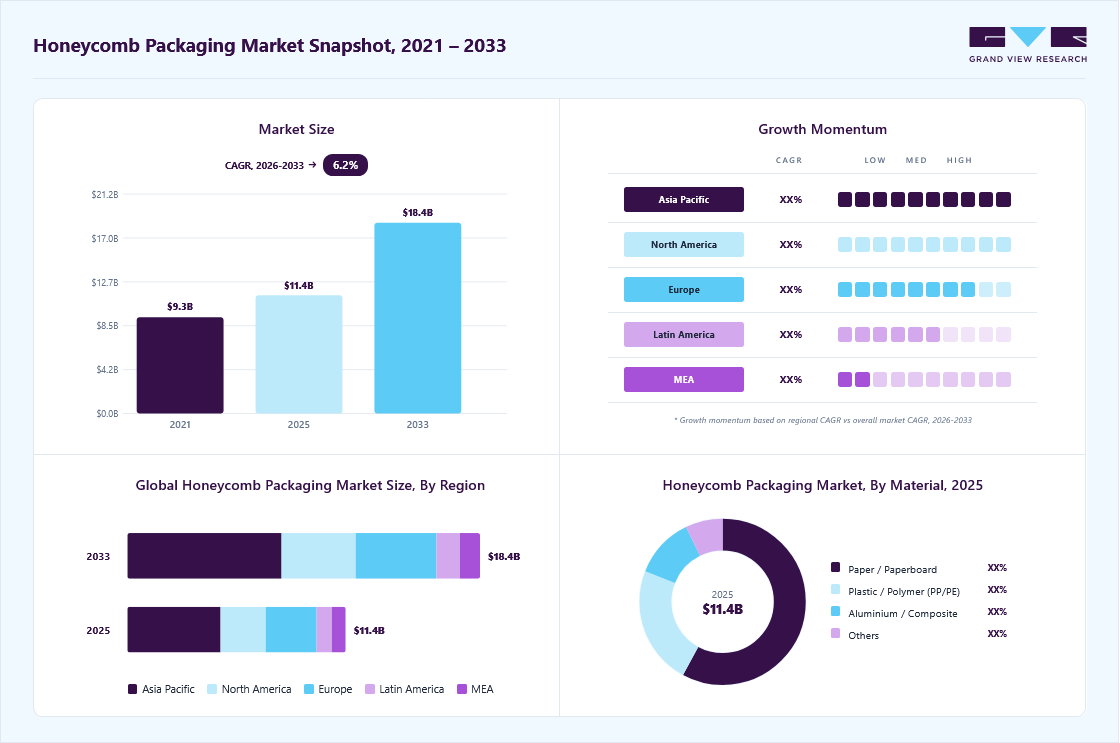
The honeycomb packaging market is expanding as businesses increasingly look for packaging solutions that combine protection, lightweight construction, cost efficiency, and sustainability. Honeycomb structures offer strong cushioning, shock absorption, and load-bearing capabilities while using comparatively less raw material than many traditional protective packaging formats.
Market Breakdown at a Glance
- Market size in 2025: USD 11.4 billion
- Estimated market size in 2026: USD 12.1 billion
- Projected market size by 2033: USD 18.4 billion
- CAGR from 2026 to 2033: 6.2%
- Leading material segment: Paper/paperboard with 57.8% share in 2025
- Leading end-use segment: Consumer goods with 29.5% share in 2025
- Largest regional market: Asia Pacific with 42.7% revenue share in 2025
- Fastest-growing material segment: Plastic/polymer (PP/PE), with a 6.5% CAGR
- Fastest-growing end-use segment: Consumer goods, with a 6.5% CAGR
Core Growth Drivers & Industry Trends
Sustainability is becoming a major force behind honeycomb packaging adoption. The packaging format is primarily manufactured using recyclable kraft paper and paperboard, positioning it as an alternative to plastic-based cushioning materials such as EPS foam and bubble wrap. Increasing emphasis on plastic waste reduction and circular economy initiatives is encouraging manufacturers and retailers to consider recyclable protective formats.
E-commerce is another important growth catalyst. Increasing parcel volumes create greater demand for lightweight but durable packaging that can protect products while helping control freight and handling costs. Honeycomb pallets, edge protectors, mailer inserts, boards, and wraps are increasingly suited to these requirements because they can be customized for different product shapes and sizes.
Industrial applications are also widening the opportunity. Automotive, electronics, aerospace, heavy goods, and industrial machinery require packaging capable of managing compression, vibration, shock, and transportation stresses. The high strength-to-weight ratio of honeycomb structures makes them suitable for sensitive components, vehicle parts, large glass sheets, and machinery.
The packaging industry is simultaneously moving toward automated production and digital design capabilities. These developments can improve manufacturing productivity and enable suppliers to create customized solutions around specific load-bearing and transportation requirements.
Regional Dominance
Asia Pacific remained the largest market, accounting for 42.7% of revenue in 2025. The region is also expected to record a 6.5% CAGR during the forecast period. Rapid industrial development, expanding e-commerce, electronics manufacturing, consumer goods production, and paper-processing capabilities are supporting demand.
China plays an important role in regional consumption and production, with its honeycomb packaging market expected to expand at a 6.9% CAGR from 2026 to 2033. Strong paper supply, manufacturing scale, and exports of electronics, furniture, and consumer goods are supporting demand for protective inserts, corner boards, and pallets.
North America is benefiting from e-commerce growth, logistics optimization, and demand for recyclable packaging. Manufacturers are investing in automated production technologies and customized structures for applications including aerospace, electronics, automotive, and industrial equipment.
Europe is strongly influenced by circular economy requirements and packaging waste reduction policies. Its established automotive, machinery, and furniture industries provide additional demand for engineered protective packaging.
Critical Market Vulnerabilities
Despite its growth prospects, honeycomb packaging faces limitations related to moisture resistance and durability. Paper-based structures can experience reduced structural integrity when exposed to excessive humidity, water, or harsh environmental conditions. Consequently, some applications may continue to rely on plastic, metal, or foam alternatives where moisture resistance is critical.
Another challenge is maintaining the right balance between lightweight construction, structural strength, customization, sustainability, and cost. Manufacturers must design packaging that protects products across different weights and transportation conditions without sacrificing recyclability or economic efficiency.
Competition from corrugated boards and foam-based alternatives also encourages suppliers to differentiate through material optimization, automated production, customized designs, and improved environmental performance.
With sustainability requirements, e-commerce shipments, industrial logistics, and protective packaging needs continuing to evolve, honeycomb packaging is positioned for steady expansion through 2033. Its combination of strength, lightweight construction, recyclability, and customization gives it opportunities across consumer goods, automotive, furniture, food and beverages, and industrial applications.
FAQs
How big is the honeycomb packaging market?
The honeycomb packaging market was valued at USD 11.4 billion in 2025, is estimated at USD 12.1 billion in 2026, and is projected to reach USD 18.4 billion by 2033, growing at a 6.2% CAGR from 2026 to 2033.
What challenges are affecting the honeycomb packaging market?
Limited moisture resistance and the need to balance strength, customization, sustainability, and cost are important challenges. Paper-based honeycomb structures can lose structural integrity under excessive moisture or water exposure, while manufacturers must continuously optimize designs for different transportation and storage requirements.
Key Honeycomb Packaging Companies:
· Smurfit Westrock
· Signode Industrial Group LLC
· Packaging Corporation of America
· DS Smith
About us:
Grand View Research, a market research and consulting company, provides syndicated research reports, customized research reports, and consulting services. Grand View Research database is used by the world's renowned academic institutions and Fortune 500 companies to understand the global and regional business environment. Our database features thousands of statistics and in-depth analysis on 46 industries in 25 major countries worldwide.

 English
 Arabic
 French
 Portuguese
 Deutsch
 Turkish
 Dutch
Dutch
 Italiano
 Russian
 Romaian
 Portuguese (Brazil)
 Greek
Greek