


Why Resource Recovery Could Define the Future of Industrial Waste Management
Industrial waste management is becoming increasingly important as manufacturing, chemical processing, oil and gas, pharmaceuticals, food processing, mining, and power generation create larger and more complex waste streams. Stricter environmental regulations, sustainability commitments, and growing interest in resource recovery are encouraging industrial operators to adopt structured collection, transportation, treatment, recycling, and disposal systems.
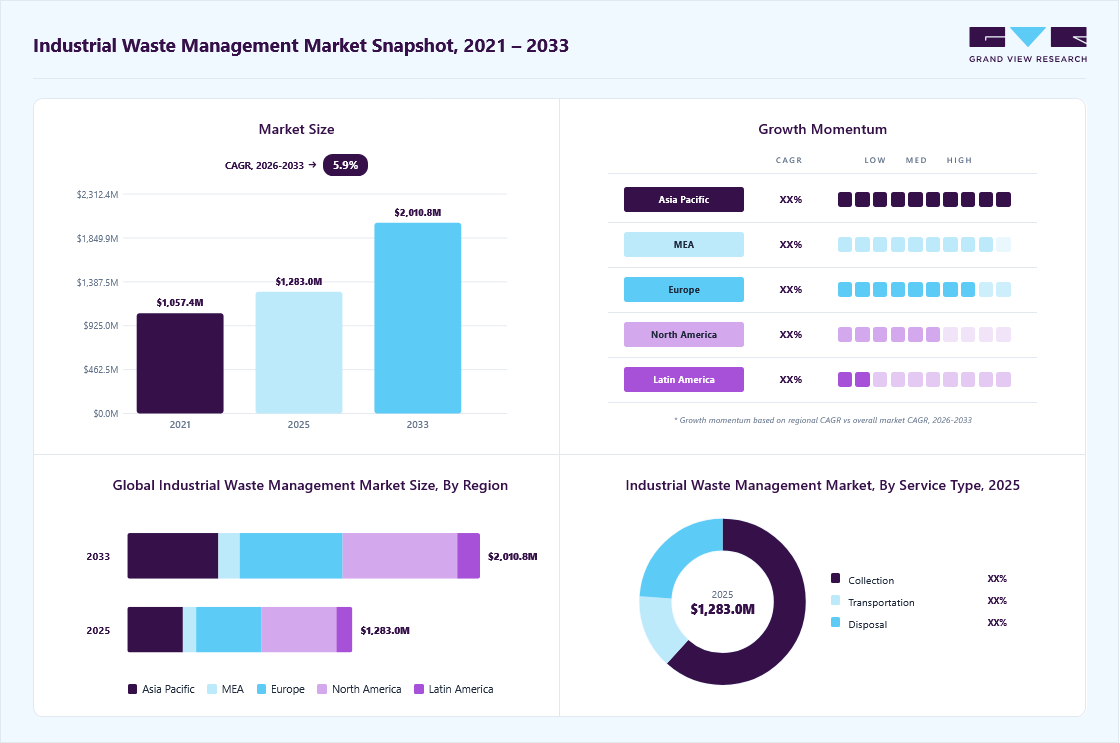
The industrial waste management market was valued at USD 1.2 billion in 2025 and is projected to reach USD 2.0 billion by 2033, expanding at a 5.9% CAGR from 2026 to 2033. The market is estimated at USD 1.3 billion in 2026, reflecting steady demand for professional waste handling and environmentally compliant disposal solutions.
Key Market Segmentation
The market is segmented by service type and end use. Collection held the leading position among service types, accounting for 61.6% of market revenue in 2025. Continuous waste generation from manufacturing and processing facilities creates recurring requirements for reliable pickup, segregation, transportation, and compliant handling. Disposal is expected to be the fastest-growing service segment, registering a 6.4% CAGR from 2026 to 2033. The shift away from uncontrolled dumping toward regulated disposal, engineered landfills, secure hazardous waste containment, and advanced treatment facilities is supporting this expansion.
Manufacturing represented the largest end-use segment with a 32.3% revenue share in 2025. Automotive, metal fabrication, food processing, electronics, and other manufacturing activities generate substantial solid, liquid, and semi-hazardous waste, creating consistent demand for professional waste management services. Meanwhile, the chemical segment is expected to register the fastest growth at a 6.4% CAGR from 2026 to 2033, supported by increasingly complex waste streams and the expansion of specialty chemicals, agrochemicals, and petrochemicals.
Major Growth Drivers & Industry Trends
Stricter environmental regulations are among the strongest forces supporting industrial waste management demand. Governments and environmental agencies are strengthening requirements for waste handling, landfill disposal, emissions control, wastewater treatment, and hazardous waste management. Industrial operators therefore need compliant systems capable of reducing environmental risks while maintaining operational efficiency.
Rapid industrialization is another important contributor. As manufacturing facilities and industrial operations expand, the volume and complexity of waste increase. This creates opportunities for specialized collection, treatment, recycling, and disposal providers.
The movement toward circular economy practices is also changing the industry. Companies are increasingly seeking ways to recycle industrial by-products, recover valuable resources, reduce landfill dependence, and lower raw-material requirements. Waste-to-energy technologies, advanced recycling systems, thermal treatment, and other processing technologies are improving recovery potential while creating additional value from industrial waste.
Technology is becoming increasingly relevant to operational efficiency. Automation, IoT monitoring, AI-based waste tracking, smart segregation, pyrolysis, plasma gasification, and digital waste traceability platforms are helping providers improve processing, monitoring, compliance reporting, and resource recovery.
Regional Variations
North America dominated the market with a 33.4% revenue share in 2025. Its established industrial base, advanced treatment infrastructure, strong regulatory framework, and high waste generation from manufacturing, energy, and chemical industries support market leadership. Continued investment in sustainable waste technologies further strengthens demand for professional services.
Asia Pacific is the fastest-growing region, with a 6.5% CAGR during the forecast period. Rapid industrialization, expanding manufacturing hubs, foreign investment, chemical and automotive production, and growing environmental awareness are increasing demand for modern waste management systems. Expanding urban-industrial clusters are also creating additional opportunities for collection and treatment providers.
Europe continues to develop through sustainability initiatives, circular economy practices, landfill reduction targets, recycling, and resource recovery. Latin America is gaining momentum as industrial development and infrastructure investment increase waste volumes, while the Middle East and Africa are seeing demand supported by expanding industrial and energy activities and improving environmental practices.
High treatment costs, capital requirements for specialized infrastructure, regulatory complexity, limited infrastructure in remote industrial areas, fluctuating technology costs, and skilled labor shortages remain important challenges. Nevertheless, the combination of regulatory pressure, industrial expansion, resource recovery, and digitalization is expected to sustain steady industrial waste management market growth through 2033.
FAQs
How big is the industrial waste management market?
The industrial waste management market was valued at USD 1.2 billion in 2025, is estimated to reach USD 1.3 billion in 2026, and is projected to reach USD 2.0 billion by 2033, growing at a 5.9% CAGR from 2026 to 2033.
What trends are shaping the industrial waste management market?
Major trends include stricter environmental compliance, circular economy adoption, resource recovery, waste-to-energy investments, advanced recycling, automation, IoT monitoring, AI-based waste tracking, smart segregation, and digital platforms for waste traceability and compliance reporting.
Key Industrial Waste Management Companies:
· WM Intellectual Property Holdings, L.L.C.
· Suez
· Valicor
· Veolia
About us:
Grand View Research, a market research and consulting company, provides syndicated research reports, customized research reports, and consulting services. Grand View Research database is used by the world's renowned academic institutions and Fortune 500 companies to understand the global and regional business environment. Our database features thousands of statistics and in-depth analysis on 46 industries in 25 major countries worldwide.

 Arabic
 French
 Spanish
 Portuguese
 Deutsch
 Turkish
 Dutch
Dutch
 Italiano
 Russian
 Romaian
 Portuguese (Brazil)
 Greek
Greek