


Pilot Training in India: Eligibility, DGCA Preparation, Costs and Career Planning
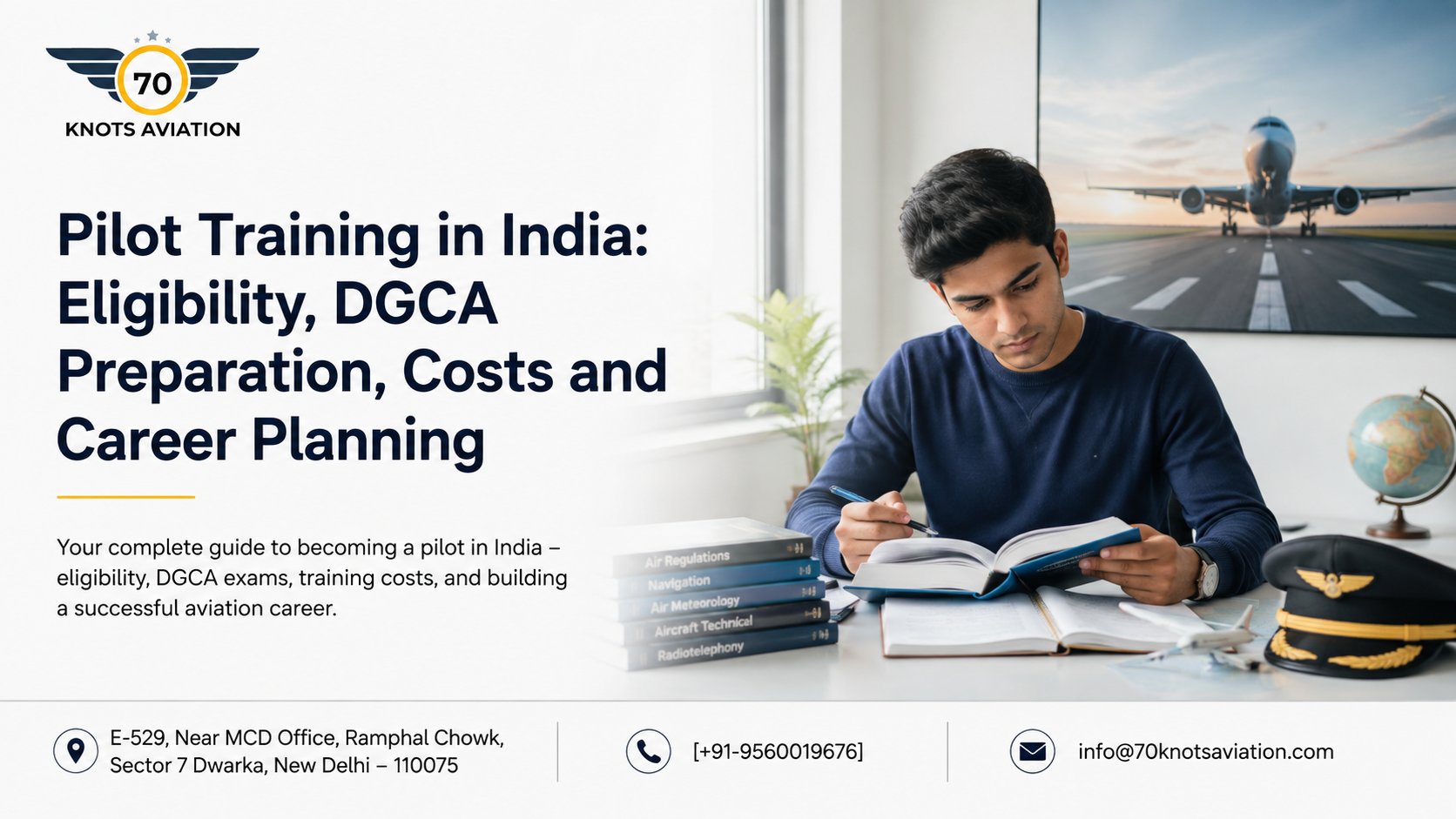
A career in aviation can offer students an opportunity to work in a highly professional and technically demanding industry. However, becoming a pilot requires careful planning because the journey involves education, medical fitness, theoretical examinations, practical flight training, and licensing requirements.
Students who start researching aviation careers often have the same basic questions: What qualifications do I need? How do I prepare for DGCA examinations? How much does pilot training cost? And how should I select a suitable training institute?
Understanding these questions before beginning training can help students make better decisions and avoid unnecessary delays.
How to Become a Pilot After Class 12
Students who want to pursue professional pilot training should first understand the educational requirements applicable to their intended licence.
For the conventional commercial pilot pathway in India, students generally need the required Class 12 qualification with Physics and Mathematics. Candidates who have followed another educational route should check the current eligibility provisions before starting their training.
The journey usually involves several stages:
- Checking educational eligibility
- Completing the applicable aviation medical assessment
- Understanding DGCA licensing requirements
- Preparing for theoretical examinations
- Completing ground training
- Undertaking practical flight training
- Completing the required flying experience
- Meeting applicable licensing conditions
- Applying for the relevant pilot licence
Students should verify current requirements before enrolling because aviation regulations and procedures can change.
Why Planning Matters Before Flight Training
Many students become interested in pilot training because they want to fly aircraft as quickly as possible. However, professional pilot training involves considerably more than cockpit experience.
Students should understand their complete training pathway before spending money on a course. A proper plan should include educational eligibility, medical requirements, examination preparation, flying schedules, expected expenses, and future career objectives.
Planning also helps students identify potential challenges early. For example, medical eligibility, examination preparation, financial planning, and training availability can influence the overall timeline.
Medical Requirements for Aspiring Pilots
Medical fitness represents one of the fundamental aspects of professional aviation.
Pilots need to meet aviation-specific medical standards because they operate aircraft in an environment where concentration, physical capability, vision, hearing, and overall fitness can affect operational safety.
Students should learn about the applicable DGCA medical requirements and complete the relevant assessment through the authorised process.
It makes sense to address medical eligibility early. Doing so can give students greater confidence before they commit substantial resources to ground and flight training.
Preparing for DGCA Examinations
Theoretical knowledge forms an important part of pilot education. Students need to understand aviation concepts, regulations, navigation principles, meteorology, aircraft-related technical knowledge, and communication procedures relevant to their training and licence.
The DGCA Pariksha process represents an important part of the examination journey for aspiring pilots.
Students should build a structured preparation strategy instead of depending entirely on last-minute revision. A practical study routine can include:
- Reviewing the applicable syllabus.
- Attending organised ground classes.
- Creating daily and weekly study targets.
- Revising important concepts regularly.
- Practising examination-style questions.
- Tracking weak areas.
- Taking mock tests before examinations.
Students should also monitor official DGCA updates so they do not miss changes to examination procedures or requirements.
The Importance of DGCA Ground Training
Ground training provides the theoretical foundation that students need before and during practical flight training.
A good learning programme should help students understand why aviation procedures exist rather than simply asking them to memorise information.
Subjects can cover areas such as:
- Air Regulations
- Air Navigation
- Aviation Meteorology
- Aircraft and technical subjects
- Radio communication
- Operational procedures
Strong theoretical knowledge can also improve practical flying because students can connect classroom concepts with real-world aviation situations.
Understanding Flight Training
Practical flight training allows students to apply their theoretical knowledge in an aircraft.
During training, students progressively develop skills related to aircraft handling, take-offs, landings, navigation, communication, emergency procedures, and operational decision-making.
Flight instructors monitor student progress and introduce more advanced exercises as students demonstrate the necessary skills.
Training schedules can vary between students and organisations. Weather, aircraft availability, maintenance, airport conditions, instructor schedules, and individual progress can all influence the pace of training.
Students should therefore focus on developing consistent skills rather than concentrating only on completing training as quickly as possible.
Understanding Pilot Training Cost in India
One of the biggest considerations for students and parents involves the Pilot training cost in India.
The total expenditure can vary depending on the training organisation, location, aircraft, number of flying hours, ground training fees, accommodation, examinations, medical assessments, licensing expenses, and other personal costs.
Students should request a detailed fee structure before enrolling.
A realistic financial plan may need to consider:
Ground Training Fees
Classroom-based theoretical education may form part of the initial training expenditure.
Flying Charges
Flight training represents a major component of the overall cost and can depend on aircraft type, flying hours, and training arrangements.
Examination Expenses
Students should account for applicable examination and administrative charges.
Medical Expenses
Aviation medical assessments and related requirements can add to the overall budget.
Accommodation and Living Costs
Students who travel to another city for training should include accommodation, food, transportation, and other daily expenses in their financial planning.
Additional Training
Students may sometimes require additional training or flying hours depending on their progress and applicable requirements. This possibility should form part of their contingency planning.
Because of these variables, students should compare complete cost structures instead of choosing an institute solely on the basis of its advertised starting price.
How to Select the Right Pilot Training Institute
Choosing a training institute requires proper research.
Students searching for the Best pilot training institute in India should evaluate the complete training environment rather than focusing on one feature.
1. Check Regulatory Information
Verify the relevant approvals, authorisations, and regulatory information before enrolling.
2. Understand the Training Structure
Ask how the institute organises ground classes, examination preparation, flight training, progress assessments, and student support.
3. Examine Aircraft Availability
Aircraft availability can directly affect training continuity. Students should ask how the institute handles aircraft maintenance and scheduling.
4. Consider Instructor Support
Qualified instructors can make a significant difference to both theoretical understanding and practical skill development.
5. Ask for a Complete Fee Breakdown
Students should understand what the quoted fees cover and which expenses they may need to pay separately.
6. Evaluate Student Guidance
A training environment that provides clear guidance can help students navigate the different stages of aviation education more effectively.
What Makes Pilot Training Different in 2026?
Aviation education continues to evolve with technology.
Students now have access to digital learning resources, online educational platforms, computer-based practice tools, aviation applications, and flight simulation technology.
Simulation can provide useful exposure to cockpit procedures and specific operational scenarios. Digital resources can also make revision more convenient.
However, technology cannot replace qualified instruction and real flight experience. Students should look for a balanced training environment that combines classroom education, practical instruction, appropriate simulation, and actual flying.
Skills Every Future Pilot Should Develop
Successful pilot training involves more than passing examinations.
Students should develop professional habits from the beginning of their aviation journey.
Important skills include:
- Discipline
- Communication
- Situational awareness
- Decision-making
- Time management
- Technical understanding
- Teamwork
- Safety awareness
Students should also learn to accept constructive feedback. Aviation training involves continuous assessment, and feedback can help students identify areas that require improvement.
Avoiding Common Pilot Training Mistakes
Students can protect their time and investment by avoiding several common mistakes.
First, they should not select an institute purely because it advertises the lowest fee.
Second, they should not ignore medical requirements until after beginning expensive training.
Third, they should avoid relying entirely on online information without verifying important regulatory details.
Finally, students should not underestimate theoretical preparation. Professional pilots need strong aviation knowledge as well as practical flying skills.
A careful approach can help students make more informed decisions throughout their training.
Guidance for Students From 70Knots Aviation
Students often need guidance before choosing their aviation education pathway. 70Knots Aviation provides aviation education and guidance for students who want to understand pilot training, DGCA preparation, and the broader professional aviation pathway.
The team can help students understand the different stages of pilot education and make informed decisions about their training journey.
Students can visit 70Knots Aviation at:
E-529, Near MCD Office, Ramphal Chowk, Sector 7 Dwarka, New Delhi – 110075
For enquiries:
Phone: +91-9560019676
Email: info@70knotsaviation.com
Five Questions Students Should Ask Before Starting Pilot Training
1. What is the first step toward becoming a professional pilot?
Students should begin by checking their educational eligibility and understanding the applicable medical requirements. After that, they can research the licensing pathway and training options.
2. What subjects should I study for DGCA examinations?
The applicable subjects depend on the licence and regulatory requirements. Students should check the current syllabus and prepare areas such as regulations, navigation, meteorology, and relevant technical knowledge.
3. Why does the total cost of pilot training vary?
Training costs depend on factors such as aircraft type, flying hours, location, training organisation, accommodation, examinations, and additional training requirements.
4. How should I compare different pilot training institutes?
Compare regulatory status, instructors, aircraft availability, training facilities, fee transparency, examination preparation, and student support before making a decision.
5. Can technology make pilot training easier?
Digital resources and simulation can support learning, revision, and procedural practice. However, students still need qualified instruction and practical flight experience to develop professional flying skills.
Building a Long-Term Aviation Career
Pilot training represents the beginning of a professional aviation journey rather than the end of it. Students should develop strong theoretical knowledge, practical flying skills, professional discipline, and a safety-focused mindset throughout their education.
For anyone searching for How to become a pilot, the best approach involves understanding the entire pathway before beginning. Research current requirements, prepare systematically for the DGCA Pariksha, compare training organisations carefully, and create a realistic budget for the Pilot training cost in India.
With proper planning and consistent preparation, students can approach pilot training with a clearer understanding of what the profession demands and what they need to accomplish at each stage.

 English
 Arabic
 French
 Spanish
 Portuguese
 Turkish
 Dutch
Dutch
 Italiano
 Russian
 Romaian
 Portuguese (Brazil)
 Greek
Greek