


The Technology Trends Reshaping Synthetic Diamond Production and Applications
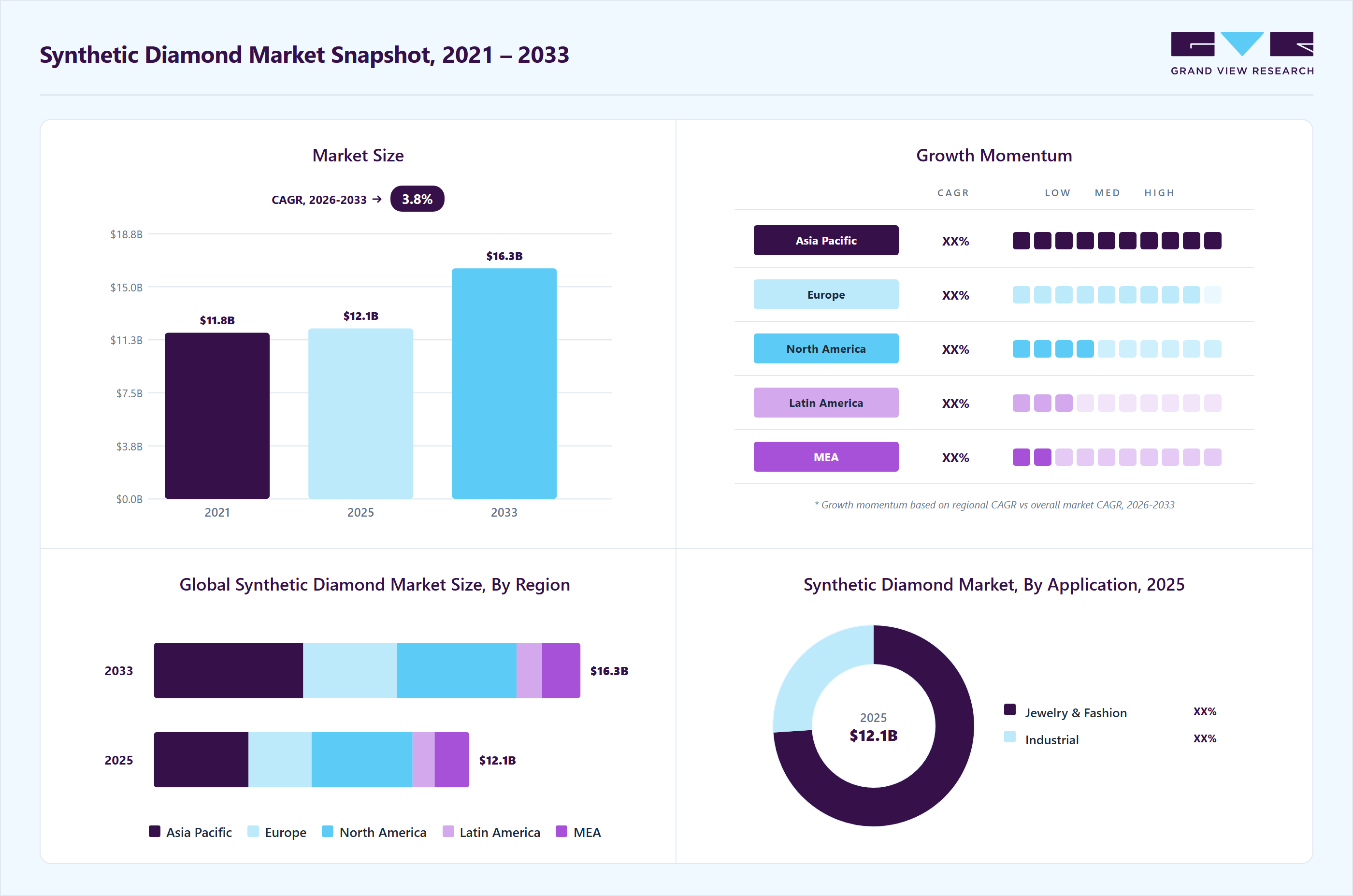
The synthetic diamond market is expanding as technological advances, sustainability considerations, cost advantages, and industrial requirements increase demand for lab-grown diamonds. The market was valued at USD 12.1 billion in 2025 and is projected to grow from USD 12.6 billion in 2026 to USD 16.3 billion by 2033, registering a CAGR of 3.8% from 2026 to 2033. North America held the largest share of over 32.0% in 2025.
Industrial Performance Creates a Strong Demand Base
Industrial applications remain a major growth engine for synthetic diamonds because of their superior hardness, thermal conductivity, and cost efficiency. These characteristics make them valuable for cutting, grinding, drilling, and polishing tools used across automotive, aerospace, construction, and electronics.
The role of synthetic diamonds is also expanding into more specialized applications. Semiconductor heat spreaders, optics, and sensor components are emerging as performance-driven uses, allowing engineered diamonds to address specific thermal, electrical, and mechanical requirements. Increasing investment in manufacturing and precision engineering is therefore supporting continued industrial consumption.
Sustainability and Cost Advantages Reshape Consumer Demand
Sustainability is becoming an important factor in the adoption of synthetic diamonds. Lab-grown diamonds avoid large-scale mining activities and can reduce concerns associated with land degradation, water consumption, carbon emissions, unethical mining practices, and supply-chain transparency.
Cost competitiveness is another major advantage. Lab-grown diamonds are typically priced 30–50% lower than natural diamonds while maintaining identical physical, chemical, and optical characteristics. This price-quality combination is particularly attractive to younger consumers who place greater emphasis on value, ethical sourcing, sustainability, and design flexibility.
Colorless Diamonds Continue to Lead
Colorless diamonds accounted for the largest revenue share of over 71.0% in 2025 and are projected to register the highest CAGR over the forecast period. Their broad applicability across jewelry and industrial uses helps maintain their leading position.
In jewelry, colorless synthetic diamonds provide a close economic and optical alternative to natural diamonds and are widely used in engagement rings and classic jewelry. Industrial users also favor colorless diamonds for cutting, grinding, and polishing because of their consistent crystal structure and hardness.
At the same time, advances in chemical vapor deposition technology are enabling manufacturers to produce colored diamonds in yellow, blue, pink, and green hues with controlled saturation. Social media trends and celebrity endorsements are contributing to interest in customized stones, particularly for bespoke jewelry and limited-edition collections.
Jewelry and Fashion Remain a Leading End Use
The jewelry & fashion segment held the highest revenue share and is projected to achieve a CAGR of 4.3% from 2026 to 2033. The segment benefits from changing attitudes toward lab-grown diamonds, especially among Millennials and Gen Z consumers.
Comparable brilliance and durability at significantly lower prices are encouraging adoption, while sustainability and ethical sourcing are strengthening the appeal of lab-grown stones. Major jewelry brands are also expanding their lab-grown collections and introducing fashion-oriented designs, further supporting segment growth.
Production Expansion Supports Market Development
Manufacturers are increasing capacity and exploring strategic partnerships and acquisitions to capture emerging opportunities. In May 2025, Element Six expanded its CVD diamond production capacity in China to serve jewelry and industrial applications.
Mergers and acquisitions are also creating opportunities to strengthen production footprints and integrate value chains. In August 2025, Adamas One signed a letter of intent to acquire Flawless Allure Grown Diamonds, an India-based diamond-cutting and polishing company.
However, competitive pressures remain. In May 2025, De Beers announced its intention to close the Lightbox lab-grown diamond jewelry brand and focus on natural diamonds. This illustrates pricing and brand-positioning challenges within the luxury jewelry segment.
Regional Markets Reflect Different Growth Drivers
North America dominated the synthetic diamond market with over 32.0% of revenue in 2025. Strong acceptance of lab-grown jewelry, sustainability considerations, price transparency, and advanced industrial applications support regional demand. The U.S. also maintains industrial demand across aerospace, defense, electronics, and machining tools.
Asia Pacific is the fastest-growing regional market. China leads reactor manufacturing and industrial synthetic diamond output, while India serves as a major hub for cutting, polishing, jewelry manufacturing, and exports. Rising disposable incomes and industrial activity across electronics, automotive, and construction are supporting regional expansion.
Europe benefits from sustainability, ESG priorities, responsible luxury, and advanced manufacturing. Latin America is developing through growing jewelry awareness and industrial applications, while the Middle East & Africa market is supported by luxury retail, sustainable jewelry demand, and industrial cutting and drilling applications.
FAQs
What trends are shaping the synthetic diamond market?
Sustainability, lower pricing, advances in CVD production, customized colored diamonds, expanding industrial applications, and growing use in electronics are among the trends shaping the market.
Which segment leads the synthetic diamond market?
The jewelry & fashion segment held the largest revenue share in 2025 and is projected to achieve the fastest CAGR of 4.3% from 2026 to 2033. By color, colorless diamonds held the largest revenue share of over 71.0% in 2025.
Key Synthetic Diamond Companies:
· ALTR Created Diamonds
· Diamond Foundry Inc.
· Element Six
· Henan Huanghe Whirlwind Co., Ltd.
About us:
Grand View Research, a market research and consulting company, provides syndicated research reports, customized research reports, and consulting services. Grand View Research database is used by the world's renowned academic institutions and Fortune 500 companies to understand the global and regional business environment. Our database features thousands of statistics and in-depth analysis on 46 industries in 25 major countries worldwide.

 English
 French
 Spanish
 Portuguese
 Deutsch
 Turkish
 Dutch
Dutch
 Italiano
 Russian
 Romaian
 Portuguese (Brazil)
 Greek
Greek