


Data Masking Market Approaches $2.9 Billion Amid Accelerating Security Demand
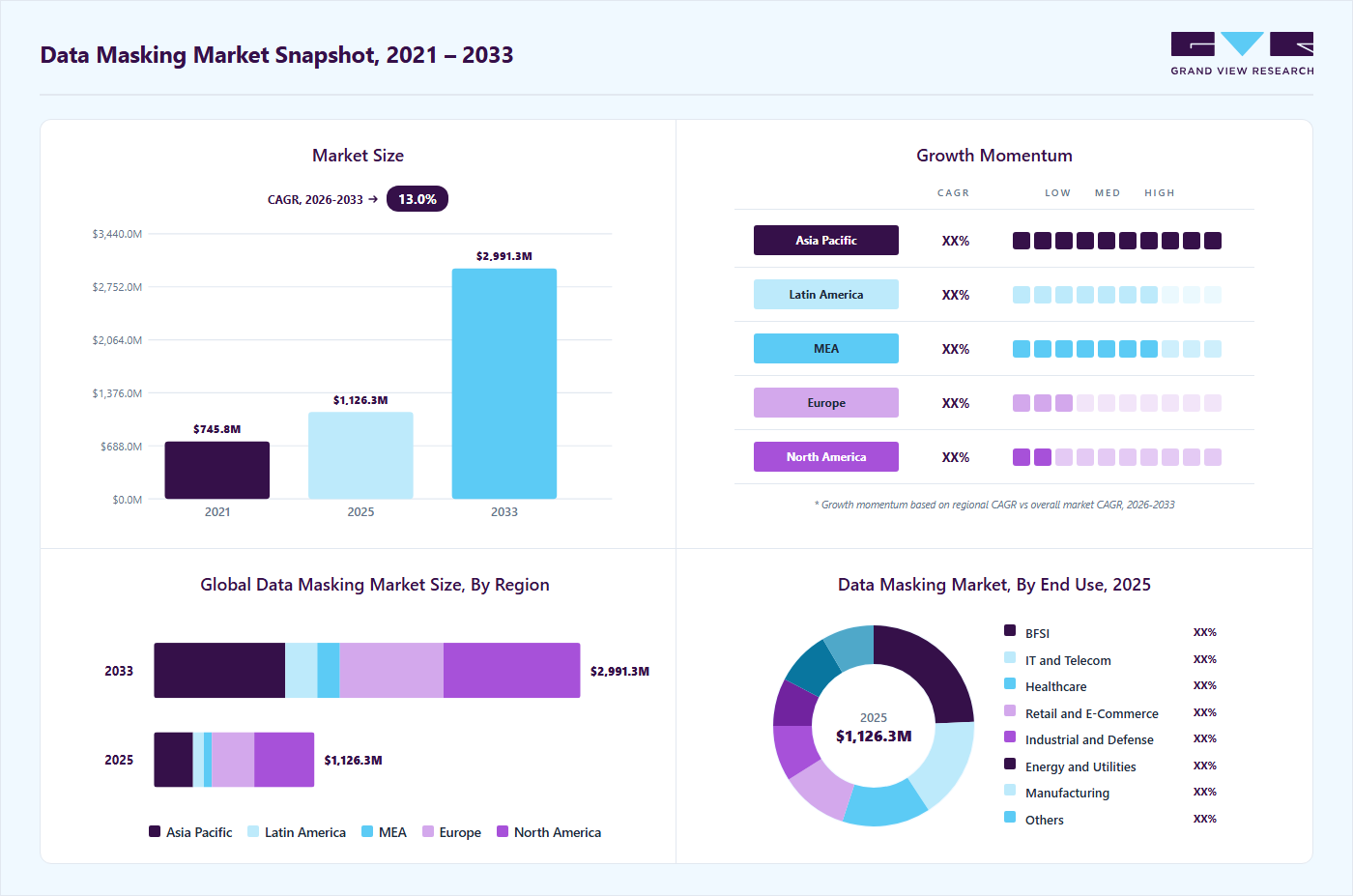
The data masking market is entering a strong growth phase as enterprises increasingly prioritize protection of sensitive information while continuing digital transformation. Data masking enables organizations to reduce exposure of personally identifiable information and other regulated data while supporting development, testing, analytics, and secure data sharing. The market was valued at USD 1.1 billion in 2025 and is projected to increase from USD 1.3 billion in 2026 to USD 2.9 billion by 2033, registering a CAGR of 13.0% from 2026 to 2033. North America accounted for over 37% of the market in 2025.
Cloud, AI, and Privacy Requirements Strengthen Market Demand
The growing need for advanced data protection technologies is a major factor supporting market expansion. Enterprises are adopting cloud computing, AI-driven analytics, and automated data governance platforms, creating more complex environments in which sensitive information must remain protected. AI-driven data discovery, automated sensitive data classification, privacy-enhancing technologies, tokenization-based masking, and dynamic data masking engines are becoming increasingly important for enterprise security strategies.
The growing emphasis on privacy-by-design and zero-trust security is also accelerating investment. Large-scale cloud migration, real-time data sharing, secure analytics, and hybrid multi-cloud environments are increasing the need for technologies capable of protecting customer and transaction data without restricting legitimate business use. Expanding privacy regulations and compliance requirements, including GDPR, CCPA/CPRA, HIPAA, and PCI DSS, are further increasing organizational accountability.
Static Masking Maintains Its Leading Position
Static data masking accounted for a revenue share of over 59% in 2025, making it the leading type segment. Its continued adoption is supported by lower operational complexity, compatibility, and the need for repeatable production datasets. Organizations use static masking extensively for test and development environments, data migration projects, analytics sandboxes, and secure database replication.
Dynamic masking, meanwhile, is expected to register the fastest CAGR of over 15% from 2026 to 2033. Its growth reflects increasing adoption of real-time data access models, API-driven applications, hybrid cloud architectures, and role-based access governance. Dynamic masking can protect sensitive fields on the fly while controlling what individual users are allowed to view, making it increasingly relevant to live analytics, reporting, and modern DevSecOps environments.
Software and Automation Shape Enterprise Deployments
Software accounted for the largest solution share at over 69% in 2025. Enterprises favor data masking software for scalable automated masking, compliance enforcement, enterprise database integration, and centralized management of masking rules. Its application across large-scale governance programs, continuous testing environments, and multi-database deployments supports continued demand.
Services are expected to experience the fastest CAGR from 2026 to 2033. Increasing multi-cloud complexity, legacy modernization, regulatory requirements, and the need for specialized masking validation expertise are supporting demand for professional and managed services. These services can help enterprises accelerate deployment and strengthen compliance reporting while managing increasingly complicated data environments.
On-Premise Protection Remains Strong While Cloud Adoption Accelerates
On-premise deployment held the largest revenue share of over 59% in 2025. Organizations in highly regulated environments continue to value maximum data residency control, low-latency masking execution, and governance over private database environments. BFSI, government, and healthcare organizations managing sensitive financial, customer, and personal information continue to support demand for on-premise solutions.
Cloud deployment is expected to register the fastest CAGR from 2026 to 2033. Cloud-native data warehouses, SaaS analytics platforms, multi-cloud modernization, and API-driven applications are encouraging enterprises to shift masking capabilities into cloud environments. Hybrid cloud adoption and AI/ML analytics workloads are adding further momentum.
BFSI Leads While Healthcare Creates New Growth Opportunities
BFSI accounted for the largest end-use share of over 24% in 2025. Financial institutions face strong requirements to protect customer information, payment data, and transactional records while complying with stringent regulations. Increasing fintech integration, cybersecurity threats, and secure internal data sharing are supporting continued adoption.
Healthcare is expected to register the fastest CAGR from 2026 to 2033. The digitization of electronic health records, expansion of telehealth, and growing use of AI-driven clinical analytics are increasing demand for secure patient-data de-identification. Health data interoperability and medical research collaborations are also encouraging organizations to protect sensitive information while enabling controlled access.
Regional Adoption Reflects Different Security Priorities
North America maintained the leading position with over 37% of revenue in 2025, supported by strong enterprise adoption of data-driven business models, SaaS applications, cloud services, and privacy-focused cybersecurity investments. The integration of automated data discovery, dynamic masking, and zero-trust frameworks is strengthening enterprise compliance readiness.
Asia Pacific is expected to record the fastest CAGR of over 16% from 2026 to 2033. Rapid digital transformation, expanding cloud adoption, fintech development, e-commerce activity, digital payments, AI analytics, and IT outsourcing are increasing the volume of sensitive data requiring protection. The U.S. accounted for over 85% of its market in 2025, while Europe is expected to grow at a CAGR of over 11% from 2026 to 2033.
FAQs
How big is the data masking market?
The data masking market was valued at USD 1.1 billion in 2025 and is estimated to reach USD 1.3 billion in 2026. It is projected to reach USD 2.9 billion by 2033.
Which segment leads the data masking market?
Static data masking led the type segment with a revenue share of over 59% in 2025. The software segment led solutions with over 69%, on-premise led deployment with over 59%, and BFSI led end use with over 24%.
Key Data Masking Companies:
· IBM Corporation
· Oracle Corporation
· Informatica Inc.
· SAP SE
About us:
Grand View Research, a market research and consulting company, provides syndicated research reports, customized research reports, and consulting services. Grand View Research database is used by the world's renowned academic institutions and Fortune 500 companies to understand the global and regional business environment. Our database features thousands of statistics and in-depth analysis on 46 industries in 25 major countries worldwide.

 English
 Arabic
 French
 Spanish
 Portuguese
 Deutsch
 Turkish
 Dutch
Dutch
 Russian
 Romaian
 Portuguese (Brazil)
 Greek
Greek