


Index-Linked Contracts and the Future of Rubber Procurement
For B2B procurement leaders and supply chain managers in the rubber sector, managing raw material volatility requires looking beyond top-line price movements. Data captured through Grand View Signal shows that Indian RSS3 natural rubber prices surged by 33.5% year-over-year, escalating from 2,269 USD per ton in August 2025 to 3,028.90 USD per ton in August 2026. This dramatic shift highlights three dominant supply chain trends that are currently defining price movements across natural and synthetic rubber categories.
1. Fragmentation Between Domestic and International Natural Rubber Markets
Natural rubber pricing is showing sharp geographic divergence rather than following a uniform global trajectory. Regional prices are heavily dictated by localized physical availability, domestic demand, currency fluctuations, and import economics.
- Domestic Tightness vs. International Softening: Indian domestic sheet-rubber reference prices have remained comparatively firm, driven by tight local availability and steady domestic procurement schedules. Conversely, international reference benchmarks such as Bangkok RSS3 values experienced notable declines during late-month trading periods.
- Fluctuating Import Markets: In major Asian processing hubs like China, standard natural rubber prices moved from early-period weakness to a modest mid-month recovery, then lost momentum toward the end of the month.
- Controlled Procurement: Across major regions, buyers are strictly purchasing against immediate manufacturing schedules rather than building aggressive inventory positions. This disciplined, hand-to-mouth procurement pattern continues to limit sustained upward price momentum.
- Real-World Impact: Indian tire manufacturers (such as MRF and Apollo Tires) faced margin compression as domestic RSS4 sheet prices traded near all-time highs above ₹270–280/kg. To offset localized domestic premiums, major processors were forced to evaluate cheaper imported alternatives or adjust domestic blending ratios where import tariffs allowed.
Schedule a free demo of Grand View Signal to get real-time preview of price fluctuations in the Rubber Sector
2. Sharp Mid-Month Price Reversals in Butadiene Rubber (BR)
Synthetic rubber variants, particularly Butadiene Rubber (BR), recorded the most pronounced price volatility within the segment.
- Rapid Price Spike: Following sustained early-period declines in major markets such as China, BR experienced a swift mid-month recovery as processors and traders returned to cover short-term operational needs.
- Downstream Margin Pressure: The rapid rise in BR spot prices increased immediate replacement-cost pressures for tire manufacturers, industrial rubber goods producers, and footwear makers.
- Cautious Late-Month Moderation: Because the price surge outpaced the speed of recovery in actual downstream end-user demand, buyers resisted aggressive inventory accumulation. As immediate buying urgency subsided, BR prices moderated from their peak while remaining higher overall than at the start of the month.
- Real-World Impact: When Butadiene feedstock spikes ripple through synthetic rubber contracts, automotive component manufacturers and footwear producers (e.g., shoe sole compounders) struggle to pass on raw material costs to OEMs. Many compounders chose to pause non-essential production runs during mid-month spikes to avoid locking in high spot rates.
Access commodity-wise monthly forecast datasets for the next 6 months. Request Free Access to Grand View Signal
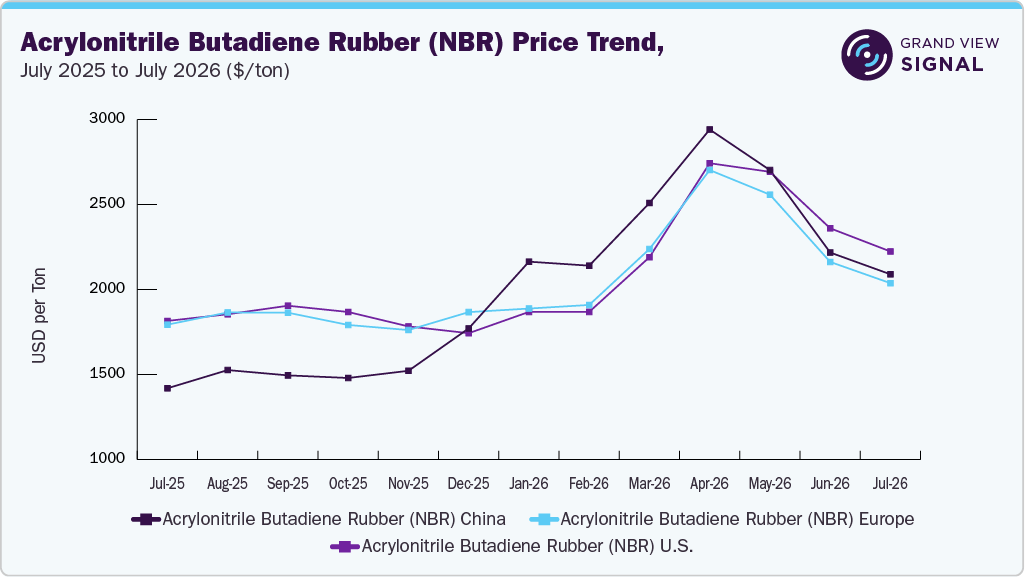
3. Measured Recovery in Acrylonitrile Butadiene Rubber (NBR)
Acrylonitrile Butadiene Rubber (NBR) exhibited a distinct, application-driven recovery path compared to the sharp movements seen in tire-centric materials.
- Steady Second-Half Gains: After initial early-period softening, NBR prices strengthened steadily during the second half of the month, establishing itself as a top-performing rubber commodity.
- Diversified Demand Base: Unlike BR, which is heavily tied to tire manufacturing, NBR demand was supported by a broader range of industrial applications requiring oil- and fuel-resistance, including automotive seals, hoses, industrial gaskets, rollers, cable products, and specialized footwear.
- Replenishment-Led Stability: While industrial end-users maintained conservative purchasing strategies due to uneven manufacturing conditions, consistent replenishment across diversified end-use sectors allowed NBR to maintain a comparatively firm and stable price position near month-end.
- Real-World Impact: Industrial seal and gasket suppliers serving the oil and gas and industrial machinery sectors benefited from stable end-use demand for NBR. Unlike tire producers operating on thin-spot margins, specialty industrial fabricators maintained steady operating rates due to predictable replacement cycles.
Transforming Rubber Commodity Intelligence with Grand View Signal
Grand View Signal empowers category managers to bridge the gap between reactive spot buying and predictive risk management through a unified SaaS commodity price intelligence tool. By combining high-frequency pricing assessments across natural rubber grades (such as Indian RSS3 and U.S. RSS3) with real-time upstream monomer tracking for Butadiene and Styrene, Signal isolates true feedstock shifts from supplier surcharges. This enables procurement teams to audit vendor quotes against actual market trajectories, identify material substitution arbitrage opportunities, and structure resilient, index-linked supply contracts before market spikes erode gross margins.
In an environment marked by weather anomalies, volatile petrochemical feedstocks, and diverging regional demand, relying on static annual RFPs or lagging monthly averages is an operational liability. Long-term category performance now belongs to supply chain leaders who replace reactive purchasing habits with continuous, data-driven market visibility. By leveraging predictive pricing intelligence to anticipate structural shifts across natural and synthetic markets, forward-thinking procurement teams can transform rubber volatility into a sustainable competitive advantage.
Read our latest articles on

 Arabic
 French
 Spanish
 Portuguese
 Deutsch
 Turkish
 Dutch
Dutch
 Italiano
 Russian
 Romaian
 Portuguese (Brazil)
 Greek
Greek