


What Production AI Agents Need in 2026: MCP, Event Driven Orchestration, Validation, and Zero Trust
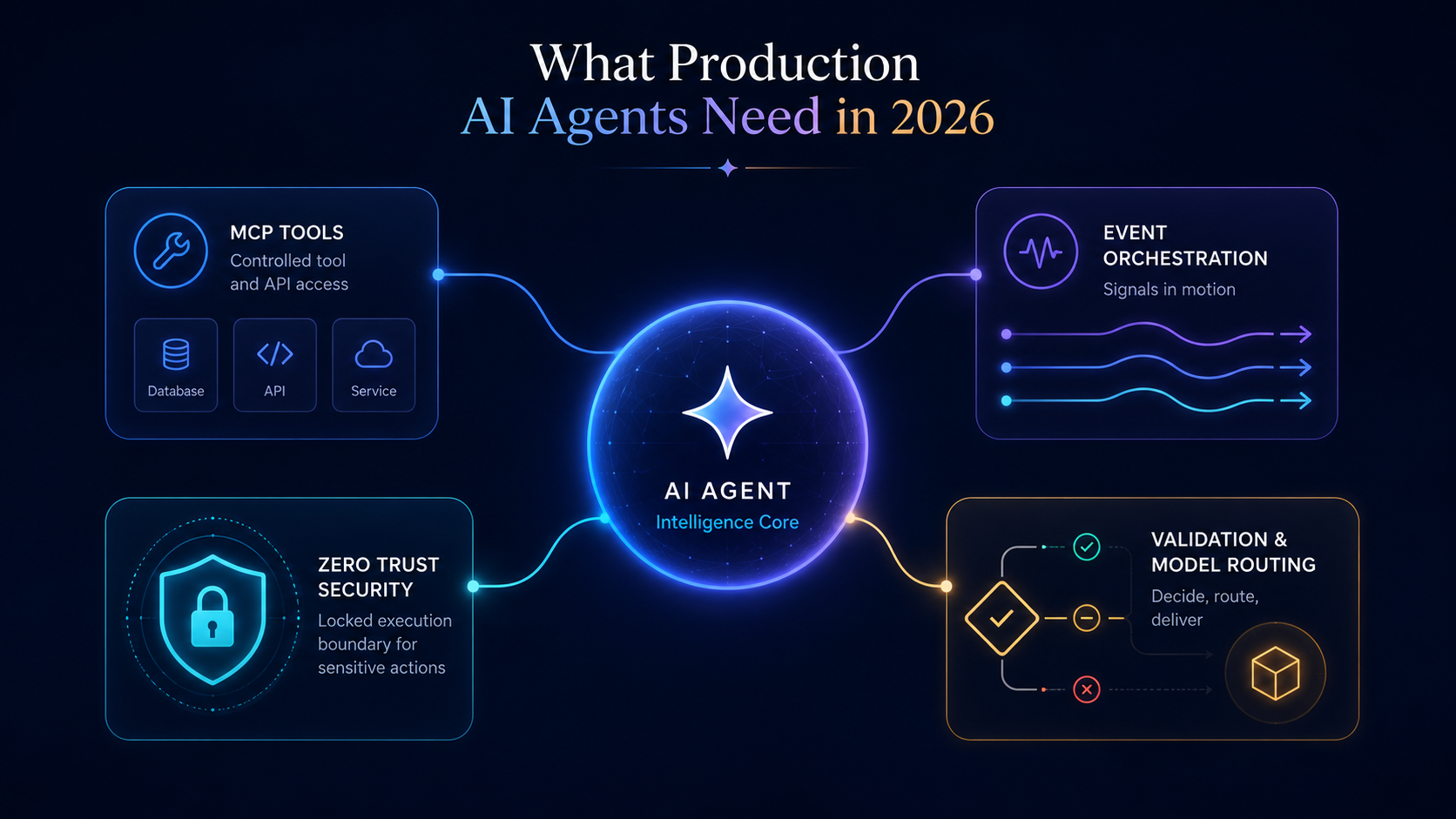
AI agent development has reached a point where model capability is no longer the only engineering question. Teams are now dealing with agents that call APIs, query databases, execute code, hand work to other agents, update business systems, and operate across long running workflows. That changes the technical requirements considerably.
I have seen the same shift while following work from ClixLogix Technologies around AI Engineering Services. Production AI applications increasingly need orchestration, controlled tool access, evaluation, routing, observability, and security designed into the application from the beginning.
That direction became especially clear on September 2, 2026, when Google published findings from thousands of submissions to its AI Agents Challenge. The strongest systems repeatedly used bidirectional MCP, event driven concurrency, consistent validation across fallback models, and staged model routing.
MCP is becoming infrastructure for agent communication
Model Context Protocol started largely as a way for AI systems to access tools and external data. Production architectures are now using MCP in both directions.
An agent can consume tools through MCP while also exposing its own capabilities as an MCP server for other agents.
This matters because agent systems are becoming more distributed.
Imagine an operations agent that can inspect application telemetry. Instead of passing an entire database table into a language model, the agent can call narrowly defined tools to retrieve a specific execution plan, stack trace, or incident record.
Google highlighted this approach in its recent AI Agents Challenge analysis. Bounded tool responses kept model context smaller while making the same reasoning capabilities reusable by other agents.
For AI engineering teams, this creates an important architectural principle: agents should expose controlled capabilities rather than unrestricted access to underlying systems.
Linear agent chains become expensive at scale
Many early multi agent demonstrations follow a simple sequence.
Agent A completes a task.
Agent B receives the result.
Agent C waits for Agent B.
That structure becomes inefficient when several agents could act on the same event independently.
Google described one production example where agents subscribed to typed events through asynchronous queues. When an event occurred, the relevant agents could begin work immediately instead of waiting for a complete call chain to finish.
This matters for workflows such as fraud detection, customer support, logistics, monitoring, compliance, and real time operations.
A useful architecture asks which tasks depend on one another and which can run concurrently.
That decision directly affects latency.
Model fallback needs the same quality gate
AI applications also need to plan for unavailable or overloaded models.
A common response is to retry the same model or switch to a faster alternative. The risk appears when the fallback path does not receive the same validation as the primary model.
Google highlighted a clinical reasoning system that routed between different Gemini models while forcing both outputs through the same validation function. The system verified that required evidence was present regardless of which model produced the response.
This is a useful engineering rule for any AI application.
Validation should sit after model selection.
The model may change because of cost, latency, availability, geography, or task complexity. The acceptance criteria for the output should stay consistent.
For a financial workflow, that validation might check transaction limits.
For document extraction, it might verify required fields.
For customer support, it might validate policy references.
For structured output, it might enforce a schema.
Fallback should preserve the quality contract of the application.
Every request does not need the most expensive model
Model routing is also becoming a major cost control.
Google reported one challenge submission where a deterministic first pass handled more than 40 percent of incoming requests before a full reasoning model was called. Simple navigational requests were resolved using basic rules, ambiguous cases were classified using a cheaper model, and only complex requests reached the most capable model.
That has significant implications for AI application economics.
A production system receiving millions of requests should classify tasks before deciding how much inference capacity they require.
Simple questions may be answered from deterministic logic or cached data.
Moderately complex tasks may use a faster model.
High consequence or ambiguous tasks can be routed to stronger reasoning models.
The goal is to match compute cost with task difficulty.
Security has to exist outside the prompt
Autonomous agents introduce another serious issue.
Once an agent can issue refunds, change database records, execute code, or trigger external APIs, a system prompt cannot serve as the primary security control.
Google demonstrated this in August 2026 with a zero trust AI agent architecture. Their reference implementation used cryptographic signatures for database writes, isolated execution environments for generated code, and deterministic validation before sensitive actions were allowed.
The principle is straightforward.
Assume the model can make a mistake or be manipulated.
Then design infrastructure that limits what the mistake can actually do.
An agent may decide that a refund should be $10,000. The transaction service should still reject that request if the permitted amount is $149.
An agent may generate Python code. That code should execute inside a restricted environment with controlled network and resource access.
An agent may request sensitive information. Authorization should determine whether the user can access that data before the model receives it.
AI engineering is becoming systems engineering
The most useful lesson from current agent development is that production quality depends on the surrounding system.
Models will continue improving. Applications still need clear tool contracts, event orchestration, model routing, evaluation, observability, fallback behavior, access controls, and deterministic business rules.
OpenAI has followed a similar direction in its Agents SDK, adding controlled sandbox execution and separating agent orchestration from compute so long running workflows can be managed with stronger security and operational control.
The next generation of AI applications will therefore be judged by more than the quality of a single generated response.
Teams will need to ask:
Can the system recover when a model fails?
Can independent tasks run concurrently?
Can expensive inference be avoided for simple requests?
Can every action be traced?
Can sensitive operations be rejected outside the model?
Can one agent safely interact with another?
Those are software engineering questions.
And in 2026, they are quickly becoming the questions that separate an impressive AI demo from a dependable production system.

 English
 Arabic
 French
 Spanish
 Portuguese
 Deutsch
 Turkish
 Dutch
Dutch
 Italiano
 Romaian
 Portuguese (Brazil)
 Greek
Greek