


Computational Photography Demand Expands Across Consumer and Industrial Imaging
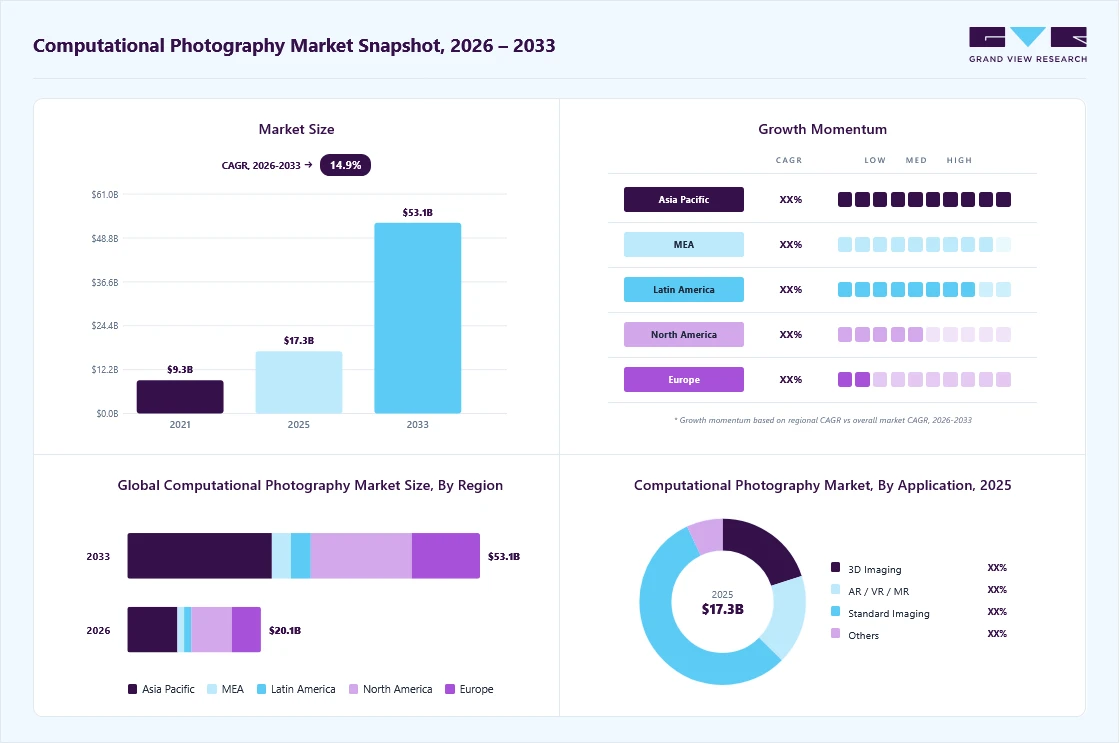
The computational photography market is entering a strong growth phase as artificial intelligence, machine learning, advanced sensors, and image-processing technologies transform how digital images are captured and enhanced. The market was valued at USD 17.3 billion in 2025 and is estimated to reach USD 20.1 billion in 2026. It is projected to expand to USD 53.1 billion by 2033, registering a CAGR of 14.9% from 2026 to 2033. Asia Pacific accounted for the largest revenue share of 37% in 2025.
AI Becomes a Core Driver of Imaging Innovation
Artificial intelligence and machine learning are becoming central to computational photography workflows. Modern imaging systems can use AI algorithms for multi-frame processing, noise reduction, dynamic range optimization, scene recognition, and real-time image enhancement. This enables manufacturers to improve image quality through software rather than relying exclusively on hardware upgrades.
The shift toward software-defined photography is also creating opportunities for adaptive and scalable imaging systems. Cloud computing, edge AI, and generative imaging technologies are supporting increasingly sophisticated processing capabilities. Personalized image editing, automated enhancements, object recognition, background modification, and real-time customization are further strengthening demand across digital content ecosystems.
Camera Modules Continue to Lead the Offering Segment
Camera modules represented the largest offering segment, accounting for a 50% revenue share in 2025. Growth has been encouraged by the rapid adoption of multi-camera smartphone configurations, improved sensors, high-resolution imaging, enhanced low-light performance, and optical image stabilization. Camera modules are also finding applications beyond smartphones, including automotive vision, security surveillance, and industrial automation.
Software, meanwhile, is expected to register the fastest CAGR during the forecast period. The transition from hardware-centric imaging toward computation-led photography is increasing demand for AI-based algorithms, scene recognition, semantic segmentation, depth mapping, and real-time enhancement.
Smartphone Cameras Anchor Product Demand
Smartphone cameras held the largest product share, representing 49.5% of revenue in 2025. Advanced mobile devices increasingly combine multi-camera systems, AI-powered processing, HDR, night mode, portrait enhancement, and other computational features to deliver higher-quality photography. The growing importance of mobile-first content creation and social media is reinforcing demand for these capabilities.
Machine vision cameras are expected to record the fastest CAGR during the forecast period. Increasing demand for high-precision imaging, automated inspection, quality assurance, defect detection, and zero-defect manufacturing is encouraging their adoption across electronics, semiconductor fabrication, and pharmaceutical manufacturing.
3D Imaging Opens New Application Opportunities
Standard imaging accounted for the largest application share in 2025, supported by widespread adoption across smartphones and consumer electronics. At the same time, 3D imaging is projected to grow at the fastest CAGR during the forecast period. Depth sensing, spatial imaging, facial recognition, biometric authentication, gesture tracking, and immersive AR, VR, and MR experiences are expanding its role.
LiDAR, advanced sensors, and AI-based image reconstruction are improving depth mapping and real-time spatial rendering. Applications are also expanding into healthcare diagnostics, automotive vision systems, and industrial inspection, broadening the commercial potential of computational imaging.
Industrial Adoption Adds a New Growth Engine
Consumer electronics accounted for the largest end-use revenue share in 2025, reflecting the integration of computational imaging into smartphones and other smart devices. However, the industrial segment is projected to grow at the fastest CAGR of 18% from 2026 to 2033.
Industrial users are increasingly applying computational photography to automated inspection, precision measurement, defect detection, intelligent sorting, and real-time analytics. Edge computing, high-resolution sensors, and AI-powered image processing can enable faster analysis, lower latency, and greater accuracy in digitally integrated production environments.
Asia Pacific Maintains Market Leadership
Asia Pacific dominated the computational photography market with a 37% revenue share in 2025 and is projected to grow at the fastest CAGR during the forecast period. Strong smartphone manufacturing, consumer demand for advanced mobile imaging, semiconductor investments, and the presence of major OEMs and technology companies are supporting this leadership.
China accounted for the largest market revenue share within Asia Pacific in 2025. Strong domestic smartphone manufacturing, AI-powered imaging adoption, multi-camera systems, image sensors, and semiconductor innovation are supporting continued development of computational photography capabilities.
FAQ
What trends are shaping the computational photography market?
AI-powered image processing, machine learning, multi-camera systems, advanced image signal processors, AR/VR, 3D imaging, LiDAR, edge AI, and software-defined photography are among the major trends shaping the market.
Which segment leads the computational photography market?
Camera modules led the offering segment with a 50% revenue share in 2025, while smartphone cameras led the product segment with a 49.5% revenue share in 2025. Standard imaging led the application segment, and consumer electronics held the largest end-use revenue share in 2025.
Key Computational Photography Companies:
· Apple Inc.
· Samsung Electronics
· Google (Alphabet)
· Huawei
About us:
Grand View Research, a market research and consulting company, provides syndicated research reports, customized research reports, and consulting services. Grand View Research database is used by the world's renowned academic institutions and Fortune 500 companies to understand the global and regional business environment. Our database features thousands of statistics and in-depth analysis on 46 industries in 25 major countries worldwide.

 English
 Arabic
 French
 Spanish
 Portuguese
 Deutsch
 Turkish
 Dutch
Dutch
 Italiano
 Romaian
 Portuguese (Brazil)
 Greek
Greek