


Liquid Hydrogen Demand Gains Pace as Low-Carbon Energy Systems Evolve
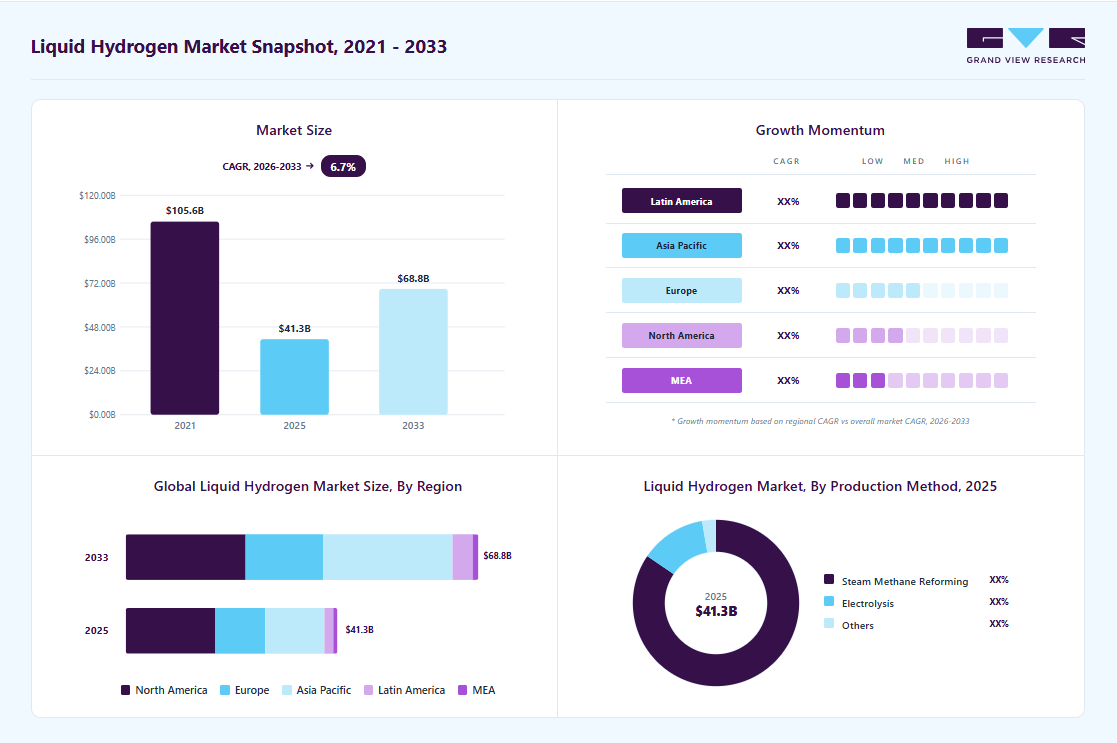
The liquid hydrogen market is entering an important phase of expansion as industries, governments, and energy companies increase their focus on decarbonization and low-emission fuels. The market was valued at USD 41.3 billion in 2025 and is projected to grow from USD 43.9 billion in 2026 to USD 68.8 billion by 2033, registering a CAGR of 6.7% from 2026 to 2033. North America accounted for a 42.2% revenue share in 2025.
Decarbonization and Energy Security Strengthen Market Demand
The accelerating shift toward decarbonization is a major factor supporting liquid hydrogen adoption. Governments and industries are investing in hydrogen as an energy carrier capable of reducing carbon footprints across transportation, power generation, refining, and chemical applications.
Liquid hydrogen is produced by cooling hydrogen gas to cryogenic temperatures of -253°C. This enables efficient storage and transportation over long distances while providing high energy density for applications where conventional storage approaches may be less suitable. Growing investments in liquefaction plants, storage facilities, and distribution networks are consequently strengthening the supporting infrastructure.
Energy security and diversification of fuel sources are also contributing to demand. The development of hydrogen supply chains can support cross-border energy trade while helping economies integrate clean energy resources into broader energy systems.
Steam Methane Reforming Continues to Lead Production
Steam methane reforming accounted for the largest production-method revenue share of 84.5% in 2025. Its established infrastructure, cost-effectiveness, high-volume production capabilities, and extensive industrial adoption support its leading position.
SMR is widely used across refineries, ammonia production, and chemical industries where hydrogen demand remains substantial. The integration of carbon capture, utilization, and storage technologies is also helping improve the sustainability of SMR-based hydrogen, while natural gas availability and existing pipeline infrastructure provide additional support.
At the same time, electrolysis is emerging as a major growth opportunity. The segment is expected to register the fastest CAGR of 21.2% over the forecast period. Rising investments in renewable energy, declining renewable energy costs, advances in electrolyzer technology, and supportive government policies are improving the commercial potential of renewable-powered hydrogen production.
Cryogenic Tanks Anchor Distribution Infrastructure
Cryogenic tanks held the largest distribution-method revenue share of 62.8% in 2025. These systems are designed to maintain hydrogen in its liquid state at extremely low temperatures while minimizing heat transfer and reducing boil-off losses.
Their use across hydrogen liquefaction plants, transportation networks, aerospace, and mobility applications is supporting segment demand. Investments in storage terminals and export facilities are also increasing the importance of cryogenic tank infrastructure.
Meanwhile, the others segment is expected to register the fastest CAGR of 11.0%. Pipeline-based transportation, tube trailers, and advanced material-based storage solutions are creating additional options for decentralized distribution and last-mile delivery.
Green Hydrogen Creates New Technology Opportunities
The integration of renewable energy with electrolysis is opening another important opportunity for the liquid hydrogen market. Surplus electricity generated from solar and wind resources can be used to produce hydrogen, which can subsequently be liquefied for storage and export.
This approach can strengthen energy security while supporting international hydrogen trade. Opportunities are also emerging in aviation fuel, heavy-duty transportation, and grid-scale energy storage. Improvements in cryogenic storage, liquefaction efficiency, and hydrogen-handling technologies are helping enhance the economic feasibility of these applications.
Infrastructure Challenges Remain Important
Despite its growth potential, liquid hydrogen faces technical and economic challenges. The liquefaction process is energy-intensive, increasing production and operating costs. Storage and transportation also require specialized systems because hydrogen must remain at cryogenic temperatures.
Boil-off losses, limited infrastructure, lack of widespread standardization, safety considerations, and regulatory uncertainties can restrict large-scale adoption. Liquid hydrogen also faces competition from alternative clean energy solutions, including battery storage and other hydrogen carriers such as ammonia.
North America Maintains Market Leadership
North America accounted for the largest market share at 42.2% in 2025, supported by investments in hydrogen infrastructure, clean energy transition initiatives, and industrial decarbonization. Hydrogen production, liquefaction, storage, and distribution facilities are being developed alongside hydrogen hubs and clean mobility initiatives.
Latin America is expected to record the fastest CAGR of 10.7% during the forecast period. Investments in renewable energy and green hydrogen production, supported by solar and wind resources, are creating opportunities for domestic applications and export-oriented hydrogen supply chains.
Strategic Partnerships Shape the Future of Liquid Hydrogen
Collaboration among energy companies, governments, and technology providers is supporting commercialization and infrastructure development. Such partnerships are helping advance hydrogen production, liquefaction, storage, transportation, and end-use technologies.
A notable development occurred in November 2025, when Air Products and Chemicals, Inc. was awarded a major contract by NASA to supply approximately 36.5 billion pounds of liquid hydrogen to multiple U.S. space centers, including the Kennedy Space Center. The contract was valued at over USD 140 billion.
FAQs
Which segment leads the liquid hydrogen market?
Steam methane reforming led the production-method segment with an 84.5% revenue share in 2025, while cryogenic tanks led the distribution-method segment with a 62.8% revenue share.
What trends are shaping the liquid hydrogen market?
The market is being shaped by decarbonization, hydrogen infrastructure investments, renewable-powered electrolysis, advancements in cryogenic technologies, green hydrogen development, and the expansion of applications across transportation, aerospace, refining, and power generation.
Key Liquid Hydrogen Companies:
· Air Liquide
· Air Products and Chemicals, Inc.
· Chart Industries, Inc.
· Iwatani Corporation
About us:
Grand View Research, a market research and consulting company, provides syndicated research reports, customized research reports, and consulting services. Grand View Research database is used by the world's renowned academic institutions and Fortune 500 companies to understand the global and regional business environment. Our database features thousands of statistics and in-depth analysis on 46 industries in 25 major countries worldwide.

 English
 Arabic
 French
 Spanish
 Portuguese
 Deutsch
 Turkish
 Dutch
Dutch
 Italiano
 Romaian
 Portuguese (Brazil)
 Greek
Greek