


From Dreaming of the Cockpit to Preparing for a Career in Aviation: A Student’s Guide to Pilot Training in India
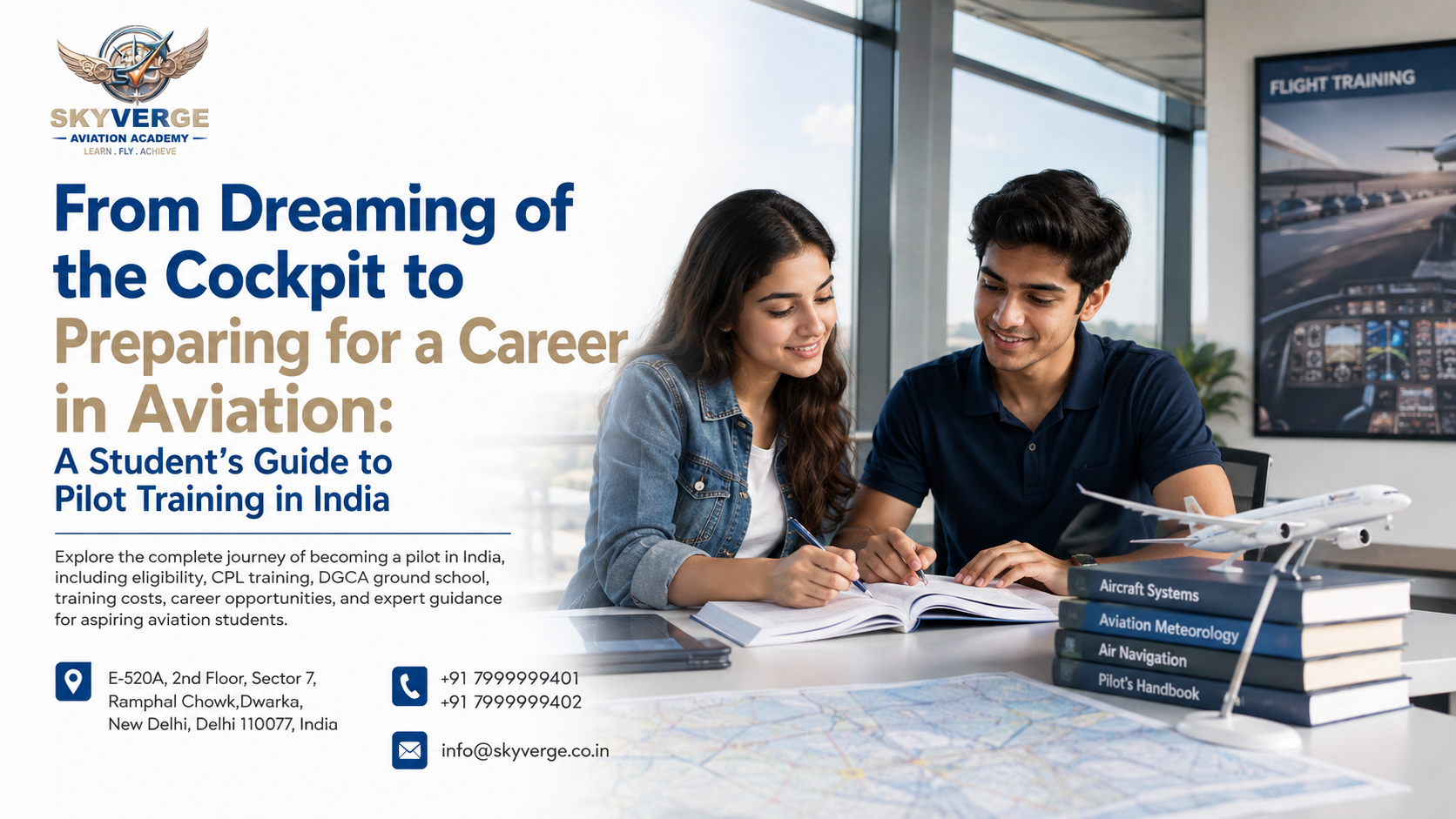
For many students, the dream of becoming a pilot begins with a simple moment.
Perhaps it happens while watching an aircraft take off from an airport window. Perhaps it starts with a fascination for aviation, or maybe a student simply knows that they want a career that combines technology, responsibility, travel, and the excitement of flying.
But after the dream comes a long list of questions.
How do I actually become a commercial pilot? What qualifications do I need? How does DGCA fit into the process? How much does pilot training cost? Should I join a flight school immediately? What exactly is taught during ground training?
These are important questions, and understanding the answers before making a major career decision can save students from confusion later.
This is where proper aviation education and guidance become important. At SkyVerge Aviation Academy, located in Dwarka, New Delhi, students can begin understanding the different stages involved in building a career in aviation and preparing themselves for the journey ahead.
Every Pilot Journey Begins Before the First Flight
Imagine a student named Aarav.
Like many aspiring pilots, Aarav has always been fascinated by aircraft. After completing school, he starts searching online for information about becoming a commercial pilot.
At first, everything seems straightforward.
He discovers terms such as CPL, DGCA, ground school, medical examination, flying hours, examinations, and flight training. But the more he searches, the more complicated the process appears.
One website talks about flight training. Another discusses DGCA examinations. Someone on social media talks about the cost of becoming a pilot, while another person recommends a particular flight school.
Aarav soon realizes something important:
Wanting to become a pilot is only the beginning. Understanding the journey is equally important.
What Does It Take to Become a Commercial Pilot in India?
The commercial pilot journey involves several stages rather than one single course.
Students generally need to understand the eligibility requirements, complete the necessary medical assessments, prepare for DGCA-related examinations, undertake ground training, complete flight training through an appropriate flight training organization, and fulfill the requirements associated with obtaining a Commercial Pilot Licence.
This is why students should avoid choosing a training path based only on advertisements or a single fee figure.
Before spending a significant amount of money, it is useful to understand:
- What qualifications are required?
- What examinations need to be cleared?
- What does ground training involve?
- Where will flight training take place?
- How are flying hours planned?
- What expenses are included in the quoted fees?
- What additional expenses may arise?
- What kind of academic support is available?
Having answers to these questions gives students a much clearer picture of the road ahead.
Understanding Commercial Pilot Training
Once Aarav understands the overall pathway, he encounters another important term: CPL.
A CPL course in India is designed for students who want to pursue commercial pilot licensing and eventually build a professional career in aviation.
However, students should understand that CPL training is not simply about sitting inside an aircraft and learning how to fly.
There is a strong academic component as well.
Aspiring pilots need knowledge of subjects related to aviation operations, navigation, meteorology, regulations, aircraft and flight-related principles, and other areas required for their training and examinations.
The combination of theoretical knowledge and practical flight training helps students develop the foundation required for professional flying.
For someone like Aarav, this changes the way he looks at pilot training.
He no longer sees becoming a pilot as simply learning how to control an aircraft. He begins to understand that professional aviation demands discipline, technical knowledge, decision-making, communication, and consistent preparation.
Why DGCA Ground Preparation Matters
One of the areas that often creates confusion among new students is ground training.
Before beginning practical flight training, students need to understand the theoretical side of aviation and prepare themselves for the relevant examinations. This is why structured ground preparation can play an important role in an aspiring pilot's journey.
A DGCA ground school can help aspiring pilots build a stronger theoretical foundation for their aviation examinations and future flying.
Students may study subjects involving areas such as air navigation, aviation meteorology, air regulations, aircraft-related knowledge, and other areas relevant to their pilot training pathway.
Ground preparation is particularly important because aviation is highly dependent on knowledge and procedures.
A pilot needs to understand the weather before a flight, interpret navigation information, follow applicable regulations, understand aircraft systems, and make informed decisions.
In other words, flying skills and theoretical knowledge work together.
At SkyVerge Aviation Academy, students can focus on understanding the academic side of their aviation journey and develop a stronger foundation before progressing through the different stages of pilot training.
The Question Every Student Eventually Asks: How Much Does It Cost?
Aarav's next question is probably the one most aspiring pilots ask:
“How much money will I need to become a pilot?”
The answer is not always a single fixed number.
When researching pilot training cost in India, students should look beyond the headline figure advertised by a training provider.
The overall expenditure can depend on several factors, including the flight training organization selected, aircraft and training availability, flying hours, training duration, accommodation, examination-related expenses, equipment, medical requirements, travel, and other individual requirements.
There can also be differences between the advertised course fee and the student's actual total expenditure.
That is why students should request a detailed fee structure before making a decision.
A useful approach is to divide the expected expenses into categories such as:
- Ground training
- Flight training
- Examination-related expenses
- Medical assessments
- Licensing and documentation
- Accommodation and living expenses
- Travel
- Study materials and equipment
- Possible additional flying or training requirements
This approach allows students and parents to create a more realistic financial plan.
Choosing the Right Training Environment
After understanding the academic and financial side, Aarav reaches another important decision.
Where should he begin his preparation?
Students often search for the Best pilot training institute in India, but the word “best” can mean different things to different students.
Instead of selecting an institute simply because it appears at the top of a search result, students should consider whether the training environment matches their educational requirements.
Some useful questions include:
Does the Institute Provide Structured Academic Preparation?
A clear study plan can help students understand what they need to learn and when they need to learn it.
Are the Instructors Experienced and Approachable?
Students should be able to ask questions without hesitation, particularly when studying technical aviation subjects.
Is the Course Focused on Understanding Rather Than Memorization?
Aviation education should help students understand concepts and their practical relevance.
Does the Institute Clearly Explain the Overall Pilot-Training Pathway?
A student should know what comes after ground preparation rather than feeling lost after completing one stage.
Are Fees and Expectations Explained Clearly?
Transparency is especially important when students and families are planning a substantial educational investment.
These questions can help students make a more informed decision.
A Conversation Every Aspiring Pilot Should Have With Their Parents
When Aarav tells his parents that he wants to become a pilot, they are excited—but they also have concerns.
They ask about the duration, expenses, career opportunities, eligibility, medical requirements, and what happens if something does not go according to plan.
These conversations are important.
Pilot training represents a significant educational and financial commitment. Students should therefore involve their families in the decision-making process.
Instead of simply saying, “I want to become a pilot,” students can prepare a simple roadmap explaining:
- Their educational background
- The pilot licensing pathway
- Ground-training requirements
- Flight-training requirements
- Expected expenses
- Approximate training timeline
- Medical and examination requirements
- Their long-term aviation career goals
A well-researched plan demonstrates that the decision is based on preparation rather than simply excitement.
Questions Students Commonly Ask Before Starting Pilot Training
“Can I Start Pilot Training Immediately After School?”
Students should first check the applicable eligibility requirements and understand the academic and medical requirements before enrolling in any training program.
“Is Flying the Only Thing I Need to Study?”
No. Professional pilot training has a substantial theoretical component. Students need to develop knowledge across several aviation subjects alongside practical flight training.
“Why Is Ground Training Important If I Want to Fly?”
Because a professional pilot needs more than aircraft-control skills. Understanding weather, navigation, regulations, aircraft systems, and operational procedures is fundamental to safe and informed decision-making.
“Is the Cheapest Pilot Training Option Always the Best?”
Not necessarily. Students should compare what is included in the fee, the training structure, aircraft availability, additional charges, support systems, and overall training environment before making a decision.
“What Should I Ask an Aviation Academy Before Joining?”
Students should ask about the curriculum, instructors, examination preparation, training pathway, fees, additional expenses, documentation requirements, and what guidance is available during the different stages of their journey.
From a Dream to a Plan
A few months after beginning his research, Aarav looks back at how much his understanding has changed.
Initially, becoming a pilot seemed simple: study, learn to fly, and get a licence.
Now he understands that there is much more involved.
There is academic preparation.
There are regulatory requirements.
There are medical considerations.
There is flight training.
There are financial decisions.
And, most importantly, there is a need for consistency.
This is the difference between simply dreaming about aviation and preparing seriously for an aviation career.
Starting the Journey With the Right Information
For students considering aviation as a career, the first step does not necessarily have to be stepping into an aircraft.
It can simply be asking the right questions.
Understanding the CPL pathway, researching training options, learning about DGCA examinations, estimating expenses realistically, and discussing the decision with family can give aspiring pilots a stronger foundation.
SkyVerge Aviation Academy aims to help students understand this journey and approach aviation education with greater clarity and preparation. Based in Dwarka, New Delhi, the academy provides guidance and educational support for students taking their first steps toward a career in aviation.
Get in Touch With SkyVerge Aviation Academy
Students and parents who want to learn more about aviation education and the pilot-training journey can contact SkyVerge Aviation Academy at the following address:
SkyVerge Aviation Academy
E-520A, 2nd Floor, Sector 7, Ramphal Chowk,
Dwarka, New Delhi, Delhi 110077, India
Website: https://www.skyverge.co.in/
Phone: +91 7999999401 | +91 7999999402
Email: info@skyverge.co.in
The journey to becoming a pilot is not something that should be rushed.
It is a journey that rewards preparation, discipline, knowledge, and patience.
And for every student standing at the beginning of that journey, the most important first step may simply be understanding where the runway begins.

 English
 Arabic
 French
 Spanish
 Portuguese
 Deutsch
 Turkish
 Dutch
Dutch
 Italiano
 Romaian
 Portuguese (Brazil)
 Greek
Greek