


Office Canteen vs Catering Services: Which Is Better for Your Company?
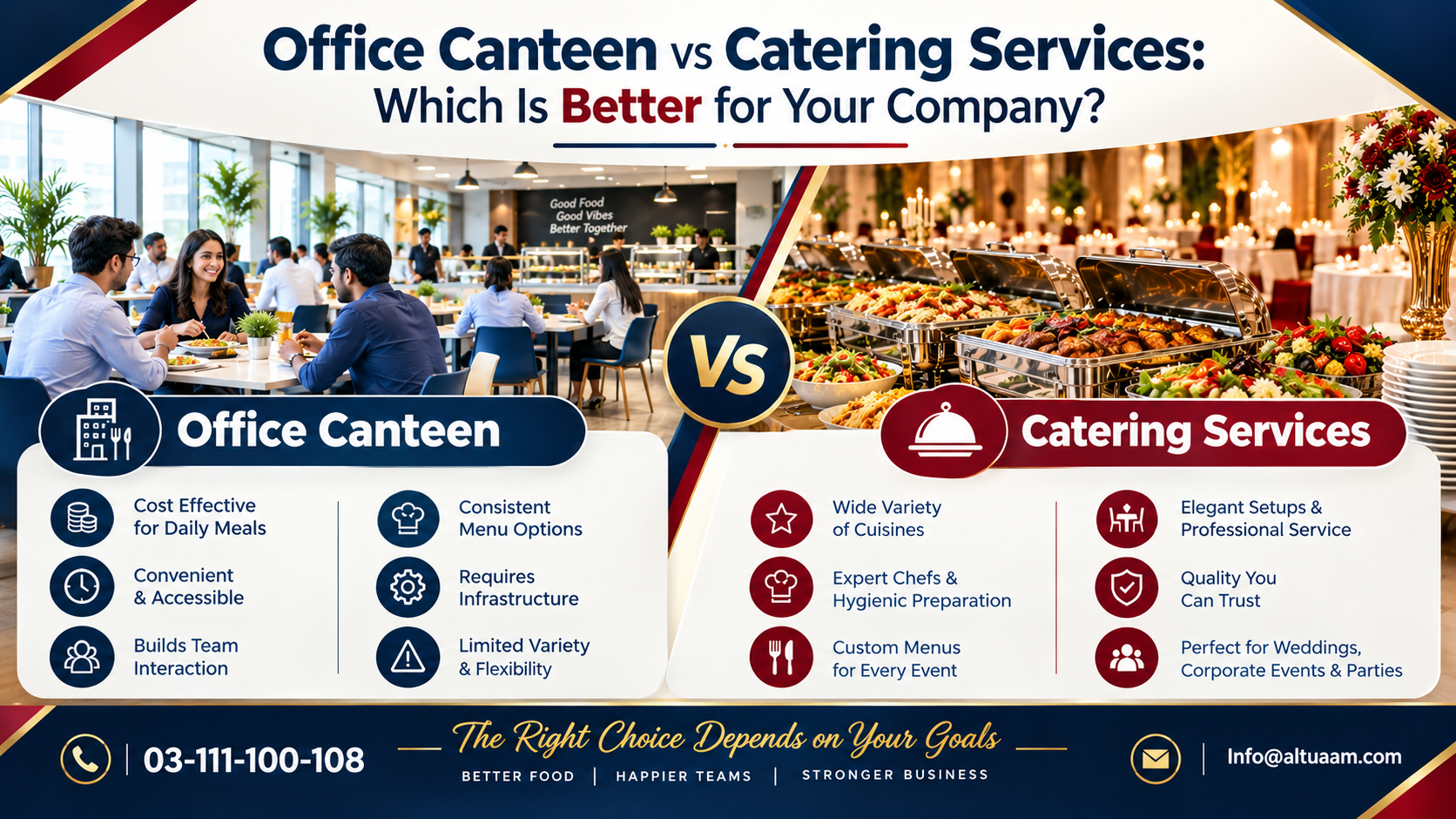
Providing quality meals to employees has become an important part of creating a productive and comfortable workplace. For companies in Lahore, one common question is whether to operate an in-house office canteen or hire professional Catering Services for daily meals.
Both options have advantages and challenges. An office canteen gives a company direct control over food preparation, staff, and operations. Professional catering, on the other hand, allows businesses to provide regular meals without investing in a commercial kitchen, hiring kitchen staff, or managing daily food operations.
The right choice depends on your company's employee count, office space, budget, meal requirements, and operational capacity. This guide compares both options to help businesses make a practical decision.
What Is an Office Canteen?
An office canteen is an in-house food facility operated within a company or workplace. The company may hire cooks, kitchen helpers, supervisors, and other staff to prepare and serve meals.
Running a canteen also requires suitable kitchen infrastructure, cooking equipment, ingredient storage, utilities, cleaning arrangements, and food safety procedures.
For large organizations with hundreds of employees, an in-house canteen can sometimes make sense because the fixed costs can be distributed across a large number of daily meals.
However, for smaller companies, maintaining all these facilities can become expensive and time-consuming.
What Are Catering Services?
Professional Catering Services provide food preparation and delivery without requiring the company to operate its own kitchen.
Instead of investing in kitchen infrastructure, a business partners with an external catering provider. The caterer handles menu planning, ingredient purchasing, food preparation, packaging or buffet setup, and delivery.
Depending on the agreement, companies can receive meals daily, weekly, or according to a customized schedule.
AL-Tuaam provides corporate catering and daily lunch solutions designed around company requirements, including flexible meal planning and professional food delivery in Lahore.
Office Canteen vs Catering: Cost Comparison
Cost is one of the biggest factors when deciding between an office canteen and catering.
An in-house canteen may require:
Kitchen construction or renovation
Cooking equipment
Gas and electricity connections
Refrigeration and storage
Kitchen staff salaries
Ingredient purchasing
Cleaning supplies
Equipment maintenance
Waste management
These expenses can continue even when fewer employees are present in the office.
With professional catering, companies generally pay according to the number of meals or an agreed package. This can make budgeting easier because there is no need to manage kitchen salaries, equipment repairs, or ingredient procurement internally.
For small and medium-sized businesses, outsourcing food service can therefore reduce operational overhead.
Convenience and Daily Management
An office canteen requires continuous management.
Someone needs to monitor staff attendance, purchase ingredients, maintain inventory, plan menus, supervise food preparation, maintain cleanliness, and deal with equipment problems.
This can place an additional burden on HR, administration, or office management teams.
With an outsourced catering arrangement, much of this responsibility moves to the catering provider.
The company mainly needs to communicate:
Number of employees
Required meal times
Menu preferences
Dietary requirements
Delivery location
Budget per meal
This allows HR and administrative teams to focus on their primary responsibilities rather than managing kitchen operations.
Food Quality and Variety
Food quality depends on the individual provider, whether you choose a canteen or catering company.
An in-house kitchen can provide excellent food when experienced cooks and effective management are in place. However, maintaining consistency can become difficult when kitchen staff change or ingredient procurement is inconsistent.
A professional caterer that specializes in corporate meals may offer a wider range of dishes and structured menu rotations.
For example, an office can receive different meals throughout the week rather than serving the same limited dishes repeatedly.
Menu rotation can include traditional Pakistani meals, rice dishes, curries, BBQ options, vegetables, salads, desserts, and other customized choices depending on employee preferences and budget.
Employee Satisfaction
Food can have a direct effect on the employee experience.
Employees appreciate having convenient access to fresh, properly prepared meals during working hours. A well-managed food program can also create a more comfortable workplace environment.
An in-house canteen can provide a familiar dining environment and direct interaction with kitchen staff.
However, outsourced catering can provide greater menu variety and consistency when managed by an experienced provider.
Companies should also collect employee feedback regularly. Ask employees about:
Food taste
Portion sizes
Menu variety
Meal timing
Food freshness
Dietary preferences
Overall satisfaction
This feedback can help companies improve their food program regardless of which model they choose.
Space and Infrastructure Requirements
Office space is another major consideration.
An in-house canteen requires dedicated space for cooking, storage, ventilation, equipment, and often dining.
For companies operating from rented offices in areas such as Gulberg or DHA, dedicating valuable office space to a commercial kitchen may not be practical.
Professional catering eliminates most of these infrastructure requirements. Food can be prepared at the caterer's facility and delivered to the office according to an agreed schedule.
This allows businesses to use their office space primarily for employees and business operations.
Hygiene and Food Safety
Food safety should never be compromised.
An in-house canteen requires the company to monitor kitchen cleanliness, ingredient storage, food temperatures, employee hygiene, and overall food preparation practices.
This means management must establish and maintain appropriate food safety procedures.
With a professional catering provider, the food preparation process is managed by the caterer's kitchen team. A reputable provider should have appropriate procedures for ingredient handling, preparation, packaging, transportation, and delivery.
Companies should still ask potential caterers about their hygiene standards before signing a long-term agreement.
Scalability for Growing Companies
Businesses often experience changes in employee numbers.
A company may have 50 employees today and 100 employees after a period of growth. Alternatively, hybrid work policies may cause daily attendance to fluctuate.
An in-house canteen has relatively fixed costs. Increasing capacity may require additional staff, equipment, and kitchen space.
Professional catering offers greater flexibility. Companies can usually adjust meal quantities according to their current requirements.
This makes outsourced catering particularly useful for startups, growing businesses, companies with hybrid teams, and organizations with changing employee numbers.
When Does an Office Canteen Make Sense?
An in-house canteen can be a suitable option for certain organizations.
It may work well when:
The company has a very large and stable workforce.
The building already has kitchen infrastructure.
Employees eat meals at the workplace every day.
The company wants maximum control over food preparation.
There is enough space for a proper commercial kitchen.
The organization has staff available to manage kitchen operations.
Large manufacturing facilities, campuses, hospitals, and other organizations with substantial daily meal requirements may benefit from this model.
When Is Catering a Better Choice?
Professional catering is often more practical for small and medium-sized companies.
It can be especially useful when:
The office has limited kitchen space.
The company rents its office.
Employee attendance changes regularly.
HR teams have limited administrative capacity.
The business wants predictable food costs.
Employees want more menu variety.
The company is expanding.
Management does not want to handle kitchen staff and equipment.
For these organizations, outsourcing meals can provide convenience without the long-term commitment of building and managing a canteen.
The Hybrid Option
Companies do not always have to choose one model completely.
A hybrid approach can combine a basic office pantry or small canteen with outsourced catering.
For example, a company could maintain an internal pantry for tea, coffee, snacks, and beverages while using a professional caterer for daily lunch.
This approach can provide some of the convenience of an office canteen while reducing the workload associated with full-scale kitchen operations.
Menu Customization and Dietary Preferences
Modern workplaces often include employees with different food preferences.
Some employees may prefer lighter meals, while others may want traditional Pakistani food. Some may require vegetarian options or customized portions.
A professional catering provider can help create rotating menus according to the company's requirements.
Businesses can also discuss weekly menus in advance and collect employee feedback to identify popular dishes.
This makes the meal program more flexible and helps prevent employees from becoming tired of repetitive food choices.
Budget Predictability
Financial planning is another important advantage of outsourced catering.
An in-house canteen can have several unpredictable expenses, including equipment repairs, staff replacement, utility costs, ingredient price changes, and food waste.
Professional catering can provide an agreed per-meal or package-based cost, making monthly budgeting easier.
Before selecting a provider, companies should request a clear quotation that explains what is included in the price.
Ask whether the package includes delivery, packaging, serving arrangements, beverages, desserts, and any other additional services.
A Simple Example
Imagine a company with 60 employees operating from a rented office in Lahore.
Building a complete kitchen would require construction, ventilation, equipment, staff, storage, utilities, and ongoing management.
If employee attendance changes because of hybrid work, the company could still have to maintain most of those fixed costs.
Instead, the company could partner with a catering provider and order meals according to confirmed attendance.
Now consider a manufacturing facility with 500 employees working at the same location every day. If the facility already has kitchen infrastructure, an in-house canteen may become more financially practical because the fixed costs are distributed across hundreds of daily meals.
This demonstrates why the best choice depends on company size, infrastructure, and workforce stability.
Why AL-Tuaam Can Be a Corporate Food Partner
AL-Tuaam offers corporate catering and daily lunch solutions for businesses in Lahore. Its services can help companies provide regular meals without creating and managing their own kitchen infrastructure.
A professional catering arrangement can be structured around employee numbers, meal frequency, budget, menu preferences, and office schedules.
For companies that want fresh meals without taking on the responsibility of kitchen management, outsourcing can be a practical alternative to establishing a complete office canteen.
Final Verdict: Canteen or Catering?
There is no single answer for every company.
An office canteen may be suitable for a large organization with a stable workforce, existing infrastructure, and a strong need for direct operational control.
For many small and medium-sized companies, however, professional Catering Services offer greater flexibility, easier budgeting, less infrastructure investment, and reduced administrative responsibility.
Before making a decision, compare the complete cost rather than looking only at the price of individual meals.
Consider kitchen setup, salaries, utilities, maintenance, ingredient procurement, food waste, office space, employee satisfaction, scalability, and management time.
For growing businesses in Lahore, outsourced catering can provide a convenient way to deliver quality office meals while allowing the company to focus on its core business.
The most important goal is not simply choosing between a canteen and a caterer. It is creating a reliable food program that provides employees with fresh, enjoyable meals while making financial and operational sense for the company.

 English
 Arabic
 French
 Spanish
 Portuguese
 Deutsch
 Turkish
 Dutch
Dutch
 Italiano
 Russian
 Portuguese (Brazil)
 Greek
Greek