


How to Get BIS Certification in Delhi? A Complete Guide for Businesses
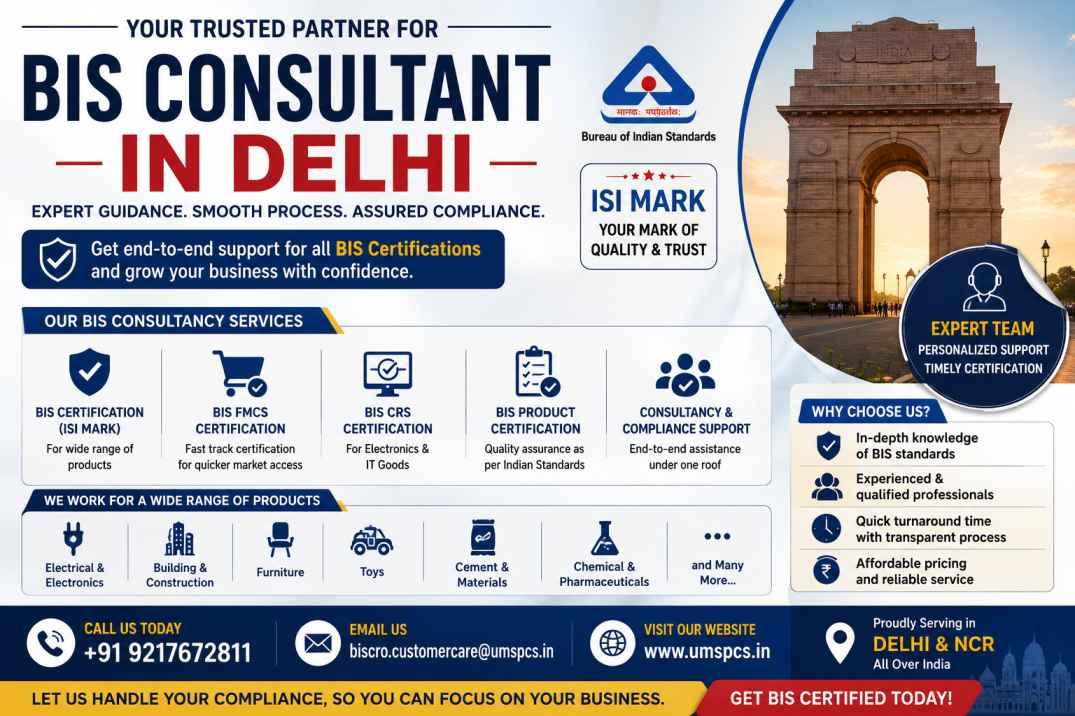
If you manufacture, import, distribute, or sell products in India, meeting the required quality and safety standards is not just a business advantage—it can be an important regulatory requirement. This is where BIS Certification in Delhi becomes relevant for businesses dealing with products covered under applicable Indian Standards. The Bureau of Indian Standards (BIS) is India's national standards body, responsible for establishing standards and providing conformity assessment services for a wide range of products.
For businesses operating in Delhi and the wider NCR region, understanding the BIS process can save considerable time and prevent avoidable documentation or testing issues. Whether you are a manufacturer looking for an ISI Mark licence, an electronics company seeking CRS registration, or an overseas manufacturer exploring FMCS requirements, getting the right guidance from the beginning can make the process much smoother.
What Is BIS Certification?
BIS Certification demonstrates that a product conforms to the applicable Indian Standard and relevant BIS requirements. Depending on the product category and applicable scheme, BIS may require product testing, factory inspection, documentation, registration, or other conformity assessment activities.
The certification is particularly important for products where the government has made compliance with specific Indian Standards mandatory. Selling a product without the required BIS approval, where certification is compulsory, may create regulatory and commercial difficulties.
BIS covers a broad range of products, including electrical appliances, construction materials, cement, steel products, household items, electronics, chemicals, and many other categories
.
Why Is BIS Certification Important for Delhi Businesses?
Delhi is one of India's major commercial and manufacturing hubs, with businesses supplying products across NCR and other parts of the country. Regulatory compliance can therefore play an important role in maintaining smooth business operations.
Some key benefits of BIS compliance include:
-
Regulatory compliance: Helps businesses meet applicable mandatory requirements.
-
Customer confidence: A recognised quality mark can increase buyer trust.
-
Market access: Certification may be necessary for selling certain regulated products in India.
-
Better quality control: Following Indian Standards encourages consistent product quality.
-
Business credibility: Compliance can strengthen your position with distributors, institutional buyers, and business partners.
-
Reduced compliance risks: Proper certification can help avoid problems caused by missing or incorrect approvals.
Which Types of BIS Certification Are Commonly Required?
BIS requirements depend on the product and the applicable Indian Standard. Some commonly encountered BIS schemes include:
BIS ISI Mark Certification
The ISI Mark is associated with products that comply with the relevant Indian Standard. Manufacturers of products covered under mandatory certification requirements may need to obtain a BIS licence before placing the ISI Mark on their products.
BIS CRS Registration
The Compulsory Registration Scheme (CRS) applies to specified electronic and IT products. Depending on the product, applicants generally need testing from a recognised laboratory followed by the relevant registration process.
BIS FMCS Certification
The Foreign Manufacturers Certification Scheme (FMCS) is intended for manufacturers located outside India whose products are required to comply with applicable Indian Standards. Overseas manufacturers may need to follow specific requirements involving testing, factory inspection, authorised representation, and other documentation.
Because each scheme follows different procedures, identifying the correct certification route is one of the first and most important steps.
Read More- BIS FMCS Certification in Delhi
What Is the BIS Certification Process in Delhi?
Although the exact process varies by product and certification scheme, the general procedure can involve the following stages:
1. Identify the Applicable Indian Standard
The first step is determining whether your product falls under a mandatory BIS requirement and identifying the correct Indian Standard. Using an incorrect standard can lead to unnecessary testing and delays.
2. Prepare the Required Documents
Applicants may need documents such as business registration details, manufacturing information, product specifications, test reports, technical documents, factory details, and authorised signatory information.
3. Product Testing
Where applicable, product samples are tested through a BIS-recognised or otherwise applicable laboratory. The testing requirements depend on the product and relevant standard.
4. Submit the Application
Once the necessary documents and test-related requirements are ready, the application can be submitted through the applicable BIS process.
5. Factory Inspection
For schemes that require inspection, BIS officials may assess the manufacturing facility, production process, testing arrangements, quality control system, and related facilities.
6. Grant of Licence or Registration
After successful completion of the applicable assessment and compliance requirements, BIS may grant the relevant licence or registration.
The process does not necessarily end with approval. Businesses may also need to maintain ongoing compliance, conduct required testing, follow marking requirements, and meet surveillance or renewal-related obligations.
What Documents Are Generally Needed?
The exact documents depend on the product and certification scheme, but businesses may commonly need:
-
Company or manufacturer details
-
Manufacturing address and factory information
-
Product technical specifications
-
Product drawings or datasheets
-
Manufacturing process details
-
Quality control information
-
Test reports, where applicable
-
Details of testing facilities
-
Trademark or brand-related documents, where applicable
-
Authorisation documents
-
Identity and address-related documents of relevant representatives
Preparing accurate documentation is important because inconsistencies between the application, product, test report, and manufacturing details can create unnecessary complications.
How Can a BIS Consultant Help?
The BIS process can become complicated when businesses are unfamiliar with Indian Standards, testing requirements, documentation, or application procedures. A professional consultant can assist with understanding the applicable requirements and organising the certification process.
UMSPCS - BIS Consultant assists businesses with activities such as requirement assessment, documentation preparation, testing coordination, application support, inspection preparation, and post-certification compliance.
The advantage of working with an experienced consultant is not simply saving paperwork. Proper guidance can help identify potential issues before submission and provide a clearer roadmap for completing the certification process.
Why Choose UMSPCS for BIS Certification in Delhi?
Choosing the right compliance partner can make a significant difference, particularly when certification involves testing, inspections, technical documentation, and regulatory communication.
UMSPCS focuses on providing practical compliance assistance based on the specific product and certification requirement. From understanding the applicable BIS scheme to preparing documentation and coordinating different stages, the objective is to make the process easier for manufacturers, importers, and other businesses.
Instead of approaching certification as a one-time paperwork exercise, businesses should treat BIS compliance as part of their long-term quality and regulatory strategy.
Read More- EPR Certification in Noida
Conclusion
Obtaining BIS approval can be an important step for businesses that manufacture, import, or sell products covered by applicable Indian Standards. However, the requirements are not identical for every product. The applicable scheme, standard, testing requirements, documents, and inspection process can all differ.
If you are planning BIS Certification in Delhi, getting the requirements assessed before beginning the application can help you avoid common mistakes and unnecessary delays. With professional assistance from UMSPCS, businesses can receive support throughout documentation, testing, application, inspection, and related compliance activities.
If you are unsure whether your product requires BIS certification or want to understand the applicable process, consult a BIS professional and start with a proper product-specific assessment.
Frequently Asked Questions (FAQs)
1. What is BIS Certification?
BIS Certification confirms that a product complies with the applicable Indian Standard and relevant BIS conformity assessment requirements.
2. Is BIS Certification mandatory for every product?
No. BIS certification is not mandatory for every product. It depends on the applicable regulations, product category, and Indian Standard.
3. How long does BIS Certification take?
The timeline varies depending on the product, certification scheme, testing requirements, documentation, and whether a factory inspection is required.
4. Can an importer apply for BIS Certification?
It depends on the applicable BIS scheme and product category. Certain certification schemes are specifically intended for manufacturers, while other requirements may involve importers or authorised representatives.
5. What is the difference between ISI and CRS?
ISI Mark certification is generally associated with products covered under the relevant BIS licensing scheme, while CRS is a registration framework applicable to specified electronic and IT products.
6. Does BIS Certification need to be renewed?
Requirements depend on the applicable BIS scheme and licence or registration conditions. Businesses should monitor validity, renewal, testing, and continuing compliance requirements.
7. Can a BIS consultant help with testing?
Yes. A consultant can generally assist with understanding testing requirements and coordinating the testing stage with an appropriate laboratory, depending on the certification scheme.
8. Why should businesses take BIS compliance seriously?
For products covered by mandatory requirements, compliance is important for lawful market access and reducing regulatory risk. It can also improve customer confidence and demonstrate commitment to product quality.

 Arabic
 French
 Spanish
 Portuguese
 Deutsch
 Turkish
 Dutch
Dutch
 Italiano
 Russian
 Romaian
 Portuguese (Brazil)
 Greek
Greek