


Marine Foundry Services for Bronze, Lead Casting and Precision Lathe Works
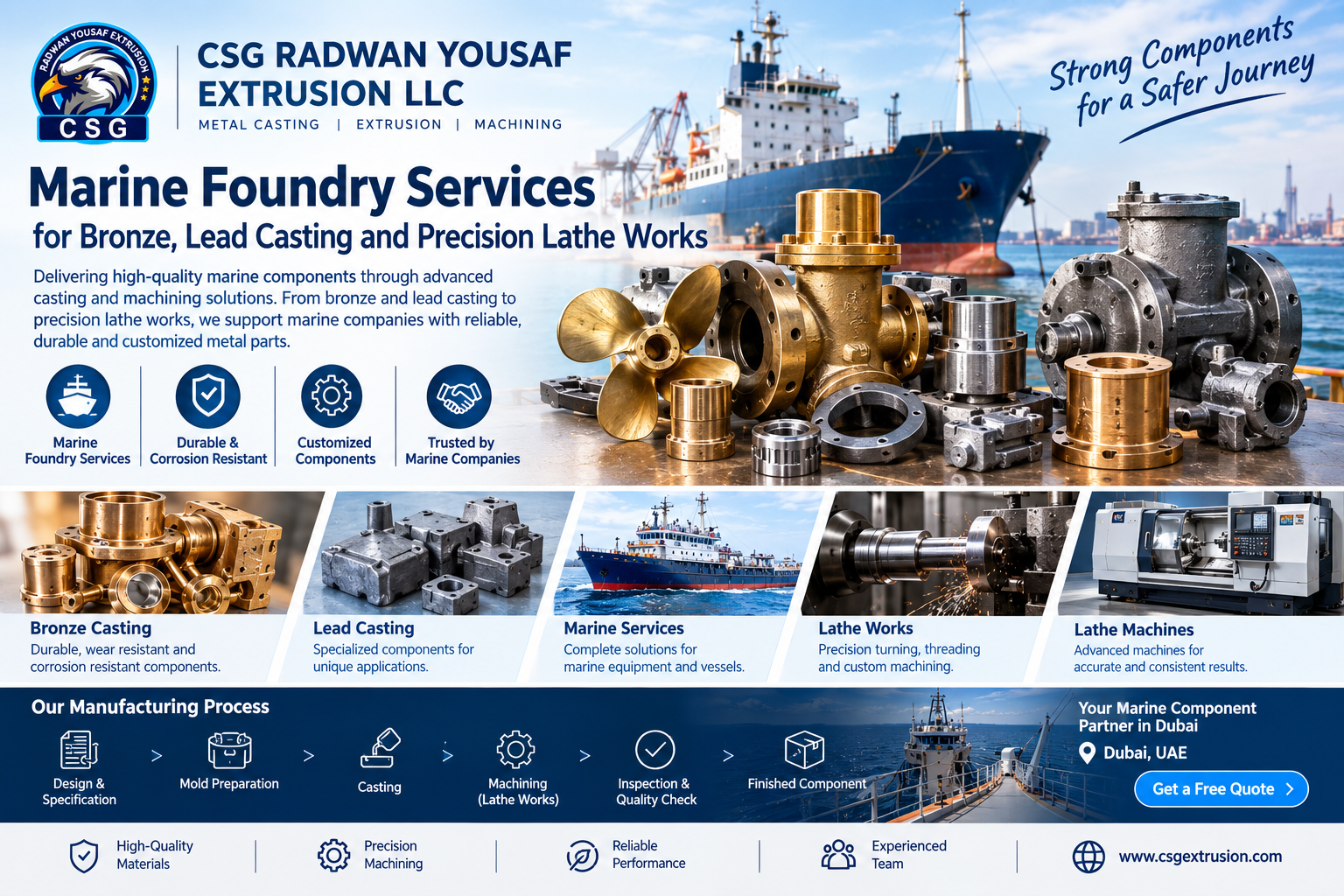
The marine industry requires dependable metal components that can perform in demanding operating environments. Moisture, corrosion, mechanical loads, friction, and continuous use can place significant demands on marine equipment. Marine foundry services provide customized manufacturing solutions for companies that need cast metal components for vessels, marine machinery, repair projects, and industrial applications. CSG Radwan Yousaf Extrusion LLC provides casting and machining solutions for industries including marine applications. Its service portfolio includes metal casting, bronze casting, lathe works, and marine services. For more information, businesses can explore the company's Marine Services and Casting Services.
Casting allows manufacturers to produce components in different shapes and sizes according to technical drawings and specifications. After casting, manufacturers can perform machining and finishing to achieve accurate dimensions and functional surfaces.
Understanding Marine Casting Services
Marine casting services help companies manufacture customized components according to material, shape, dimensions, and application requirements. The process generally begins with reviewing the component design and selecting an appropriate metal and casting method.
Manufacturers then prepare a mold and introduce molten metal into the mold cavity. Once the material cools and solidifies, the casting can be removed, inspected, and prepared for additional machining.
This approach can support new component production as well as replacement parts. Businesses can provide drawings, measurements, material requirements, and application details to help manufacturers plan the production process.
CSG's services information states that its casting operations work with ferrous metals such as cast iron and SG iron as well as non-ferrous materials including aluminium, brass, bronze, and copper.
Bronze Casting for Marine Components
Bronze casting offers a useful option for components that require durability, wear resistance, and corrosion resistance. Depending on the specific alloy and application, manufacturers can produce bronze components for mechanical and marine-related uses.
Common examples include bushings, bearings, fittings, and other customized mechanical components. The final material selection should depend on the component's operating environment and required performance.
Professional bronze casting services can produce components according to customer drawings and dimensional requirements. After casting, machining can create accurate holes, threads, grooves, and finished surfaces.
CSG's website lists bronze among the non-ferrous metals used in its casting operations and describes its casting capabilities as supporting components such as sleeves, gears, flanges, pulleys, and other industrial parts.
Lead Casting for Specialized Applications
Lead casting serves specialized manufacturing requirements where the material's particular properties are appropriate for the application. Manufacturers can form lead into customized shapes according to required dimensions and specifications.
Professional lead casting services require suitable handling procedures and careful production planning. Businesses should communicate the intended use, component dimensions, quantity, and technical requirements before manufacturing begins.
Lead does not suit every marine application, so material selection should always depend on the component's actual operating environment and performance requirements.
Casting Services for Marine Companies
Casting services for marine companies can support businesses that require customized or replacement metal components. Ship operators, marine equipment businesses, repair workshops, and related companies may require components with specific dimensions and material characteristics.
A manufacturer can review the component design and determine an appropriate casting process. Bronze may suit certain marine applications, while other materials may provide better performance for different requirements.
CSG specifically presents casting solutions for marine companies and states that its marine offering is tailored toward shipping companies, offshore operators, and marine service providers.
Marine Services and Component Manufacturing
Reliable marine services can extend beyond routine maintenance. Customized component manufacturing can help marine businesses obtain replacement parts and specialized metal products according to their equipment requirements.
Marine equipment can operate in challenging environments, so manufacturers need to consider material selection, component geometry, operating conditions, and finishing requirements.
Combining casting with machining can make the manufacturing process more convenient. A business can provide technical specifications at the beginning of a project and coordinate casting and machining through the same supplier.
CSG's service portfolio identifies marine services as part of its capabilities and describes these services as supporting durability, safety, and reliable performance in challenging marine environments.
Precision Lathe Works After Casting
Casting often produces the primary shape of a component, but many parts require additional machining before installation. Lathe works can provide the precision required for cylindrical and rotational components.
A lathe rotates the workpiece while a cutting tool removes material from its surface. Depending on the design, machinists can perform turning, facing, boring, drilling, threading, taper turning, grooving, and related operations.
Professional Lathe works service can therefore complement casting by transforming a cast component into a finished engineering part. This combination can improve production coordination and help businesses manage multiple manufacturing stages through one supplier.
CSG's dedicated Lathe Works page states that its facility handles precision turning and offers operations including cylindrical turning, facing, thread cutting, boring, taper turning, knurling, and grooving.
Lathe Machines for Accurate Metal Components
Modern lathe machines play an important role in precision metal manufacturing. They allow machinists to remove material accurately and produce components according to required dimensions.
CSG reports that its workshop includes precision lathes alongside furnaces, milling machines, sand mixers, and molding systems. The company also states that its lathe operations work with materials such as cast iron, aluminium, brass, bronze, stainless steel, and mild steel.
For marine components, accurate machining can help prepare parts for correct installation and operation. Businesses should provide accurate drawings and dimensional specifications before machining begins.
Benefits of Combining Casting and Lathe Works
Combining casting with Lathe works can create a more coordinated manufacturing workflow. Casting establishes the primary shape, while machining refines the component to meet dimensional and functional requirements.
This approach can prove valuable for customized marine components, replacement parts, machinery components, and industrial products. Instead of coordinating casting with one supplier and machining with another, businesses can manage both stages through a capable manufacturing partner.
The integrated approach can also simplify communication. Customers can provide drawings and specifications at the beginning of the project, allowing manufacturers to plan casting, machining, and finishing together.
Quality Considerations for Marine Components
Quality should remain a priority throughout the manufacturing process. Proper material selection, mold preparation, casting, cooling, inspection, and machining all contribute to the finished component.
Businesses should provide complete technical information before production. Details about dimensions, operating conditions, material preferences, quantities, and finishing requirements can help manufacturers understand the project.
CSG states that its facility uses modern machinery and focuses on precise tolerances, uniform quality, and the requirements of different industries.
Choosing the Right Marine Manufacturing Partner
Businesses looking for marine foundry services should evaluate several factors before selecting a supplier. Casting capabilities, material knowledge, machining facilities, production capacity, quality procedures, and experience with customized components can all influence the final result.
A supplier that offers both casting and machining can provide an efficient option for projects requiring multiple production stages. Businesses should also discuss their technical drawings and application requirements before production starts.
For companies requiring specialized marine components, CSG's website provides dedicated information about its marine casting services and related manufacturing capabilities.
Final Overview
Reliable marine foundry services can help marine companies obtain customized metal components for demanding applications. Bronze casting services can support suitable components where durability and corrosion resistance are important, while lead casting services can address specialized requirements where lead is appropriate.
Businesses can further refine cast components through Lathe works, a professional Lathe works service, and modern lathe machines. Combining casting and machining creates a coordinated manufacturing process that can support accurate and functional components.
For marine businesses, choosing a supplier with casting, machining, and marine capabilities can simplify production and communication. With suitable material selection, controlled manufacturing, and precision machining, marine casting services can provide practical solutions for customized components across marine and industrial applications.

 English
 Arabic
 French
 Spanish
 Portuguese
 Deutsch
 Turkish
 Dutch
Dutch
 Italiano
 Russian
 Romaian
 Greek
Greek