


Hair Transplant in Dubai for Temple Recession
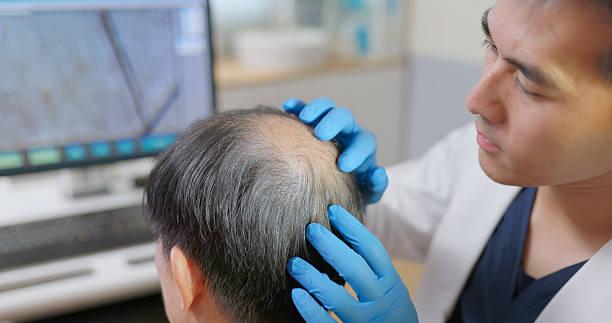
Receding temples can change the apparent shape of the forehead even when the central hairline remains relatively intact. For suitable candidates, Hair Transplant in Dubai can address localized temporal loss by restoring carefully selected follicles while preserving the natural transition between the frontal and side hairlines.
Temple restoration requires particular precision because the area is structurally different from the central scalp. The goal is not simply to add hair to an empty region, but to recreate a transition that follows the patient's existing anatomy.
Why Temple Recession Changes Facial Framing
The temples help connect the frontal hairline to the sides of the head.
When this area recedes, the forehead may appear wider and the hairline can develop a more pronounced triangular shape.
Even relatively small changes can therefore influence the overall appearance of the face.
Temporal Loss Is Not the Same as Frontal Recession
The central frontal hairline and temples can progress at different rates.
Some patients maintain reasonable central coverage while experiencing significant temporal recession.
Others develop broader frontal loss at the same time.
This distinction matters because the treatment plan should target the actual pattern rather than automatically reconstructing the entire frontal region.
The Temple Has a Three-Dimensional Shape
The temporal region curves around the side of the head.
Hair placement therefore needs to account for changing scalp contours and growth directions.
A design that looks appropriate from a straight-on view may appear unnatural from an angle if the transition is too abrupt.
Hair Transplant in Dubai for Targeted Temple Restoration
When temple loss is localized and stable, targeted transplantation may provide meaningful improvement without requiring extensive treatment elsewhere.
The surgeon needs to determine where the natural temporal boundary should sit and how it should connect to existing hair.
The Shape of the Temple Point Matters
The temple point is not simply a straight extension of the frontal hairline.
Its position and angle influence the appearance of the forehead and side profile.
A restoration that places the temple too far forward can make the hairline appear heavy.
Placing it too far backward may leave the forehead appearing excessively wide.
Conservative Placement Can Preserve Natural Anatomy
Temple restoration generally benefits from restraint.
The objective is to restore the missing structure rather than create a dense block of hair.
A carefully planned transition can use fewer grafts while producing a more convincing visual improvement.
Understanding the Natural Temple Transition
Natural temple hair tends to become finer and less dense as it approaches the side of the face.
Recreating this gradual change can be more important than simply increasing the number of follicles.
Hair Caliber Influences the Transition
Fine hairs can create a softer edge, while thicker follicular units can provide stronger coverage behind the transition.
The patient's donor characteristics determine what is realistically available.
Direction Becomes Increasingly Important
Hair in the temple does not necessarily grow in the same direction as hair at the central frontal scalp.
The implantation plan should therefore reflect the surrounding growth pattern.
This helps prevent transplanted hair from standing out against neighboring native follicles.
Evaluating Temple Recession Before Surgery
A proper consultation should examine more than the visible recession.
| Assessment area | What is examined | Why it matters |
|---|---|---|
| Temple depth | Degree of temporal recession | Establishes restoration requirements |
| Temple angle | Relationship with frontal hairline | Supports natural lateral transition |
| Existing follicles | Remaining native hairs | Provides anatomical reference |
| Hair caliber | Thickness of available hair | Influences visual blending |
| Growth direction | Orientation of surrounding follicles | Guides implantation |
| Donor density | Available follicular reserve | Determines realistic graft use |
| Hair-loss stability | Recent progression | Helps determine timing |
| Facial structure | Forehead and facial proportions | Prevents excessive correction |
This assessment helps distinguish between a patient who needs limited temple restoration and someone whose broader frontal pattern requires a different strategy.
When Temple Recession Is Suitable for Targeted Restoration
Not every receding temple needs surgery.
If the recession is mild, stable, and easily concealed by existing hair, the potential benefit of transplantation may be limited.
Surgery becomes more relevant when the temporal loss creates a persistent cosmetic concern and the donor area can support selective restoration.
Stable Recession Is Easier to Plan
A stable temple pattern provides a clearer reference for determining where grafts should be positioned.
If the region is changing rapidly, the final boundary may continue moving after transplantation.
That can complicate long-term planning.
Donor Preservation Still Matters
Even a small temple procedure uses permanent donor follicles.
A conservative approach can preserve resources for possible future needs.
This is particularly important when the patient has an ongoing pattern of androgenetic hair loss.
Why Overbuilding the Temples Can Look Unnatural
One of the risks of aggressive temple restoration is creating excessive lateral density.
The result can look more artificial than the original recession.
The Temple Should Transition Gradually
Natural hair density generally changes across the temporal region.
Reproducing this gradual transition can help the restored area integrate with existing hair.
The Frontal Hairline Should Remain Connected
Temple restoration should not be planned in isolation.
The restored area needs to connect visually with the frontal hairline without creating a sharp corner or abrupt density change.
This is particularly important when only one side has experienced significant recession.
Unilateral Temple Recession Requires Extra Precision
Some patients have noticeably more recession on one side.
This can result from natural asymmetry or unequal progression.
Equal Treatment Is Not Always Necessary
If one temple is substantially more recessed, treating both sides identically may waste donor resources.
A targeted approach can address the side that requires greater correction while preserving the stronger side.
Symmetry Should Be Visual Rather Than Mathematical
The goal is not necessarily to make both sides identical when measured precisely.
The goal is to create a balanced appearance that fits the patient's natural facial structure.
Hair Transplant in Dubai and Lifestyle Planning
Dubai's environment can influence practical recovery planning even when the treatment area is relatively small.
Strong sunlight, high temperatures, outdoor activities, swimming, and frequent travel may need to be considered when scheduling the procedure.
Sun Exposure
Patients should follow their clinic's specific instructions regarding protection of the healing scalp.
Those with outdoor-heavy routines may find it easier to schedule treatment when direct sun exposure can be reduced during early recovery.
Exercise and Swimming
Postoperative activity restrictions vary according to the procedure and individual recovery.
Patients should obtain specific guidance rather than assuming that a small treatment area means immediate return to every activity.
Professional Commitments
Although temple restoration can be localized, temporary redness or visible healing can still occur.
Patients with upcoming events may therefore want to allow appropriate recovery time.
Preserving Native Hair Around the Temples
Existing temporal hair can be extremely valuable.
Aggressive intervention around healthy native follicles may create unnecessary trauma or consume grafts that could be useful elsewhere.
Restoration Should Work Around Stable Hair
A targeted plan can reinforce areas of genuine loss while leaving healthy surrounding follicles undisturbed.
This helps maintain a more natural relationship between transplanted and native hair.
Progressive Loss Changes the Strategy
If native temple hair continues to recede, the surgeon may need to consider how transplanted follicles will relate to the future hairline.
Long-term planning is therefore more important than simply recreating the patient's previous temple position.
When Hair Transplant in Dubai May Be Considered for Temple Recession
Targeted temple restoration may be worth discussing when:
- Temple recession is clearly visible.
- The pattern has remained sufficiently stable.
- The central hairline does not require extensive reconstruction.
- The donor area contains suitable follicles.
- The patient wants localized improvement.
- Existing hair can provide a natural transition.
- Expectations are realistic about density and long-term progression.
The decision should always follow an individualized assessment.
Questions to Ask About Temple Hair Restoration
Can temple recession be treated without restoring the entire hairline?
Yes. When the loss is localized and suitable for surgery, treatment can focus specifically on the temporal regions.
Does temple restoration require high density?
Not necessarily. Natural temples tend to have a softer, less dense transition, so excessive density can make the result appear artificial.
Why is hair direction important in the temple?
Temporal hair follows changing anatomical contours and directions. Matching those characteristics helps transplanted follicles blend with surrounding hair.
Should both temples receive the same number of grafts?
No. Unequal recession may require different graft allocations on each side.
Can temple recession continue after transplantation?
Native hair can continue to thin if the underlying hair-loss process remains active. Long-term planning should account for this possibility.
The Strategic Investment
Temple restoration is a precision-focused form of hair restoration where small placement decisions can significantly influence facial framing. Patients exploring hair transplant in Dubai should consider temple anatomy, existing native hair, growth direction, donor preservation, and future recession before deciding how much coverage is appropriate. An individualized consultation with Tajmeels Clinic can help determine whether targeted temple restoration is suitable for the patient's anatomy and long-term goals.

 English
 Arabic
 French
 Portuguese
 Deutsch
 Turkish
 Dutch
Dutch
 Italiano
 Russian
 Romaian
 Portuguese (Brazil)
 Greek
Greek