


What Is Web3 Marketing and How Is It Different From Traditional Digital Marketing?
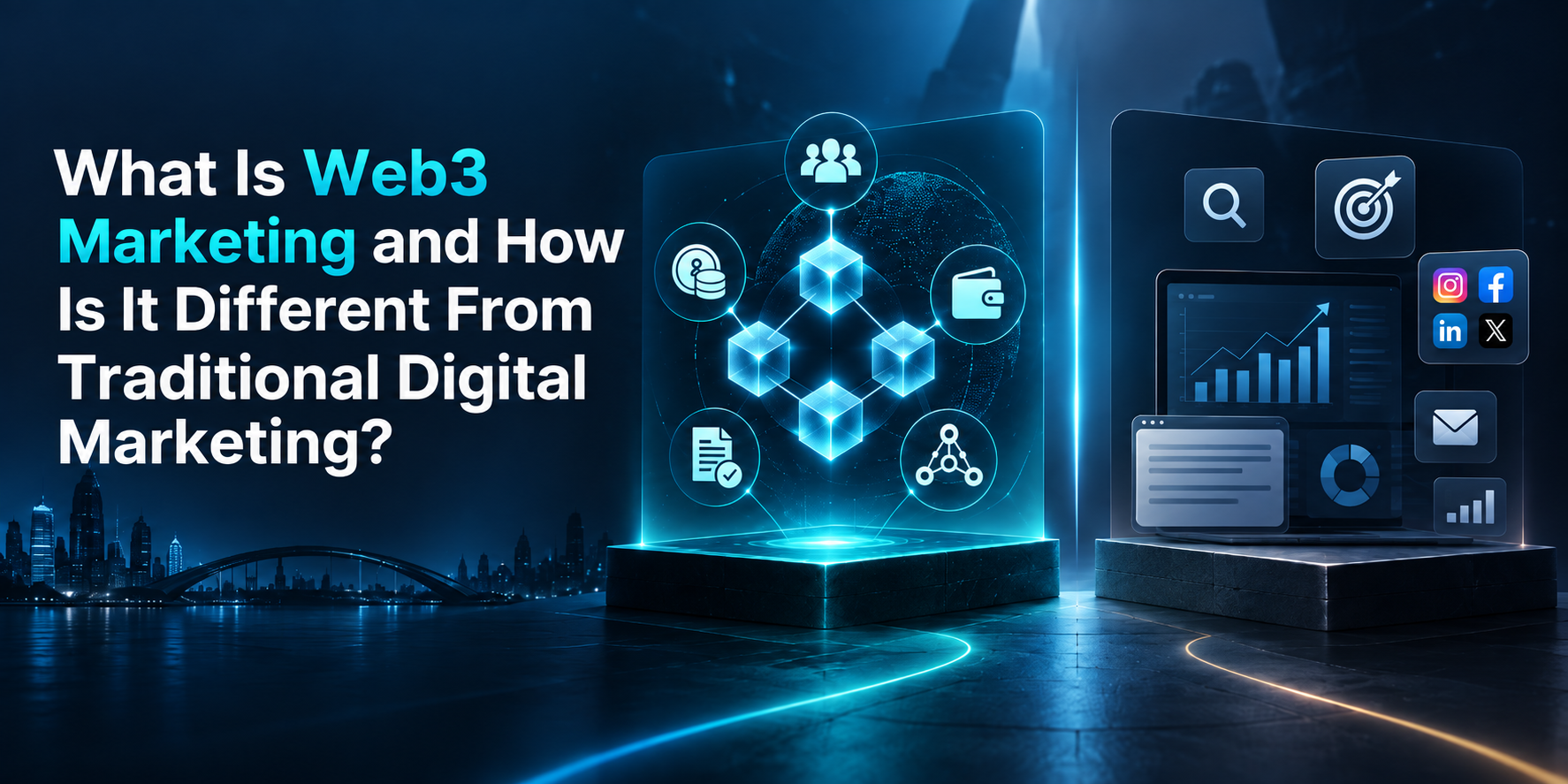
Web3 marketing has emerged as a distinct approach to promoting blockchain-based products, decentralized applications, cryptocurrencies, NFTs, DeFi platforms, DAOs, and other decentralized technologies. Although it uses familiar digital marketing channels such as social media, search engines, content marketing, influencer outreach, email, and paid advertising, its underlying philosophy is different. Web3 marketing is not simply traditional digital marketing applied to a blockchain company. It places greater emphasis on community participation, transparency, user ownership, education, trust, and ecosystem development.
The distinction has become increasingly important as blockchain adoption expands beyond early crypto enthusiasts. Chainalysis ranked India first in its 2025 Global Crypto Adoption Index, followed by the United States, Pakistan, Vietnam, and Brazil. The same research found that APAC crypto activity increased 69% year over year in the 12 months ending June 2025, demonstrating the growing importance of markets where blockchain products are reaching mainstream users.
Understanding the difference between Web3 and traditional digital marketing therefore requires looking beyond individual marketing channels. The real difference lies in how audiences are acquired, how communities are developed, how trust is established, and how users participate in the product ecosystem.
What Is Web3 Marketing?
Web3 marketing is the practice of promoting blockchain-powered products and ecosystems through strategies designed around decentralized technology and its communities. It can include search engine optimization, social media marketing, content marketing, influencer campaigns, community management, public relations, educational campaigns, token-focused campaigns, Discord and Telegram engagement, and ecosystem partnerships.
However, Web3 marketing introduces another dimension: community ownership and participation.
In traditional marketing, the relationship is generally straightforward. A company develops a product, creates advertising campaigns, attracts prospects, converts customers, and measures revenue. The audience primarily consumes the company's marketing messages.
Web3 ecosystems can operate differently. Users may become community members, token holders, governance participants, creators, ambassadors, liquidity providers, NFT collectors, developers, or ecosystem contributors. Consequently, marketing is often not limited to convincing someone to purchase a product. It can involve encouraging people to join, contribute to, use, govern, promote, and grow an ecosystem.
This makes Web3 marketing particularly dependent on trust and credibility. A polished advertisement might generate awareness, but it rarely creates sustainable confidence in a blockchain project. Users may investigate a project's tokenomics, founders, smart contracts, documentation, roadmap, community activity, partnerships, security audits, and on-chain behavior before becoming participants.
How Traditional Digital Marketing Works
Traditional digital marketing is built around established customer-acquisition principles. Businesses identify target audiences, create marketing messages, distribute those messages through appropriate channels, and optimize campaigns according to measurable outcomes.
Search engine optimization, for example, attempts to improve visibility for relevant searches. Paid advertising can place a company directly in front of potential customers. Email marketing nurtures prospects, while social media marketing increases awareness and engagement.
The central objective is usually to move users through a relatively familiar funnel:
Awareness → Interest → Consideration → Conversion → Retention
A software company might publish articles about a problem, rank for relevant Google searches, collect leads, send educational emails, and eventually convert those leads into paying customers.
Web3 marketing can also use this funnel, but the journey is often more complicated. Someone discovering a decentralized application may need to understand blockchain technology, connect a wallet, evaluate transaction fees, research the project's security, understand token utility, join a community, and only then become an active user.
The marketing process therefore frequently resembles:
Awareness → Education → Community → Trust → Participation → Advocacy
That difference is fundamental.
The Biggest Difference: Community Instead of Just Audience
Perhaps the most important distinction between Web3 marketing and traditional digital marketing is the role of community.
Traditional brands certainly build communities, but Web3 projects often make community participation an integral part of the product itself. A DAO, blockchain protocol, NFT ecosystem, or token-based platform may depend heavily on active users who discuss the project, create content, provide feedback, participate in governance, or introduce new users.
This explains why platforms such as X, Telegram, YouTube, Discord, and Reddit can be especially important to Web3 marketers. A 2026 CoinGecko survey found that X, Telegram, and YouTube collectively accounted for 84% of respondents' primary crypto social-media usage, while Discord, Reddit, and other platforms accounted for another 15%.
This environment changes the marketer's role. Instead of simply broadcasting promotional messages, marketers must facilitate conversations, answer questions, explain technical concepts, identify misinformation, gather community feedback, and maintain trust.
A successful Web3 campaign may therefore be measured not only by impressions and clicks but also by community quality, active users, wallet activity, developer participation, retention, governance engagement, and organic advocacy.
Web3 Marketing Is More Education-Driven
Blockchain products can be difficult for mainstream audiences to understand. Terms such as smart contracts, liquidity pools, staking, tokenomics, Layer 2 networks, decentralized governance, wallets, bridges, and zero-knowledge proofs can create significant barriers to adoption.
Consequently, education is often one of the most valuable forms of Web3 marketing.
Instead of publishing content that simply says a project is "innovative," an effective campaign explains what the technology actually does and why it matters. For example, a DeFi platform might create educational content explaining how decentralized lending works, what risks users should understand, how collateralization operates, and how the protocol differs from conventional lending.
This approach builds credibility because it gives users information they can use to make informed decisions.
Token Incentives Change the Marketing Model
Another major difference is the potential use of tokens as incentives.
Traditional companies generally use discounts, loyalty points, referral programs, or rewards to encourage customer behavior. Web3 projects may introduce token-based incentives that give users economic exposure to an ecosystem.
For example, a blockchain project might reward contributors for completing educational activities, referring users, creating content, participating in governance, or providing other forms of ecosystem support. However, token incentives also create significant risks.
Poorly designed incentives can attract short-term speculators rather than genuine users. A campaign may produce impressive wallet numbers while generating little long-term product usage. This is why sustainable Web3 marketing should focus on utility and user value rather than simply maximizing token-related attention.
The objective should be to attract people who have a genuine reason to remain part of the ecosystem after promotional incentives decline.
Paid Advertising Is More Complicated in Web3
Traditional digital marketing has extensive access to paid advertising platforms, but cryptocurrency marketing faces additional restrictions.
Google's current cryptocurrency advertising policy allows certain blockchain-related businesses to advertise while placing restrictions or certification requirements on other categories. For example, Google's policy states that some cryptocurrency exchanges and wallets require certification, while certain categories such as ICOs, IDOs, DeFi trading protocols, and cryptocurrency trading promotions are prohibited under its cryptocurrency advertising rules.
These restrictions mean Web3 marketers cannot simply copy the paid-media strategy of an ordinary SaaS company.
Instead, projects often need a broader marketing mix involving:
- Search engine optimization
- Educational content
- Community marketing
- Influencer and KOL campaigns
- PR and thought leadership
- X and Telegram campaigns
- Discord community development
- Partnerships
- Referral programs
- Ecosystem collaborations
- Developer-focused marketing
This makes organic credibility particularly valuable.
Trust Is More Important in Web3
Trust is important in every industry, but it carries unusual weight in Blockchain Marketing Services because users may be dealing with irreversible transactions and digital assets.
A conventional ecommerce customer may return a product or contact customer support after a problem. A cryptocurrency user who sends assets to the wrong address may not have the same recovery options.
Therefore, Web3 marketing needs to demonstrate credibility through substance rather than hype.
Projects can strengthen trust by providing transparent documentation, explaining token economics clearly, publishing security audits where applicable, introducing the team, communicating risks responsibly, maintaining active development, and providing verifiable information about partnerships and product functionality.
This is also why exaggerated claims can be particularly damaging. Promising guaranteed returns, artificially emphasizing token price predictions, or presenting speculative assets as risk-free may create short-term attention but can undermine long-term reputation.
Traditional Digital Marketing vs. Web3 Marketing
| Aspect | Traditional Digital Marketing | Web3 Marketing |
|---|---|---|
| Primary focus | Customer acquisition | Community and ecosystem growth |
| Audience | Customers and prospects | Users, holders, contributors and communities |
| Main objective | Leads, sales and retention | Adoption, participation, trust and ecosystem growth |
| Content | Product and industry education | Product education plus blockchain literacy |
| Community | Valuable but often secondary | Often central to the project |
| Incentives | Discounts, loyalty programs | Potential token or ecosystem incentives |
| Advertising | Broad paid-media options | Greater regulatory and platform restrictions |
| Trust | Brand reputation and reviews | Transparency, technology, community and on-chain credibility |
| Measurement | CTR, leads, conversions, CAC, revenue | Users, wallets, retention, community activity, transactions and ecosystem participation |
The table illustrates why a conventional marketing playbook cannot simply be copied into a Web3 environment.
Real-World Example: Marketing a Tokenization Platform
Consider a company developing a real-world asset tokenization platform.
A traditional digital marketing campaign might emphasize its software capabilities, publish SEO articles, run LinkedIn campaigns, collect leads, and use email marketing to nurture prospective clients.
A Web3-oriented strategy would still use these methods but could expand the campaign around education and ecosystem development. The company could publish detailed guides explaining asset tokenization, create educational videos about fractional ownership, host community discussions about regulatory considerations, collaborate with blockchain developers, participate in industry conversations, and build relationships with investors and ecosystem partners.
The objective is not simply to generate website traffic. It is to establish the company as a credible participant in a developing technological ecosystem.
That distinction is particularly important for emerging areas such as real-world asset tokenization, where prospective users may need substantial education before they understand the technology's commercial implications.
How Businesses Can Build an Effective Web3 Marketing Strategy
An effective Web3 marketing strategy should begin with the product rather than promotional channels.
First, the project needs to clearly define its value proposition. What problem does the blockchain solution solve? Why does blockchain make the solution better? Who actually needs it?
Second, marketers should identify the project's real audience. A DeFi protocol, NFT marketplace, blockchain infrastructure company, gaming ecosystem, and RWA platform require completely different communication strategies.
Third, educational content should become a long-term foundation. Instead of chasing every trending cryptocurrency topic, brands should build authoritative resources around questions that potential users genuinely need answered.
Fourth, community channels should be managed as ongoing relationship-building environments rather than promotional distribution lists. A Telegram or Discord group filled exclusively with announcements is unlikely to develop meaningful engagement.
Finally, marketers should establish measurable KPIs. These can include organic traffic, qualified leads, community retention, active users, developer participation, referral activity, product usage, and conversion rates. Vanity metrics such as follower counts should not become the primary measure of success.
The Future of Web3 Marketing
The future of Web3 marketing is likely to become increasingly sophisticated as blockchain moves from speculative narratives toward practical applications.
The growth of stablecoins, tokenized assets, decentralized infrastructure, blockchain gaming, digital identity, and institutional blockchain applications will create audiences that care less about cryptocurrency hype and more about utility.
At the same time, regulatory requirements will continue influencing how blockchain companies communicate and advertise. Google's ongoing updates demonstrate how quickly the advertising environment can change. In August 2026, for example, Google expanded certain cryptocurrency advertising permissions to Iceland, Liechtenstein, and Norway under specific licensing, MiCA, local-law, and certification requirements.
This environment favors marketers who combine technical understanding, compliance awareness, SEO expertise, community management, storytelling, and data-driven optimization.
The strongest Web3 brands will therefore not necessarily be those that produce the loudest promotional campaigns. They will be the projects that explain their technology clearly, demonstrate genuine utility, communicate transparently, and create communities where users have a meaningful reason to participate.
Conclusion
Web3 marketing is best understood as an evolution of digital marketing shaped by decentralization, tokenized ecosystems, community ownership, and blockchain-based products. While it shares channels such as SEO, social media, content marketing, PR, and paid advertising with traditional digital marketing, its emphasis on education, transparency, community participation, and ecosystem growth makes it fundamentally different. Businesses entering Web3 need more than promotional visibility; they need credibility and long-term community trust. Blockchain App Factory provides best services for businesses seeking strategic blockchain and Web3 marketing solutions, helping projects build visibility, engage relevant audiences, and establish stronger digital ecosystems.
FAQs
1. What is Web3 marketing?
Web3 marketing is the promotion of blockchain-based products and ecosystems through strategies focused on education, community engagement, decentralization, and user participation.
2. How is Web3 marketing different from digital marketing?
Traditional digital marketing primarily focuses on customer acquisition and conversion, while Web3 marketing places greater emphasis on community building, ecosystem participation, transparency, and long-term engagement.
3. Which platforms are important for Web3 marketing?
X, Telegram, YouTube, Discord, Reddit, search engines, and specialized blockchain communities are commonly important channels. Their relevance depends on the project's target audience.
4. Is SEO useful for Web3 companies?
Yes. SEO can help Web3 companies attract users who are actively researching blockchain concepts, products, services, and solutions. Educational content is particularly valuable for building organic visibility and authority.
5. Why is community important in Web3 marketing?
Community can directly influence adoption, product feedback, advocacy, governance, and ecosystem growth. For many decentralized projects, an active community is an important part of the product's long-term success.

 English
 Arabic
 French
 Spanish
 Portuguese
 Deutsch
 Turkish
 Italiano
 Russian
 Romaian
 Portuguese (Brazil)
 Greek
Greek