


How to Manage Complex Subscription Pricing and Billing Scenarios
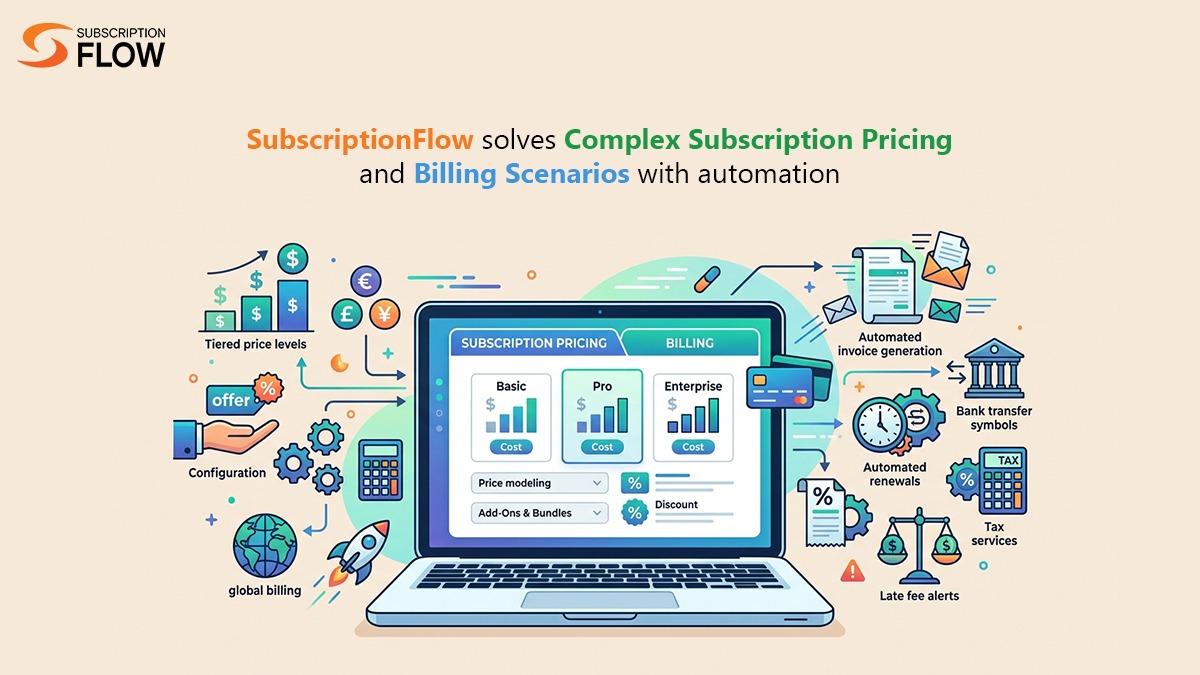
Subscription businesses rarely begin with complicated pricing structures. Most companies start with a single plan, a straightforward billing cycle, and a limited number of customers. As the business grows, however, new pricing models, product tiers, add-ons, discounts, usage-based charges, and international customers are introduced. Over time, billing becomes significantly more complicated.
This complexity can create serious operational challenges. Manual billing processes become difficult to maintain, invoices may contain errors, revenue can leak through missed charges or incorrect calculations, and customers may lose trust when their invoices are difficult to understand. The solution is not to avoid flexible pricing but to establish clear billing rules and use automation to manage them consistently.
Understanding What Makes Subscription Pricing Complex
Subscription pricing is fundamentally different from one-time purchasing because the commercial relationship continues over time. A customer may change plans, increase usage, add products, receive a promotion, change payment methods, or move to another billing cycle during their subscription.
Several factors contribute to billing complexity, including multiple pricing models, mid-cycle upgrades and downgrades, prorated charges, promotional pricing, recurring payment failures, multiple subscriptions, international currencies, tax requirements, and revenue recognition. These factors can also overlap. For example, a customer might have an annual discounted subscription, usage-based charges, additional seats, and a mid-cycle upgrade—all of which must be reflected correctly on the same invoice.
Common Subscription Pricing Models
Businesses typically use several pricing structures to monetize their products and services. Flat-rate pricing is the simplest approach because customers pay a fixed amount regardless of usage. Tiered pricing offers different packages based on features, limits, or customer requirements. Per-user or per-seat pricing adjusts the subscription cost according to the number of users or licenses.
Usage-based pricing charges customers according to consumption, such as API calls, transactions, storage, or minutes used. Hybrid pricing combines multiple approaches, such as a recurring base fee with usage charges, additional seats, or optional features. As companies mature, hybrid models often become increasingly attractive because they provide predictable recurring revenue while allowing businesses to monetize additional customer usage.
Managing Usage-Based and Hybrid Pricing
Usage-based pricing can align the customer's cost with the value they receive, but it requires accurate usage tracking and billing infrastructure. Every usage event needs to be attributed to the correct customer and billing period. The system must also understand allowances, thresholds, overages, and pricing rules.
Hybrid pricing introduces another layer of complexity because a single invoice may contain a recurring subscription charge, usage-based fees, add-ons, discounts, and taxes. Customers also increasingly expect visibility into their usage before receiving an invoice. Providing real-time or near-real-time usage information can reduce billing disputes and give customers greater confidence in variable charges.
Automated subscription billing platforms can help businesses manage these processes by collecting usage data, applying pricing rules, calculating charges, and generating invoices without requiring finance teams to perform repetitive calculations manually.
Handling Promotional Pricing and Discounts
Promotional pricing is an important acquisition and retention strategy, but discounts can become a significant source of billing errors when they are managed manually. Businesses may offer introductory rates, time-limited promotions, volume discounts, percentage-based discounts, fixed-amount discounts, referral incentives, or loyalty rewards.
Time-bound promotions require accurate start and expiration dates. Volume discounts need clearly defined thresholds and pricing rules. Stacked promotions require the billing system to understand which discounts can be combined and in what order they should be applied.
The most effective approach is to establish discount rules centrally and automate their application. This ensures that promotions are applied consistently across customers and automatically expire or convert to standard pricing when the promotional period ends.
Managing Upgrades, Downgrades, and Proration
Customers frequently change their subscriptions. They may upgrade because they need additional features or capacity, downgrade because their requirements have changed, or add new users during an existing billing period. These changes create the need for accurate proration.
When a customer changes plans in the middle of a billing cycle, the billing system needs to determine the unused value of the existing subscription and calculate the appropriate charge or credit for the new plan. Depending on the company's policy, the adjustment may be charged immediately or included on the next invoice.
Clear proration policies are essential. Businesses should determine in advance how upgrades, downgrades, seat changes, and billing-cycle changes will be handled. Automating these calculations helps prevent both customer overcharges and revenue leakage.
Structuring Trials and Introductory Pricing
Free trials and introductory offers can reduce the barrier to acquiring new customers. However, they introduce additional billing events that need to be handled correctly. A subscription platform must know when a trial begins, when it ends, and what happens after conversion.
Businesses may offer trials with or without requiring a payment method. They may also provide discounted pricing for the first few billing cycles before automatically moving customers to the standard rate. Trial extensions may also be necessary when sales or support teams want to give customers additional time to evaluate a product.
These rules should be configured in advance so that trial conversions and introductory pricing occur automatically without requiring manual intervention.
Managing Multiple Subscriptions and Add-Ons
Many businesses eventually move beyond selling a single subscription. Customers may purchase a core product, additional modules, premium features, extra seats, or separate subscriptions under the same account.
This creates the need for consolidated invoicing, independent billing cycles, bundle pricing, and relationships between products. For example, cancelling a core subscription may also require dependent add-ons to be cancelled or adjusted.
Centralizing subscription relationships within one billing system allows businesses to maintain a clear view of what each customer owns, what they are being charged for, and when each item renews.
Handling Multi-Currency, Localization, and Taxes
International expansion adds another layer of complexity to subscription billing. Businesses may need to support different currencies, payment methods, tax regulations, invoice requirements, and regional pricing strategies.
VAT, GST, and sales tax rules can vary by jurisdiction and sometimes by product category. Companies also need to determine how currency conversion should be handled and how international revenue will be reported in their base currency.
Automating tax calculations and supporting multiple currencies can significantly reduce the administrative burden associated with global subscription operations. Businesses should consider international requirements early rather than waiting until global expansion makes their existing billing infrastructure difficult to adapt.
Managing Failed Payments and Dunning
Failed payments are an unavoidable part of recurring revenue businesses. Cards expire, payment methods are declined, customers reach account limits, and financial institutions reject transactions for various reasons.
A structured payment recovery process can reduce involuntary churn. Automated retry schedules can attempt payment again at appropriate intervals, while dunning communications can notify customers when their payment requires attention. Grace periods can also provide customers with time to resolve payment issues without immediately losing access.
Businesses should track involuntary churn separately from voluntary cancellations. This distinction helps teams understand how much revenue is being lost because of payment failures rather than customer dissatisfaction with the product.
Handling Invoices, Credits, Refunds, and Adjustments
Even highly automated billing systems need to accommodate exceptions. Customers may request refunds, receive credits after service disruptions, or require billing adjustments because of unique contractual arrangements.
Accurate, itemized invoices should clearly show subscription charges, usage fees, discounts, taxes, credits, and other adjustments. Credit notes can be used to correct specific billing issues without unnecessarily reversing an entire invoice.
Manual adjustments may still be necessary in certain situations, but they should be controlled, documented, and auditable. A centralized billing system can help finance and support teams manage these exceptions while maintaining accurate financial records.
Decoupling Billing From Core Product Logic
One important principle for managing complex subscription pricing is separating billing logic from the core product application. When pricing rules are hardcoded directly into a product, every pricing change can require engineering work and a software deployment.
Pricing often changes more frequently than the underlying product. Businesses may introduce new plans, modify usage rates, create promotional offers, or develop new bundles. A dedicated billing engine allows these rules to be managed independently while receiving the necessary usage and subscription events from the product.
This approach gives finance, operations, and revenue teams greater flexibility while reducing the engineering effort required to make routine pricing changes.
Building Reliable Usage Metering
For businesses using consumption-based pricing, accurate metering is essential. Every usage event should be uniquely identifiable so that duplicate events do not result in duplicate charges. The billing system should also have rules for aggregating usage over specific periods.
For example, usage may be calculated by total consumption, maximum usage, number of unique events, or another defined measurement. Businesses also need policies for handling late-arriving usage data, particularly when an event arrives after an invoice has already been generated.
A reliable usage infrastructure therefore needs more than simple data collection. It needs clear rules for event identification, aggregation, billing periods, corrections, and exceptions.
Automating Proration and Co-Terming
Enterprise customers often make changes during an active contract. They may add seats, purchase additional products, or change service levels before the existing contract ends.
Automated proration ensures that customers are charged accurately for the remaining portion of their billing period. Co-terming can then align additional products or seats with the customer's existing renewal date.
This creates a cleaner customer experience because customers can receive fewer invoices and avoid managing multiple renewal dates.
Supporting Revenue Recognition
Billing and revenue recognition are related but not identical processes. Sending an invoice or collecting cash does not necessarily mean that the entire amount can immediately be recognized as revenue.
For subscription businesses, revenue may need to be recognized over the period in which the service is delivered. This becomes particularly important when contracts contain multiple components, such as setup fees, annual subscriptions, prepaid services, and usage-based charges.
Businesses should therefore ensure that their billing and accounting processes can distinguish between invoiced amounts, collected cash, deferred revenue, and earned revenue. Supporting accounting requirements such as ASC 606 and IFRS 15 can help businesses maintain more accurate financial reporting.
Best Practices for Complex Subscription Billing
The most effective subscription businesses establish billing policies before problems occur. They define how proration, refunds, discounts, failed payments, upgrades, downgrades, and billing exceptions will be handled.
Billing logic should also be centralized rather than scattered across spreadsheets, custom application code, and payment processor configurations. Automation should be used wherever repetitive calculations or processes are involved.
Customer transparency is equally important. Giving customers visibility into their subscriptions, usage, upcoming invoices, and billing changes can reduce disputes and improve trust.
Finally, businesses should regularly audit billing data. Reviewing invoices, pricing rules, discounts, taxes, and payment recovery processes can help identify errors before they become significant revenue or customer-experience problems.
The Future of Complex Subscription Billing
Subscription pricing will continue to become more flexible as businesses look for new ways to monetize their products. Usage-based pricing, hybrid models, personalized offers, product bundles, and global subscriptions can create significant revenue opportunities, but they also require sophisticated billing infrastructure.
The key is not to eliminate complexity but to manage it systematically. Clear pricing policies, centralized billing logic, reliable usage metering, automated proration, intelligent payment recovery, and transparent invoicing can help businesses scale without allowing billing complexity to become an operational bottleneck.
Platforms such as SubscriptionFlow are designed to help subscription businesses manage these scenarios through centralized subscription management, automated billing, usage-based pricing, invoicing, payment recovery, and revenue management. By automating complex billing processes, businesses can spend less time resolving billing issues and more time developing products, acquiring customers, and creating new revenue opportunities.
Conclusion
Complex subscription billing does not have to result in complex operations. The right combination of clear policies, centralized billing rules, automation, accurate usage tracking, and transparent customer communication can make even sophisticated subscription models manageable.
As subscription businesses introduce more pricing options and expand into new markets, investing in scalable billing infrastructure becomes increasingly important. A well-designed subscription billing system not only reduces errors and revenue leakage but also creates a foundation for sustainable growth.

 English
 Arabic
 French
 Spanish
 Portuguese
 Deutsch
 Turkish
 Dutch
Dutch
 Italiano
 Russian
 Romaian
 Portuguese (Brazil)