


Glyoxal Market Growth Finds Support in Textiles, Paper, and Specialty Chemicals
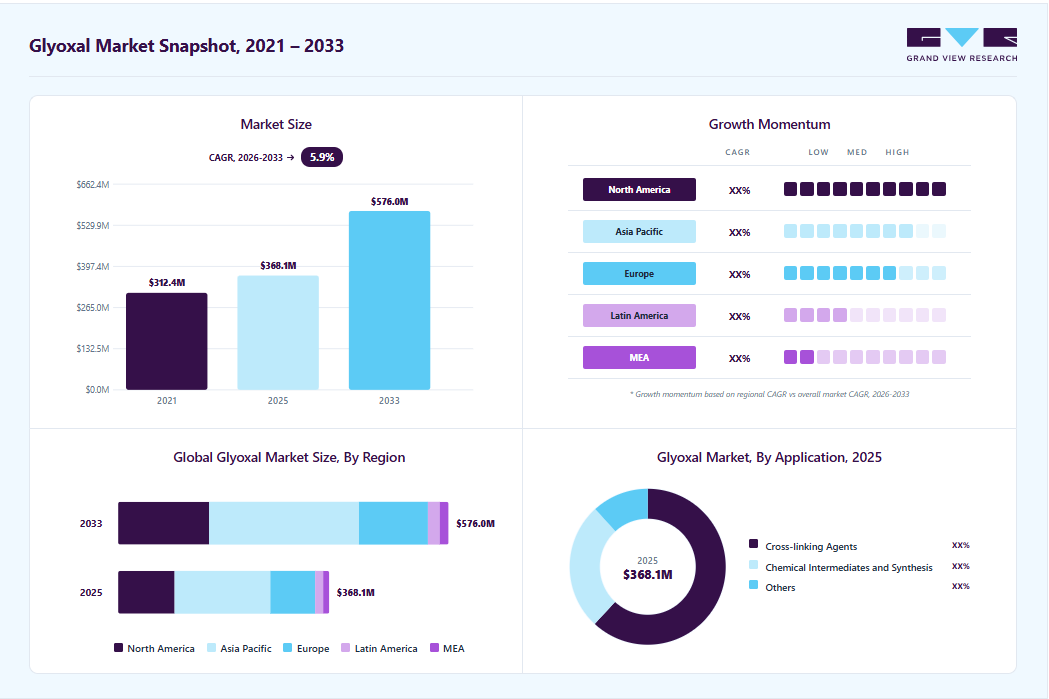
The glyoxal market is gaining steady momentum as demand increases across textile finishing, paper processing, resin systems, construction chemicals, and specialty chemical applications. The market was valued at USD 368.1 million in 2025 and is projected to grow from USD 384.9 million in 2026 to USD 576.0 million by 2033, registering a CAGR of 5.9% from 2026 to 2033. Rising demand for low-formaldehyde and sustainable chemical solutions is further supporting market development across industrial end-use sectors.
Market Growth and Demand Dynamics
Glyoxal demand is closely connected to industrial applications that require improved bonding, durability, water resistance, strength, and crease resistance. Its expanding use in construction chemicals and specialty resin systems is creating additional opportunities. Infrastructure investment, renovation activities, and increasing consumption of adhesives, coatings, and cement additives are contributing to consistent demand growth.
The market also presents opportunities through differentiated glyoxal grades designed for high-value applications, including pharmaceuticals, advanced materials, and specialty chemicals. At the same time, growing emphasis on product performance and safety is encouraging manufacturers to optimize processes and develop application-specific solutions.
Cross-Linking Applications Strengthen Market Position
Cross-linking agents represented the leading application segment, accounting for 61.9% of revenue share in 2025. Glyoxal is widely used in textile finishing, paper processing, and resin formulations, where it helps improve strength, durability, and crease resistance. Consistent demand from large-scale industrial applications and the need for cost-effective cross-linking solutions continue to support this segment.
Chemical intermediates and synthesis are also emerging as an important growth area, with the segment expected to expand at a CAGR of 6.3% from 2026 to 2033. Increasing utilization of glyoxal in pharmaceuticals, agrochemicals, and specialty chemical production is supporting this expansion, alongside growing investments in downstream chemical manufacturing.
Liquid Form Continues to Dominate
The liquid form of glyoxal accounted for 84.2% of revenue share in 2025, supported by ease of handling, uniform dispersion, and broad compatibility with textile finishing, paper processing, and resin manufacturing. Its industrial acceptance and suitability for large-scale continuous operations reinforce its leading position.
Meanwhile, solid/powder glyoxal is the fastest-growing form, with a revenue CAGR of 7.0%. Demand is being supported by improved storage stability, lower transportation costs, and precise dosage control. Adoption in specialty chemicals, pharmaceuticals, and export-oriented applications is creating further opportunities for this format.
Textiles Remain a Major End-use Driver
The textile segment held the largest end-use revenue share of 46.5% in 2025. Glyoxal is extensively used in fabric finishing to enhance wrinkle resistance, dimensional stability, and durability. Continued demand from apparel and home textile manufacturing supports the segment's strong position.
The intermediates segment is growing at a projected CAGR of 6.3%, driven by increasing use of glyoxal as a building block in pharmaceuticals, agrochemicals, and specialty chemical synthesis. Expanding downstream manufacturing and rising demand for high-value intermediates are helping create additional growth opportunities.
Regional Market Outlook
Asia Pacific dominated the glyoxal market with a 45.3% revenue share in 2025, supported by strong activity in textiles, chemicals, and construction-related industries. Cost-efficient manufacturing, domestic consumption, industrialization, and investments in downstream chemical production continue to support regional demand.
North America represented 26.7% of the global market in 2025, with demand supported by specialty chemicals, pharmaceuticals, and advanced materials. Europe is seeing continued demand as environmental regulations and low-emission chemical solutions encourage sustainable manufacturing and innovation.
Competitive Landscape and Market Outlook
The glyoxal industry has a moderately concentrated structure, combining large multinational chemical manufacturers with regional producers. Established companies benefit from integrated production capabilities, customer relationships, and economies of scale, while smaller manufacturers compete through pricing and regional availability.
FAQ
Which segment leads the glyoxal market?
Cross-linking agents led the application segment with a 61.9% revenue share in 2025, while liquid glyoxal led by form with an 84.2% revenue share. The textile segment held the largest end-use share at 46.5%.
What trends are shaping the glyoxal market?
Demand is being shaped by textile finishing, paper processing, resin applications, construction chemicals, specialty chemical synthesis, and increasing preference for low-formaldehyde and sustainable chemical solutions. Application-specific grades and high-value chemical intermediates are also creating new opportunities.
Key Glyoxal Companies:
· BASF SE
· Eastman Chemical Company
· Dow
· INEOS AG
About us:
Grand View Research, a market research and consulting company, provides syndicated research reports, customized research reports, and consulting services. Grand View Research database is used by the world's renowned academic institutions and Fortune 500 companies to understand the global and regional business environment. Our database features thousands of statistics and in-depth analysis on 46 industries in 25 major countries worldwide.

 English
 Arabic
 French
 Spanish
 Portuguese
 Deutsch
 Turkish
 Dutch
Dutch
 Italiano
 Russian
 Romaian
 Greek
Greek