


Why Is Intermediate Accounting Considered a Weed-Out Course in US Business Schools?
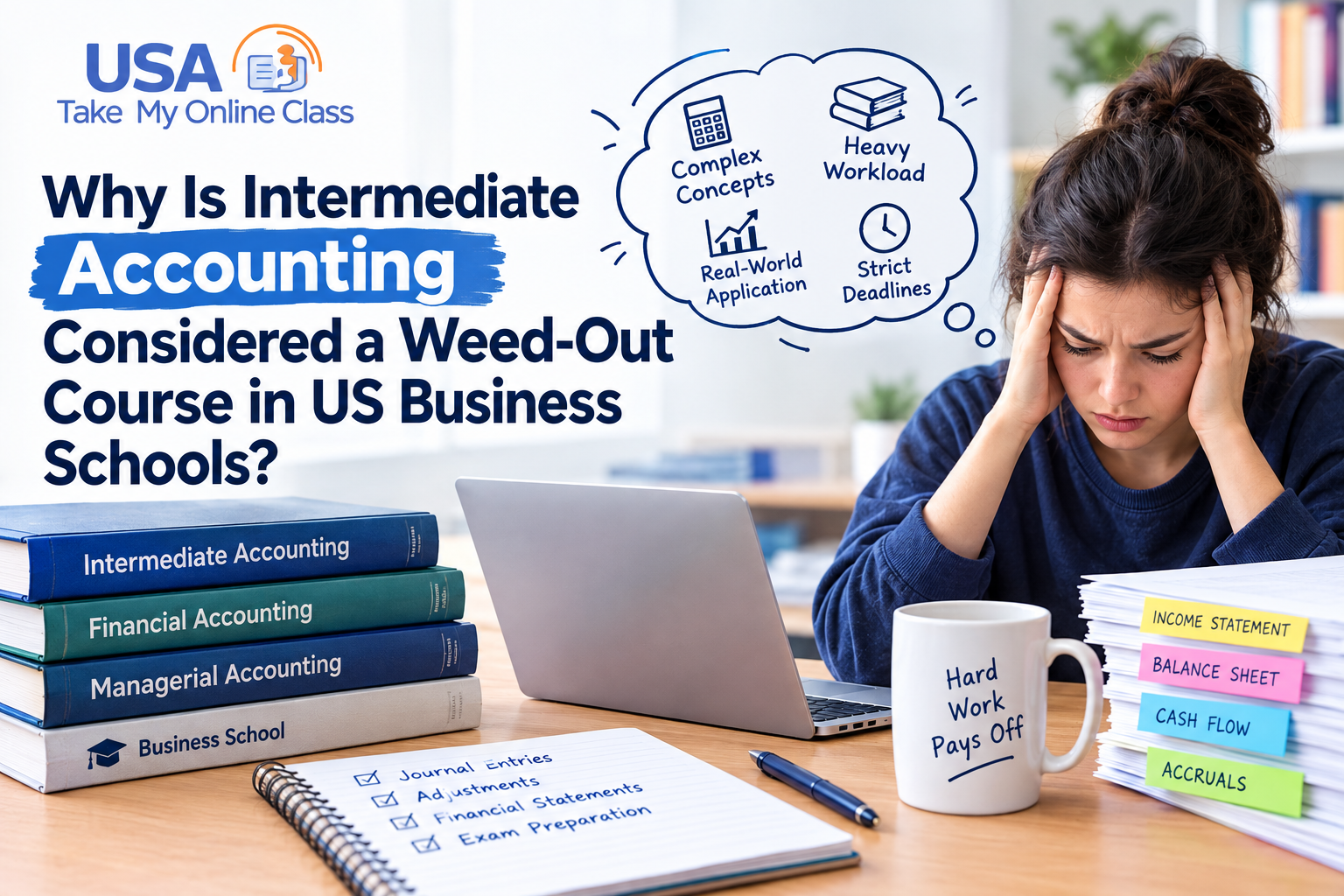
For business students across the United States, transitioning from introductory accounting to Intermediate Accounting feels less like a step up and more like hitting a brick wall. While introductory courses focus on basic bookkeeping mechanics, Intermediate I and II plunge into the rigorous, judgment-heavy realities of Financial Accounting Standards Board (FASB) guidelines and US GAAP compliance.
Universities frequently design this sequence as an intentional gateway. Intermediate Accounting is widely recognized as the primary "weed-out" course in US business schools because it shifts the curriculum from basic computation to abstract problem-solving, testing whether students possess the technical precision, analytical discipline, and stamina required for upper-level finance majors, accounting degrees, and the CPA exam.
Direct Answer: What Makes Intermediate Accounting a Gateway Course?
Intermediate Accounting functions as a weed-out course because of its massive jump in conceptual complexity, relentless volume of material, and strict grading parameters. While introductory accounting teaches students how to record standard transactions, Intermediate Accounting forces students to analyze why complex transactions are structured under specific accounting standards, requiring multi-step mathematical modeling and deep critical thinking.
Business programs utilize this curriculum to ensure that only students capable of handling the rigorous quantitative demands of professional accounting advance into specialized tracks like Advanced Financial Accounting, Auditing, and Corporate Taxation.
4 Core Reasons Intermediate Accounting Challenges Students
┌────────────────────────────────────────────────────────┐
│             Key Intermediate Accounting Hurdles        │
└───────────────────────────┬────────────────────────────┘
                            │
        ┌───────────────────┼───────────────────┐
        ▼                   ▼                   ▼
┌──────────────┐    ┌──────────────┐    ┌──────────────┐
│ Conceptual   │    │ Complex GAAP │    │ Multi-Step   │
│ Shift        │    │ Frameworks   │    │ Dependencies │
└──────────────┘    └──────────────┘    └──────────────┘
1. The Shift from Rules to Subjective Judgment
In Principles of Accounting, problems typically have one straightforward answer: cash increases, inventory decreases, or revenues are credited. Intermediate Accounting introduces subjectivity under US GAAP.
Students must apply multi-step frameworks, such as the five-step revenue recognition model under ASC 606 or lease accounting classifications under ASC 842. Determining whether a contract contains performance obligations or calculating the present value of right-of-use asset liabilities requires qualitative interpretation alongside quantitative precision.
2. Complex Accounting Topics and Calculations
The sheer breadth of technical topics covered in Intermediate I and II can easily overwhelm underprepared students. Core modules include:
-
Time Value of Money (TVM): Calculating present and future values for complex long-term debt instruments, bonds payable, and lease schedules.
-
Dilutive Securities and Earnings Per Share (EPS): Computing basic vs. diluted EPS accounting for convertible bonds, stock options, and warrants.
-
Deferred Income Taxes: Tracking temporary vs. permanent book-tax differences to calculate Deferred Tax Assets (DTAs) and Deferred Tax Liabilities (DTLs).
-
Statement of Cash Flows: Reconciling net income to cash generated from operating activities using the indirect method, adjusting for non-cash expenses and working capital shifts.
3. Automated Software Grading and Zero Tolerance for Errors
Modern US university business programs rely heavily on automated learning platforms like WileyPLUS, McGraw-Hill Connect, and Cengage. These platforms enforce strict algorithmic grading:
-
Syntax and Formatting Precision: Misplacing a debit balance, hardcoding a calculation instead of entering dynamic variables, or omitting required line items results in immediate automated rejections.
-
Cascading Errors: In multi-step financial statement problems, an error in an initial journal entry propagates through the general ledger, trial balance, and final financial statements, resulting in cumulative point deductions.
4. High Volume and Fast Pace
The volume of reading and practice sets expected weekly leaves little room for passive learning. Mastering topic areas requires hours of manual T-account analysis, ledger balancing, and solving quantitative practice problems daily. Students who rely on last-minute exam cramming frequently fail because accounting principles build cumulatively—falling behind on bond amortization in Week 4 makes understanding pension accounting in Week 8 nearly impossible.
Key Strategies to Pass Intermediate Accounting
Surviving Intermediate Accounting requires shifting from passive reading to active, structured problem-solving:
-
Master the Underlying Accounting Equation: Before entering complex journal entries, verify how every transaction impacts the primary accounting balance:
-
Work Practice Problems Daily: Quantitative accounting concepts are retained through physical practice, not textbook scanning. Dedicate 45 to 60 minutes daily to working through unassigned exercises in WileyPLUS or Connect.
-
Use T-Accounts for Multi-Step Transactions: When tracking complex adjustments, sketch T-accounts manually to trace debits and credits across intercompany accounts before entering final balances into your portal.
Navigating Demanding Business Coursework
Balancing a weed-out course like Intermediate Accounting alongside full-time jobs, internships, or other demanding business modules requires consistent preparation and effective time management. When overlapping midterms or complex automated spreadsheet projects create academic stress, having access to structured guidance helps students stay on schedule.
When academic schedules become overwhelming, utilizing professional coursework support can help students manage weekly modules and navigate challenging software platforms effectively. For university students seeking comprehensive coursework guidance, options like Take My Online Accounting Class offer expert assignment assistance, module management, and dedicated support tailored to complex business curricula.
Conclusion & Key Takeaways
Intermediate Accounting serves as a vital gateway in US business education, separating casual business students from dedicated accounting professionals. By understanding the conceptual jump, practicing quantitative problems daily, and utilizing structured support when needed, students can conquer this notorious weed-out class and build a strong foundation for a successful career in business and finance.

 English
 Arabic
 French
 Spanish
 Portuguese
 Deutsch
 Turkish
 Dutch
Dutch
 Russian
 Romaian
 Portuguese (Brazil)
 Greek
Greek