


Generative Design vs Human Design: Why a Digital Marketing Agency Still Needs Both
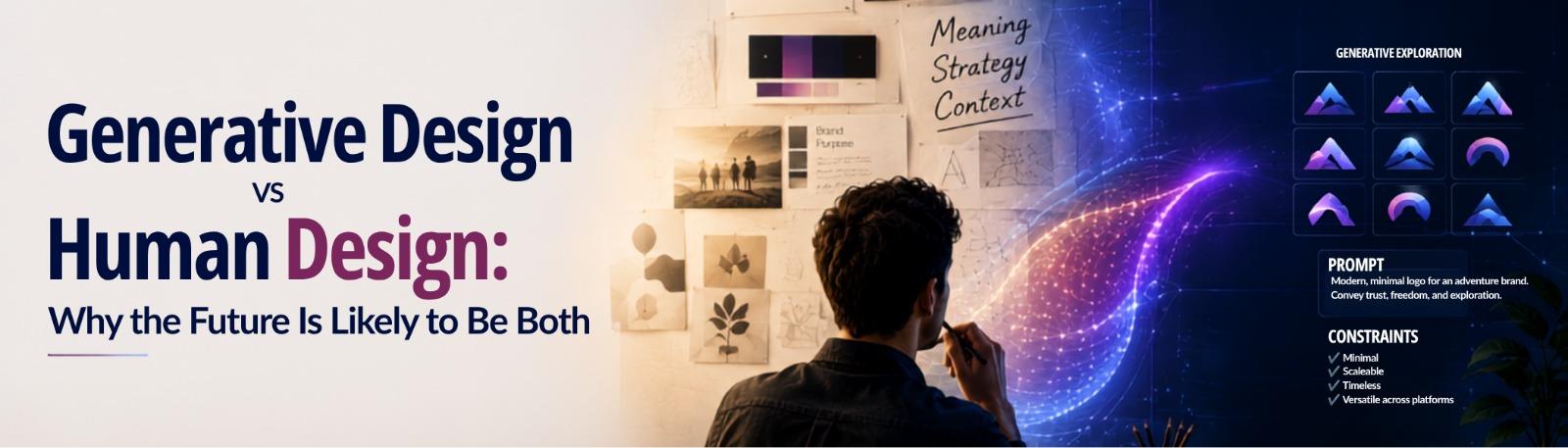
A Digital Marketing Agency working with brand teams today is watching the cost of creating an idea fall close to zero. A designer can now explore hundreds of layouts, test visual directions in minutes and turn a rough prompt into a polished concept almost instantly. Once that becomes normal, creativity itself starts to change shape.
That is both the promise and the provocation behind generative design.
Artificial intelligence is reshaping design by producing possibilities at a speed no human team could match alone. Yet the more machines generate, optimise and refine visual output, one thing becomes clearer with every new tool. The future isn't shaping up as humans against machines. It looks more like a partnership, where AI widens the creative playground and people decide which ideas actually deserve to exist.
When abundance changes what design is worth
Technology has always reshaped design tools. Computers replaced drawing boards, software replaced manual production, and digital platforms sped up how fast ideas could move. Still, the core creative questions stayed stubbornly human. What should we make? Who is it for? Why should it exist at all?
Generative design changes the economics behind answering those questions.
Using algorithms and AI, designers can set objectives and constraints, then let the system generate solutions from there. Instead of producing every variation by hand, they set direction, review alternatives and refine what comes back. AI becomes the engine for exploration. Human judgement stays responsible for the final call.
That opens up real creative territory. Generative AI can, in effect, democratise design. Concepts, compositions, styles and visual directions that once needed serious time and budget can now come together in minutes, which means smaller businesses and independent founders get to experiment with things that used to sit well out of reach.
But abundance raises an obvious question. If everyone can create something, what actually makes a creation worth paying attention to?
Once attractive images can be generated on demand, visual polish stops being much of a differentiator on its own. The value shifts toward ideas, originality, taste, context and how well something communicates. In other words, as variation gets cheaper, meaning gets harder to find, and therefore more valuable.
Why human judgement still carries the work
AI is genuinely good at spotting patterns, generating options and optimising against a set of parameters. Design, though, is rarely just an optimisation problem. Creative decisions lean on intuition, emotion, cultural understanding and context, which is exactly where a human designer earns their place, recognising when a technically flawless solution simply feels wrong, or pushing back on a brief instead of accepting it at face value.
People live inside the cultures and communities that give creative work its meaning in the first place. They carry lived experience and social nuance that doesn't reduce neatly to optimisation parameters, no matter how good the model gets. So the designer's role is likely to evolve rather than vanish. Designers may end up spending less time producing individual assets and more time working as strategists, curators, creative directors and storytellers.
There's a useful parallel from history here too. The printing press cut the cost of producing books, which pushed the value toward ideas and compelling narratives rather than the physical object itself. Generative design could trigger something similar. Once attractive logos, layouts and images become cheap to produce, the visual sign itself stops being scarce. What stays scarce is the meaning people attach to it.
Take a logo as an example. AI can produce one in seconds. But a logo becomes powerful because of everything people come to associate with it over time, a company's values, its reputation, its products, the experiences customers have had with it. Generative tools can create the symbol. They cannot manufacture the years of meaning that eventually make that symbol memorable. So in the age of generative design, the sign itself may matter less, while the meaning behind it matters considerably more.
This same shift reshapes brand identity work. Traditional brand systems lean on a defined set of assets, logos, colours, typography, imagery and templates, held together tightly. Generative tools, by contrast, can produce dynamic identities that adapt across platforms and audiences while still holding onto a strategic core. But that extra flexibility makes brand strategy more important, not less.
If a brand can now generate near-infinite visual expressions, it needs stronger principles guiding what all of them should communicate. The question stops being "what does our brand look like" and becomes "what should every single expression make people feel, understand or remember." Strong brands will end up using generative design for flexibility without giving up recognition along the way.
A different kind of creative workflow
The future creative process is likely to look something like this: human intent leads to AI exploration, which moves into human judgement, then AI refinement, and finally back to human authorship.
That sequence points to something important. AI can produce possibilities, but creativity has never just been about output. It's about connecting ideas that don't obviously belong together, understanding cultural context, questioning convention and spotting an opportunity that was never explicitly stated in the brief. Generative systems expand what's possible. Humans still decide what has relevance and meaning. So the designer of the future probably won't be the person who can generate the most concepts. It'll more likely be the person who knows which concept genuinely deserves to exist.
Where corporate communications and public relations come in
For brands, adopting generative design isn't simply a matter of learning new AI tools. The harder challenge is turning AI-generated creativity into a coherent brand narrative that actually means something.
This is where corporate communications and public relations expertise starts to matter. A firm combining brand strategy, content, creative communication, digital storytelling and reputation management under one roof can help a brand identify which narratives to own, then carry them consistently across every platform.
Generative tools speed up visual production. Strategic communication is what decides what those visuals actually mean once they're out in the world. That requires real creative guardrails: a defined brand voice, a clear sense of audience and cultural context, distinctive narratives, and human oversight to keep AI-generated content aligned with the larger story a brand is trying to tell.
The goal, ultimately, should be more ambitious creativity that stays authentic, consistent and worth remembering.
The future runs on collaboration, not competition
Generative design could end up as transformative as software and personal computers were in the 1980s, and possibly as significant as the printing press once was. Its biggest impact may not even be that machines can create. It may simply be that humans can now explore far more possibilities, far faster, than before. As creative variation gets cheaper, surface-level variation loses value fast. Ideas, narratives, originality, cultural intelligence, taste and purpose become the things that actually set work apart.
The creative process is about to move faster and get more experimental. Designers will have more options, brands more ways to express themselves, and audiences more content landing in front of them. So the real creative question gets simpler, not harder. It won't be whether AI can create something. It'll be whether humans still have something worth saying.
Looking for a communication partner built for this shift?
As AI reshapes how people discover information, the organisations that stay visible will be the ones investing in credible, well-structured content now, not later. Whether the need is government communication, PSU outreach, BFSI marketing, crisis communication, sustainability campaigns or an AI-ready content strategy, working with a Media Management Agency and Social Media Agency that also understands strategic PR helps brands build the kind of authority both readers and AI systems learn to trust.
PR Professionals functions as an integrated Digital Marketing Agency, Media Management Agency and Social Media Agency, helping brands connect AI-driven creativity to a narrative people actually remember.

 English
 Arabic
 French
 Spanish
 Portuguese
 Deutsch
 Turkish
 Dutch
Dutch
 Italiano
 Russian
 Romaian
 Portuguese (Brazil)