


When Should Businesses Consider Adding Specialists to an Existing Full Stack Team?
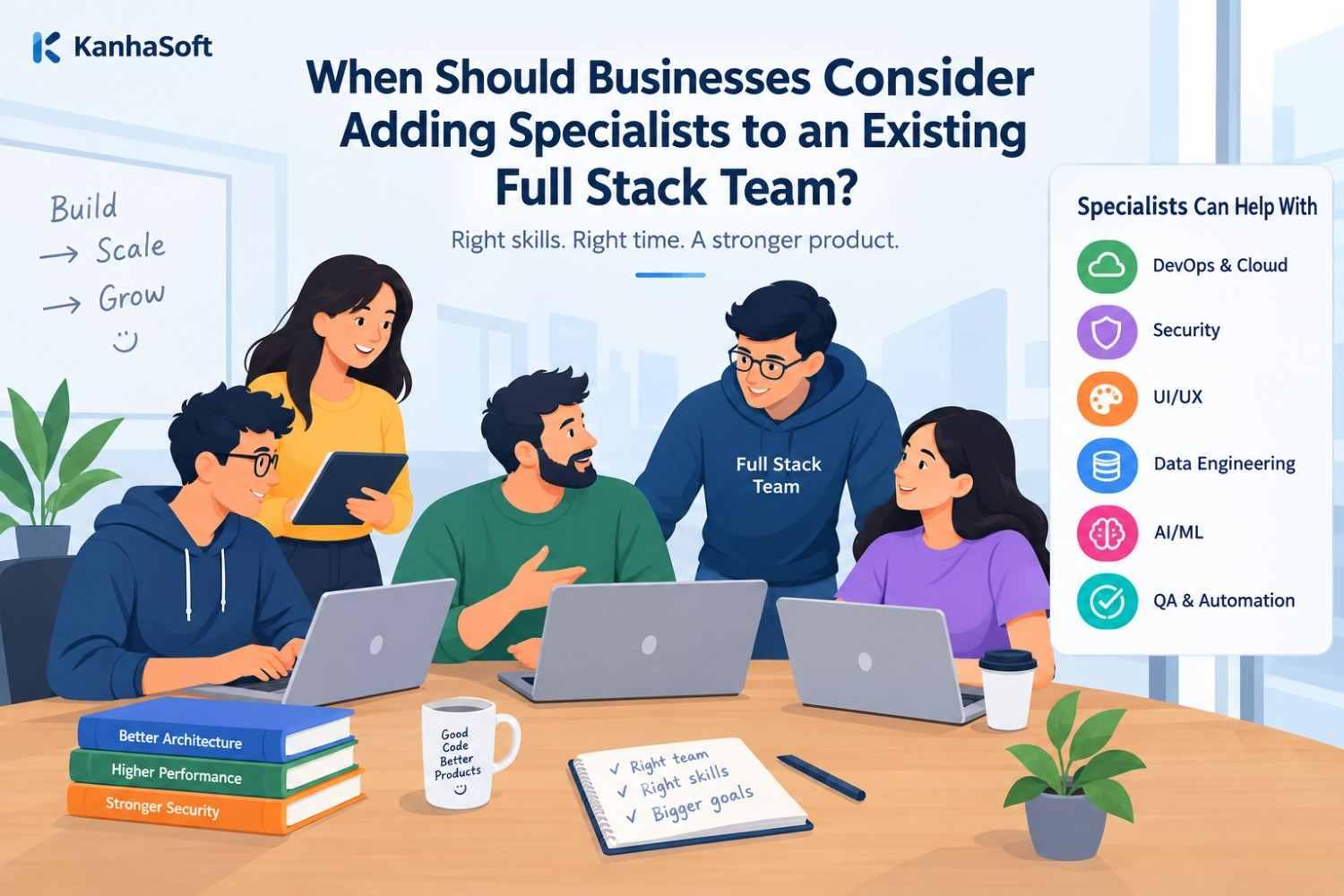
Building a software product rarely stays as simple as it looks during the planning stage.
At the beginning, a small development team may handle almost everything — frontend interfaces, backend logic, databases, APIs, testing, and deployment. This flexibility is one of the biggest advantages of having full stack developers. A capable team can move quickly without creating a separate department for every technology.
But software has a funny habit of becoming more complicated as it becomes successful.
More users arrive. Integrations multiply. Performance expectations increase. Security becomes more important. Suddenly, the same team that once handled everything comfortably is spending more time solving highly specialized problems.
This is where businesses may need to consider adding specialists.
The goal is not to replace the existing development team. Instead, specialists can provide deeper expertise in areas where a generalist approach may no longer be enough. The right decision depends on the product's complexity, business goals, technical challenges, and future roadmap.
So, when should a business actually add specialists to an existing development team?
Let's break it down.
What Does a Full Stack Team Typically Handle?
A fullstack development team generally works across multiple layers of a software application.
On the frontend, developers may work with frameworks such as React, Next.js, Angular, or Vue.js. On the backend, they may build APIs, business logic, authentication systems, and integrations using technologies such as Node.js, Django, or similar frameworks.
They may also work with databases, third-party services, testing environments, version control, and deployment processes.
This broad understanding is extremely useful.
For startups and growing businesses, having developers who can understand both frontend and backend requirements can simplify communication and accelerate product development. Instead of passing every small requirement between multiple specialized departments, developers can work across the application.
However, broad technical knowledge does not mean unlimited depth.
A developer may understand cloud infrastructure without being a dedicated cloud architect. Another may understand security fundamentals without specializing in application security. Someone may integrate an AI API successfully without having deep expertise in machine learning systems.
That distinction becomes important as the product grows.
Signs Your Existing Team May Need Additional Specialists
There is no magic number of developers that tells a business, “Now hire a specialist.”
Instead, businesses should look for practical signals.
1. Development Bottlenecks Are Increasing
If developers are spending too much time on one particular technical problem, it may indicate a need for specialized expertise.
For example, a team might be capable of building new features but repeatedly lose development time dealing with infrastructure configuration, database optimization, or complex integrations.
Adding another generalist developer may increase overall capacity, but it may not solve the underlying bottleneck.
A specialist can focus deeply on the specific problem while the existing team continues working on core product development.
2. Technical Debt Is Slowing Product Development
Technical debt is normal in software development. Not every early architectural decision will remain ideal forever.
The problem begins when technical debt starts affecting everyday development.
Developers may need to work around outdated architecture, duplicated code, inefficient database structures, or legacy integrations before they can introduce new functionality.
At this point, an experienced specialist in architecture, backend engineering, databases, or modernization may help the team identify and address deeper structural issues.
Otherwise, developers can spend weeks putting small patches on problems that really need a proper repair.
And software patches have a strange talent for becoming permanent architecture.
3. Performance Problems Keep Returning
Performance optimization is another common reason to introduce specialized expertise.
A slow application can have many possible causes:
- Inefficient database queries
- Poor API design
- Frontend rendering issues
- Inadequate caching
- Infrastructure limitations
- Incorrect resource allocation
- Poorly optimized background jobs
A full stack developer may be able to investigate many of these areas.
However, when performance becomes a major business concern, deeper expertise can become valuable. A performance or infrastructure specialist can analyze bottlenecks systematically and recommend improvements based on actual application behavior.
4. Security Requirements Are Becoming More Serious
Security should never be treated as something that gets added during the final week before launch.
As businesses grow, applications may handle customer information, payment data, business records, authentication credentials, or other sensitive information.
The security requirements naturally become more demanding.
A development team should understand secure coding practices, authentication, authorization, validation, and common vulnerabilities. But businesses with complex security requirements may also benefit from dedicated security expertise.
This can include:
- Security assessments
- Application security reviews
- Threat modeling
- Identity and access management
- Vulnerability management
- Compliance-related requirements
The specialist does not replace the development team. Instead, the specialist can provide another layer of technical depth.
5. The Product Is Entering a New Technical Area
Sometimes the need for specialization is obvious because the business is entering an entirely new technology area.
For example, an existing product may suddenly require:
- AI-powered features
- Machine learning workflows
- Advanced analytics
- Mobile applications
- Large-scale data pipelines
- Cloud infrastructure
- Real-time processing
- Advanced automation
The existing developers may learn the required technology themselves. That can work for some projects.
But if the new capability is central to the product, bringing in someone with significant experience in that area may reduce experimentation and accelerate implementation.
Which Specialists Might a Growing Product Need?
The right specialist depends entirely on the technical challenge.
DevOps and Cloud Specialists
Cloud infrastructure becomes increasingly important as applications scale.
A DevOps or cloud specialist may focus on:
- CI/CD pipelines
- Infrastructure automation
- Cloud architecture
- Monitoring
- Logging
- Deployment reliability
- Containerization
- Infrastructure security
This allows application developers to concentrate more heavily on product functionality while infrastructure receives dedicated attention.
UI/UX Specialists
Not every application problem is technical.
A product can function perfectly and still provide a frustrating user experience.
UI/UX specialists can focus on:
- User journeys
- Information architecture
- Design systems
- Accessibility
- Interface consistency
- Usability research
- Conversion-focused experiences
This becomes especially valuable when an application has grown organically and different sections now look as though they were designed by five different teams on five different Mondays.
Security Specialists
Security specialists can provide deeper expertise around application and infrastructure security.
They may review architecture, identify vulnerabilities, assess authentication mechanisms, and help development teams establish stronger security practices.
For businesses operating in highly regulated or security-sensitive environments, this expertise can become particularly relevant.
Data Engineers
As data volumes increase, storing information is only one part of the challenge.
Businesses may need reliable systems for collecting, transforming, processing, and analyzing data.
Data engineers can work on:
- Data pipelines
- ETL/ELT processes
- Data warehouses
- Real-time processing
- Analytics infrastructure
- Data quality
This becomes increasingly important when business decisions depend on large or continuously changing datasets.
AI and Machine Learning Specialists
Adding AI functionality can involve much more than connecting an API.
Depending on the product, businesses may need expertise in:
- Machine learning workflows
- Retrieval-augmented generation
- Model evaluation
- Data preparation
- AI infrastructure
- Prompt and system design
- Model integration
- AI performance monitoring
A full stack developer can integrate AI capabilities into an application, while an AI specialist can provide deeper expertise when AI becomes a major part of the product.
QA and Automation Specialists
Manual testing can work well when an application is small.
As functionality expands, however, testing every major workflow manually after every release can become increasingly difficult.
QA specialists can establish:
- Automated test suites
- Regression testing
- API testing
- Performance testing
- Cross-browser testing
- Continuous quality processes
This can help the development team ship changes without turning every release into a suspense movie.
When Should a Business Add a Specialist Instead of Hiring More Generalists?
This is one of the most important decisions.
Suppose an application needs more features and the development team simply does not have enough capacity. In that situation, adding another generalist developer may make sense.
But suppose the team has enough developers and still cannot solve a recurring infrastructure, security, AI, or performance problem efficiently.
Adding more generalists may not address the real issue.
The business should first identify whether the challenge is capacity-related or expertise-related.
If there is too much work, additional development capacity may help.
If there is a deep technical challenge, specialized expertise may be more appropriate.
This distinction can prevent businesses from increasing team size without actually solving the problem.
How Specialists Complement an Existing Development Team
The most effective model is usually collaborative.
The specialist should not operate as a completely separate island.
A practical structure may look like this:
- The existing developers continue owning core product development.
- The specialist focuses on a defined technical area.
- Both sides collaborate on architecture and implementation.
- Important decisions are documented.
- Knowledge is shared with the broader team.
- Responsibilities are clearly defined.
For example, a DevOps specialist can improve deployment infrastructure while the existing developers continue building application features.
Similarly, a security specialist can review the application's architecture and provide recommendations that developers can implement and maintain.
This approach creates a useful balance between broad product knowledge and deep technical expertise.
When Hiring Dedicated Developers Makes Sense
Specialized expertise is not always required permanently.
Some businesses need additional developers because they are launching a major feature, modernizing an existing application, or working toward an aggressive delivery schedule.
In these situations, businesses may hire dedicated developers for focused development capacity.
This approach can be useful when the requirement is clearly defined.
For example:
- A business is developing a new SaaS platform.
- An existing application requires modernization.
- A company needs additional backend capacity.
- A new integration needs to be delivered.
- A product team needs temporary support during a growth phase.
The important point is to define the role clearly.
A dedicated developer should understand the existing architecture, development workflow, communication process, and expected deliverables.
Simply adding another person to a project does not automatically make the project faster.
Sometimes it just creates another calendar full of meetings.
Specialist vs. Generalist: What Should Businesses Consider?
Businesses should evaluate the two approaches according to actual requirements.
| Consideration | Generalist Developer | Specialist |
|---|---|---|
| Broad application development | Suitable | Usually narrower |
| Deep technical expertise | May vary | Strong focus |
| Product flexibility | High | Focused |
| Specialized technical problems | May require additional support | Suitable |
| Short-term expertise | Depends on skills | Often useful |
| Long-term product ownership | Often valuable | Depends on role |
| Cross-functional understanding | Broad | Usually domain-focused |
This does not mean businesses must choose one model permanently.
A hybrid team can often provide a practical balance.
The core development team can retain broad product knowledge while specialists provide deeper expertise in areas where the product demands it.
How to Decide Which Specialist to Add First
Before hiring, businesses should follow a simple evaluation process.
Step 1: Identify the Biggest Bottleneck
Ask:
Where is the team losing the most time?
Is it development? Infrastructure? Testing? Security? Performance? Data?
The answer provides the starting point.
Step 2: Measure Business Impact
Not every technical inconvenience requires a new specialist.
Consider whether the problem affects:
- Revenue
- Customer experience
- Product reliability
- Security
- Development speed
- Scalability
- Operational costs
The bigger the business impact, the more carefully the issue should be evaluated.
Step 3: Decide Whether the Need Is Temporary or Permanent
A business may need a specialist for three months rather than three years.
Consider whether the requirement is related to:
- A specific project
- A product launch
- A migration
- A security review
- A modernization effort
- Long-term operations
This helps determine the right hiring model.
Step 4: Review Existing Team Capabilities
Before bringing in another person, identify what the current team already knows.
There is little value in hiring a specialist for a capability the existing team already handles effectively.
Step 5: Define the Specialist's Responsibilities
A clear role should include:
- Technical responsibilities
- Expected deliverables
- Collaboration requirements
- Decision-making authority
- Project timeline
- Success metrics
Clear expectations make integration much easier.
Common Mistakes Businesses Make When Adding Specialists
Businesses can also make mistakes while trying to solve a specialization problem.
Hiring Before Identifying the Problem
A business should understand the technical challenge before choosing the role.
Hiring a “cloud specialist” because the application is slow, for example, may not solve the issue if the actual bottleneck is an inefficient database query.
Adding Too Many Specialists Too Early
A growing product does not need every possible technical role immediately.
Over-specialization can increase communication overhead and make a small project unnecessarily complicated.
Creating Communication Silos
Specialists should not work independently without understanding the broader product.
Regular communication, documentation, and shared technical standards can prevent this problem.
Ignoring Knowledge Transfer
Specialized work should not become knowledge that only one person understands.
Documentation and knowledge sharing help the business avoid creating a new dependency.
Hiring Based Only on Technology Names
A long list of technologies on a résumé does not automatically demonstrate relevant experience.
Businesses should evaluate whether the developer has solved problems similar to those the product actually faces.
A Practical Hybrid Team Model for Growing Businesses
For many growing products, a hybrid structure can provide flexibility.
Core Product Team
The core team may include:
- Full stack developers
- Product manager
- QA professionals
- Technical leadership
They maintain the broader product and understand its business requirements.
Specialized Support
Depending on the product stage, businesses can add:
- DevOps/cloud specialists
- UI/UX specialists
- Security specialists
- AI/ML specialists
- Data engineers
- Performance specialists
Not every specialist needs to become a permanent employee.
Some may be required during a specific project phase, while others may become permanent as the technical requirement becomes part of everyday operations.
The team can evolve with the product.
That is often more practical than designing a huge organizational chart before the first customer even logs in.
Conclusion
A growing software product does not necessarily need a larger development team just because it is becoming more complicated.
Sometimes the team needs more people.
Sometimes it needs deeper expertise.
And sometimes the problem is simply hiding in the architecture, waiting patiently for everyone to blame the framework.
The practical approach is to identify what is actually limiting the product. If the challenge is development capacity, expanding the core team may help. If the challenge requires deep expertise in security, infrastructure, AI, data, performance, or another specialized area, bringing in the right specialist may be more appropriate.
A strong development strategy is not about collecting as many job titles as possible.
It is about having the right skills available when the product needs them — while keeping the team collaborative, flexible, and focused on the business goal.
That balance can help businesses scale their technology without unnecessarily complicating the team responsible for building it.
FAQs
1. When should a business add specialists to its development team?
A business should consider specialists when its existing developers repeatedly encounter complex technical problems that require deeper expertise or when a new technology becomes central to the product.
2. Can full stack developers handle everything without specialists?
Full stack developers can handle a broad range of application requirements. However, specialized areas such as advanced security, cloud architecture, AI, data engineering, and performance optimization may benefit from deeper expertise.
3. Which specialist should a growing software company hire first?
There is no universal answer. Businesses should identify their biggest technical bottleneck and select a specialist whose expertise directly addresses that problem.
4. Should businesses hire specialists permanently?
Not always. The appropriate model depends on whether the requirement is ongoing, project-specific, or related to a particular stage of product development.
5. Can specialists work with an existing full stack development team?
Yes. Specialists can collaborate with the existing team on architecture, implementation, reviews, documentation, and knowledge sharing.
6. When should a company consider dedicated developers?
Dedicated developers can be useful when a business needs additional development capacity or focused expertise for a specific project, product expansion, modernization effort, or development phase.
7. Does adding specialists increase development costs?
It can increase staffing costs, but the actual business impact depends on the problem being solved, project duration, required expertise, and expected improvements in development efficiency or product performance.
8. How can businesses prevent communication problems between specialists and developers?
Clearly defined responsibilities, shared documentation, regular communication, collaborative planning, and common development standards can help prevent silos.

 Arabic
 French
 Spanish
 Portuguese
 Deutsch
 Turkish
 Dutch
Dutch
 Italiano
 Russian
 Romaian
 Portuguese (Brazil)
 Greek
Greek