


Anterior Cervical Plate System: Titanium Fixation For ACDF Surgery
What Is an Anterior Cervical Plate?
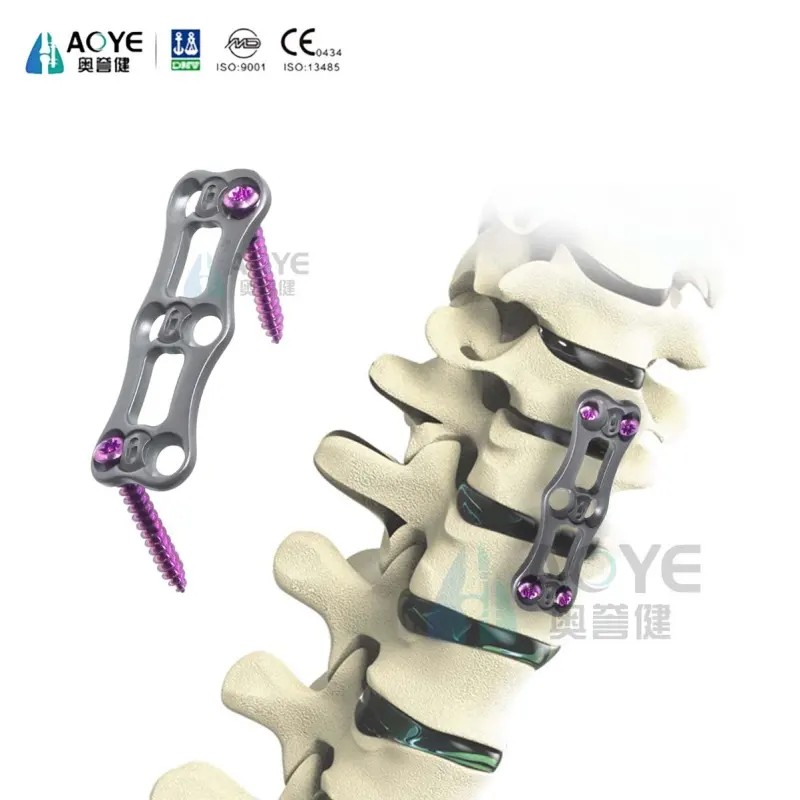
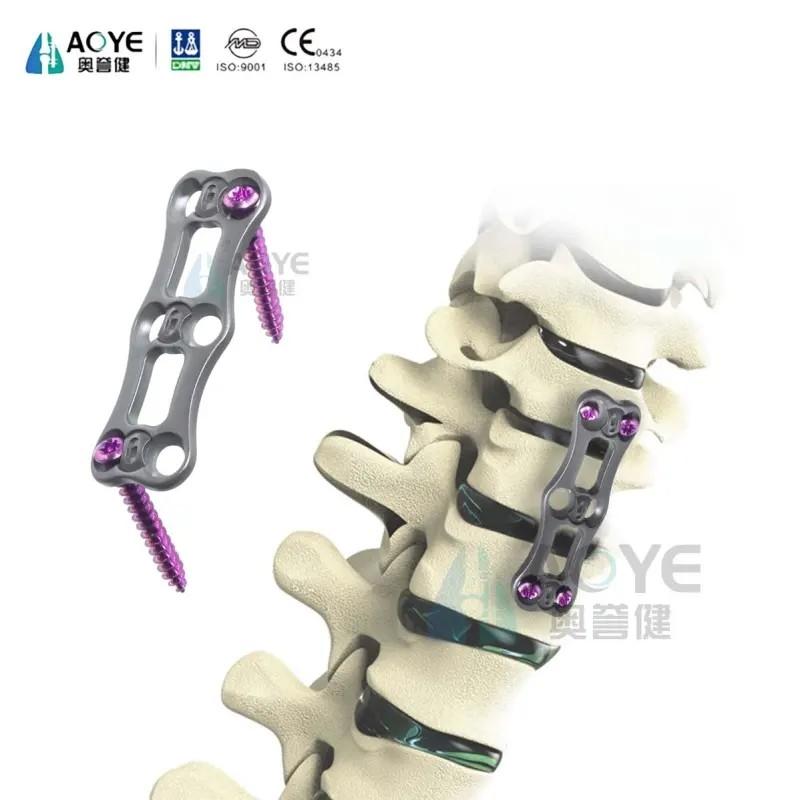
An anterior cervical plate is a thin, contoured titanium alloy implant placed on the front of the cervical vertebrae after anterior cervical discectomy and fusion (ACDF). It bridges one or more vertebral bodies with bone graft material, holds screws rigidly in place, and provides immediate stability while the bone graft fuses.
The plate acts as a load-sharing device: it neutralizes shear and bending forces across the disc space during the first 6–12 weeks of healing, then gradually transfers load to the fused bone as fusion matures. A well-designed plate maintains disc height, prevents graft extrusion, and reduces pseudoarthrosis (non-union) rates compared with stand-alone interbody grafts.
Anatomy and Design Rationale
The anterior surface of the cervical spine is concave and lordotic. An anterior cervical plate must therefore:
Match cervical lordosis to avoid prevertebral soft-tissue irritation.
Stay low-profile (≤ 2.0 mm thickness) to minimize dysphagia.
Provide convergent screw trajectories (typically 6–12° medial angulation) to stay within the vertebral body and avoid endplate breach.
Allow screw locking (constrained) or controlled settling (semi-constrained) depending on clinical scenario.
Most modern systems use fixed-angle (constrained) locking screws for primary stability, with optional variable-angle screws for revision or osteoporotic bone.
Clinical Indications
| Indication | Typical Levels | Plate Choice |
|---|---|---|
| Cervical disc herniation with radiculopathy | C4–C7, single or two-level | Short constrained or semi-constrained |
| Cervical spondylotic myelopathy (CSM) | Multi-level C3–C7 | Long constrained plate |
| Cervical spine fracture / dislocation | Single or multi-level | Constrained, locking |
| Cervical instability (post-traumatic or degenerative) | Variable | Constrained |
| Revision of failed ACDF | Variable | Longer plate, variable-angle screws |
Technical Specifications
| Parameter | AOYE ACP Specification |
|---|---|
| Material | Ti-6Al-4V ELI titanium alloy (ASTM F136, ISO 5832-3) |
| Plate thickness | 1.6–2.0 mm |
| Plate width | 16–18 mm |
| Plate lengths | 20, 22, 24, 26, 28, 30, 32, 34, 36, 40, 45, 50, 55, 60, 65, 70, 75, 80, 85, 90, 100, 110 mm |
| Screw diameter | 3.5 mm self-tapping, 4.0 mm rescue / cancellous |
| Screw length | 10, 12, 14, 16, 18 mm |
| Screw angulation | Fixed ± 6° to ± 12° (convergent) |
| Locking mechanism | Integrated cam lock or secondary locking screw |
| Surface finish | Anodized (gold / blue) per ASTM F86 |
| Sterilization | Gamma 25–40 kGy, validated per ISO 11137 |
| MRI compatibility | Conditional — titanium, non-ferrous |
| Single-use sterile packaging | Tyvek / PET blister, double pouch |
Surgical Technique Summary
Standard ACDF with plate fixation follows these steps (Smith-Robinson approach):
Exposure — transverse or oblique incision along skin crease; dissect through platysma; identify and mobilize the carotid sheath laterally and the trachea/esophagus medially.
Discectomy — confirm level with fluoroscopy; incise annulus; remove disc material and cartilaginous endplates using curettes and a high-speed burr.
Decompression — remove posterior osteophytes and any free disc fragments until the dura and exiting nerve roots are clearly decompressed.
Graft placement — insert interbody cage (PEEK, allograft, or autograft) filled with bone graft substitute; confirm disc height restoration.
Plate selection and contouring — choose plate length spanning the fused levels; contour to cervical lordosis using plate benders.
Screw fixation — drill with 2.5 mm drill bit using fixed-angle guide; tap (optional); insert 3.5 mm self-tapping screws; lock.
Closure — confirm hemostasis; layered closure over a small drain if used.
Post-op imaging — AP and lateral fluoroscopy or X-ray before discharge.
Typical operative time: 60–90 min per level. Blood loss: < 50 mL. Hospital stay: 1–3 days.
Constrained vs Semi-Constrained Plates
Modern plates fall into two biomechanical categories:
Constrained (rigid) plates lock the screw head fully to the plate, preventing any settling. Best for multi-level fusions, fracture, and unstable cases.
Semi-constrained (dynamic) plates allow 1–2 mm of axial settling as the graft integrates. This promotes graft compression and may improve fusion rates for single-level ACDF.
Selection is surgeon-specific. Both designs have similar long-term fusion rates when applied to the appropriate indication.
Complications and Risk Mitigation
The most clinically relevant complications are:
| Complication | Reported Rate | Mitigation |
|---|---|---|
| Dysphagia | 2–15% (higher with thicker plates) | Low-profile design, careful soft-tissue handling |
| Hoarseness (RLN palsy) | 1–4% | Limit retraction time; identify nerve when possible |
| Screw loosening / backout | < 2% with locking plates | Use locking mechanism; avoid endplate breach |
| Pseudoarthrosis | 0–10% single-level, up to 25% multi-level | Proper graft selection; rigid plate fixation |
| Adjacent segment disease | 2–4% per year | Limit plate length across healthy motion segments |
| Esophageal injury | < 1% | Mobilize esophagus medially; blunt dissection |
OEM/ODM Service for Distributors
AOYE Medical supplies anterior cervical plates to orthopedic distributors, hospital purchasing groups, and government tenders worldwide. OEM/ODM services include:
Private label laser engraving on plate and screws
Custom packaging design (carton, blister, IFU)
Sterilization packaging (Tyvek / PE / paper-polymer)
Regulatory document support (CE Technical File under MDR 2017/745, 510(k) preparation, country-specific registration)
Low MOQ (typically 50–100 units per SKU for trial orders)
15–30 day lead time for repeat orders; 30–45 days for new OEM SKUs
Request a quotation at oem@aoyemedical.com with your target market and required SKUs.
Frequently Asked Questions
What is an anterior cervical plate used for?
An anterior cervical plate provides immediate rigid fixation of the cervical spine after anterior cervical discectomy and fusion (ACDF). It stabilizes one or more cervical segments, maintains disc height, and promotes bone graft fusion.
What material are anterior cervical plates made of?
Most modern anterior cervical plates are manufactured from medical-grade Ti-6Al-4V ELI titanium alloy per ASTM F136, offering high biocompatibility, MRI compatibility, and fatigue resistance.
What is the difference between constrained and semi-constrained plates?
Constrained plates lock screws rigidly to the plate. Semi-constrained (or dynamic) plates allow controlled settling of the graft into the disc space, which can improve fusion rates in single-level procedures.
How long is the hospital stay after ACDF with plating?
Typical hospital stay is 1–2 days for single-level ACDF and 2–3 days for multi-level procedures. Most patients return to light activity within 2–4 weeks.
Can AOYE OEM an anterior cervical plate with private label?
Yes. AOYE provides OEM/ODM services including laser logo engraving, private label packaging, sterilization packaging (Tyvek/PE), and regulatory document support (CE Technical File, 510(k) preparation) with low MOQ.
What sizes are available?
AOYE anterior cervical plates are available in lengths from 20 mm to 110 mm in 2–4 mm increments, with screw diameters of 3.5 mm and 4.0 mm, and screw lengths from 10 mm to 18 mm.
What certifications does AOYE hold for cervical plates?
AOYE Medical is ISO 13485:2016 certified by TÜV SÜD and CE marked under EU MDR 2017/745. Full regulatory document packages are available on request.

 English
 Arabic
 French
 Spanish
 Portuguese
 Turkish
 Dutch
Dutch
 Italiano
 Russian
 Romaian
 Portuguese (Brazil)
 Greek
Greek