


Protecting Yourself When Hiring Overseas Web Designers
Budget reality hits hard when you start shopping for a new website. Local agencies quote figures that feel completely disconnected from what a growing business can spend. The natural next step is looking abroad, where talented professionals offer their skills at a fraction of the cost. You find cheap website design options everywhere and wonder why you ever considered paying domestic rates.
The hesitation sets in quickly, though. You have heard the stories. Designers who vanish once the deposit clears. Deliverables that look nothing like the brief. Code so tangled that no one else can maintain it. The risk feels enormous.
The good news is that risk is manageable with the right approach. International web design works beautifully when you apply structure and due diligence. What follows is a framework for hiring a capable cheap web designer without falling into the traps that derail so many projects.
Write Your Brief Like a Blueprint
The brief is where your project succeeds or fails before any design work begins. A loosely worded request invites interpretation, and interpretation means surprises. Offshore teams cannot read your mind, nor should they have to try.
Detail every page your website needs. Describe the features, navigation patterns, and visual tone you are aiming for. Reference specific websites that embody what you want, and articulate precisely which elements you want to emulate and which you want to avoid.
Hand over your complete brand package at the outset. That includes logo files, color specifications, font selections, and any finalized copy. Every piece of information you withhold becomes a decision someone else makes for you.
Watch the responses carefully. Designers who ask pointed questions about your brief are doing their job. Those who accept everything without a single clarification are either not reading it or not experienced enough to spot the gaps.
Test Their Portfolio for Authenticity
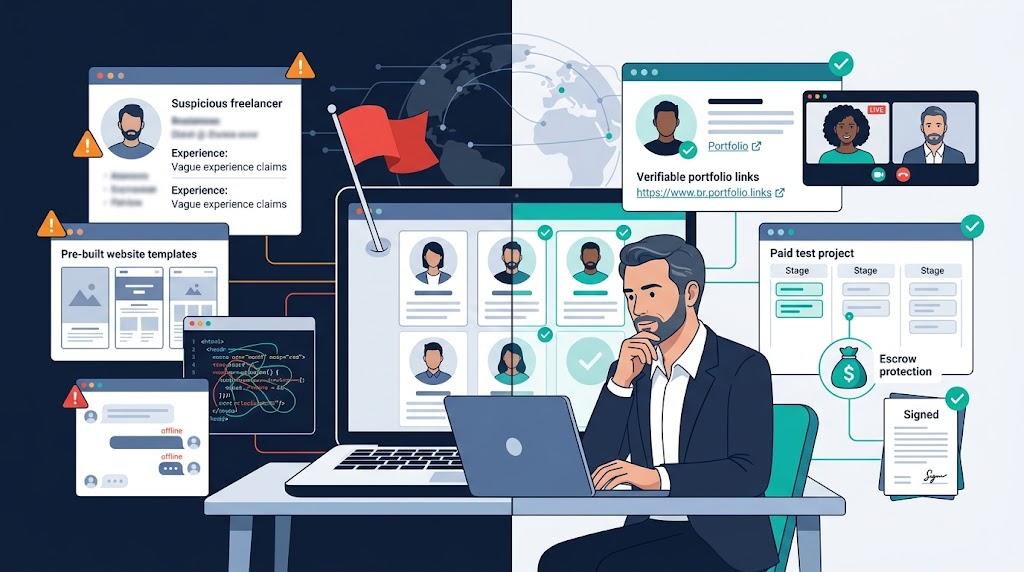
A polished portfolio can mask a lack of real experience. Templates are everywhere, and presenting someone else's theme as original work is disturbingly common. Do not take portfolio claims at face value.
Insist on live links to websites the candidate built. Browse each one thoroughly on desktop and mobile. Check page load times, test navigation flows, and look for consistency in design quality across different sections of the site.
Go further by asking for source files. Legitimate designers will have Figma, Sketch, or Adobe documents that show their process. Requesting temporary access to a staging environment adds another layer of verification.
Pay attention to responsiveness across devices. A site that collapses awkwardly on a tablet or phone suggests limited front-end skill. Portfolio work should demonstrate mastery of the basics at a minimum, not just attractive desktop layouts.
Meet Them Face to Face on Video
Text conversations reveal very little about competence or working style. A short video call provides information that weeks of messaging never could. Make this a standard part of your screening process.
Use the call to probe technical knowledge. Ask the designer to explain why they chose a particular layout approach or interaction pattern in their portfolio. Genuine builders will answer with confidence and specificity.
This is also your best tool for detecting brokers. A concerning number of freelancing profiles belong to people who outsource all actual work. They take your money and hire someone cheaper to deliver. Only someone who does the work themselves can discuss implementation details convincingly.
Assess communication clarity during the conversation as well. Complex projects require nuanced feedback over many weeks. If understanding each other feels difficult in a casual call, it will only get worse under deadline pressure.
Start Small With a Paid Trial
The temptation to award the full project immediately is understandable. You found someone promising and want to move forward. Resist that impulse and commission a limited trial instead.
Pick a self-contained task for this test. A single landing page or a specific component built from your design files works well. Pay fairly and agree on a reasonable timeline.
When the deliverable arrives, evaluate it on several dimensions. Did the designer meet the deadline without needing reminders? Is the underlying code clean and well-organized? Were potential issues flagged early, or did problems surface only at delivery?
A successful trial earns your trust through demonstrated performance rather than promises. An unsuccessful one costs a fraction of what a full project failure would. Either way, you gain critical information before committing further.
Structure Payments to Protect Both Sides
Open-ended financial arrangements invite problems. Without clear payment boundaries, you lose leverage if quality drops. A milestone-based structure solves this by tying money to measurable progress.
Divide the project into phases with specific deliverables attached to each payment. Design approvals, development benchmarks, revision completion, and final deployment represent natural checkpoints. Each payment should correspond to something you can review and approve.
Escrow services provide essential protection for international transactions. A neutral platform holds your funds until you confirm that work meets your standards. This arrangement motivates timely, quality delivery without putting your money at risk.
Document everything in a formal agreement. Define completion criteria for each milestone. Specify revision allowances and intellectual property ownership. State clearly that all code and design assets transfer to you upon final payment.
Verify Communication and Schedule Alignment
Language fluency and time zone overlap are practical factors that directly shape project outcomes. Overlooking them during hiring leads to friction that no amount of talent can overcome.
Your designer needs the ability to absorb detailed, sometimes abstract feedback and translate it into actionable changes. Strong communicators will restate your requirements to confirm alignment before beginning work.
Time differences deserve honest evaluation. When your morning is their midnight, every small question consumes an entire business day. That pace is exhausting and expensive over a multi-week timeline.
For businesses pursuing cheap website design from international markets, schedule overlap often determines whether the savings are real. A cheap web designer who is available during your working hours can resolve issues in minutes rather than days. That responsiveness compounds into faster delivery and fewer costly misunderstandings over the life of the project.
Moving Forward With Confidence
Offshore web design is a practical option for businesses that need professional results within limited budgets. The talent is real and globally distributed. Cheap website design does not have to mean cutting corners if you approach the process with discipline.
Write a brief that eliminates guesswork. Verify portfolios with tangible evidence. Speak with the actual person performing the work. Begin with a modest paid test. Lock down your financial terms with milestones and escrow. Confirm communication and scheduling compatibility before signing anything.
This methodology filters out unreliable operators systematically. What remains is a professional relationship built on verified capability and mutual accountability. Your website gets built properly, your money stays protected, and you gain a partner worth returning to for future work.

 Arabic
 French
 Spanish
 Portuguese
 Deutsch
 Turkish
 Dutch
Dutch
 Italiano
 Russian
 Romaian
 Portuguese (Brazil)
 Greek
Greek