


Is Direct-to-Consumer Lab Testing Accurate/Reliable? What to Know Before You Order
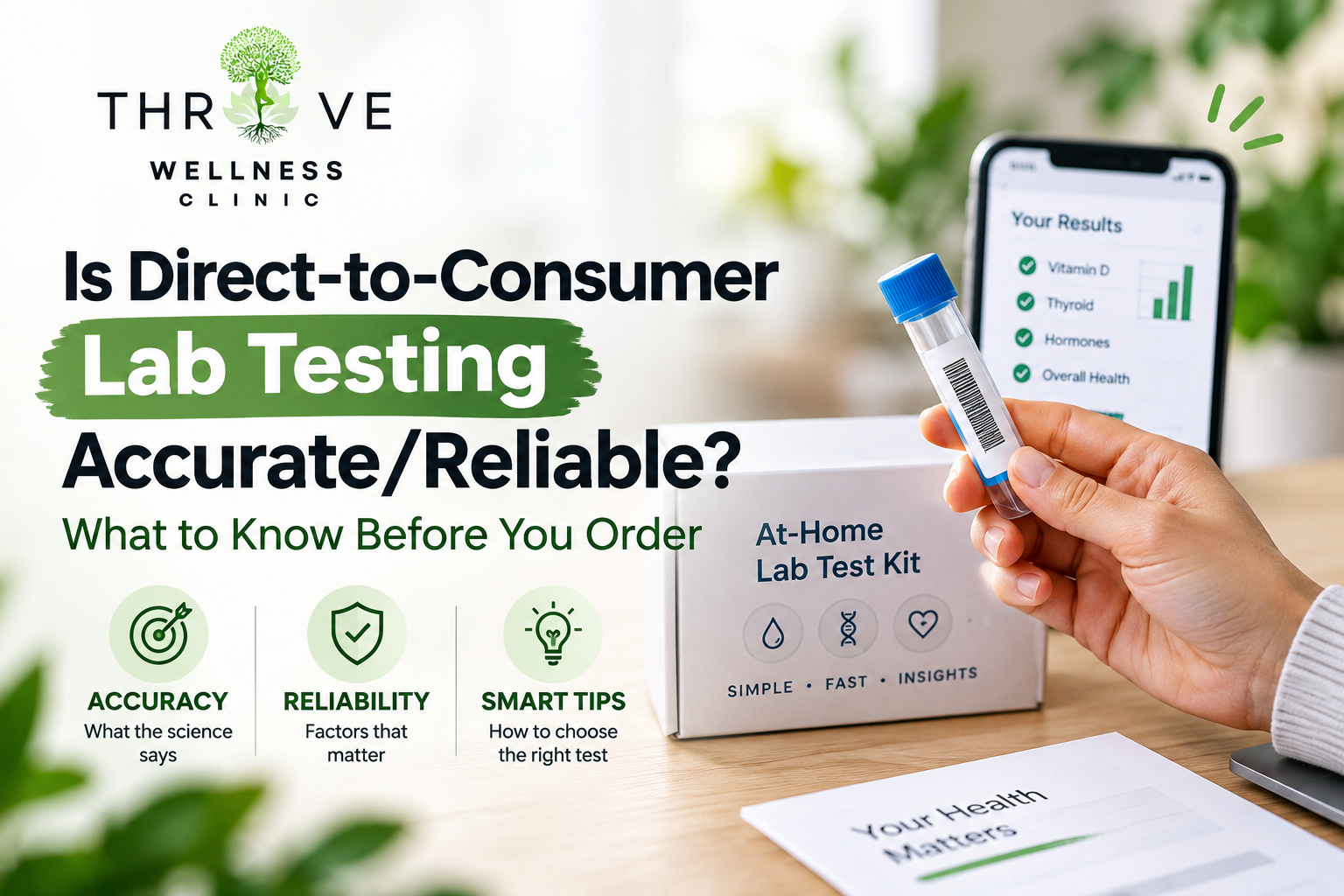
If you have searched for direct to consumer laboratory testing, you may be wondering whether ordering laboratory tests online and collecting samples at home is as reliable as testing arranged through a healthcare provider. Direct-to-consumer (DTC) testing has made health information more accessible, allowing people to order certain tests without a traditional office visit. However, convenience should not be confused with a complete medical evaluation.
The accuracy and usefulness of any laboratory test depend on several factors, including the type of test, laboratory quality, sample collection, handling, and how the results are interpreted. Understanding these factors can help you make a more informed decision before ordering an at-home or direct-access laboratory test.
What Is Direct-to-Consumer Laboratory Testing?
Direct to consumer laboratory testing allows individuals to purchase certain health or wellness tests without necessarily obtaining an order from their personal physician. Depending on the service, you may collect a sample at home, visit a collection location, or arrange professional sample collection.
Tests can measure a wide range of biomarkers, including cholesterol, blood glucose, hormones, vitamins, inflammatory markers, thyroid-related markers, and other health indicators. Some DTC services also provide genetic, wellness, or lifestyle testing.
The important distinction is that a laboratory result is only one piece of health information. A number outside a reference range does not automatically mean you have a disease, while a normal result does not necessarily rule out every possible health concern.
Is Direct-to-Consumer Lab Testing Accurate?
The short answer is: it can be accurate, but the reliability of the result depends on the specific test and testing process.
No laboratory test is perfect. Accuracy can be affected by sample collection, storage, transportation, timing, the testing method, and laboratory quality procedures. The FDA notes that consumers should carefully follow collection instructions because incorrect collection or handling can affect results.
It is also important to distinguish analytical validity from clinical validity. Analytical validity refers to whether a test accurately measures what it is designed to measure. Clinical validity concerns how well that measurement relates to a particular health condition or clinical outcome.
This distinction matters because a laboratory may accurately measure a biomarker while the meaning of that biomarker is more complicated than a simple “healthy” or “unhealthy” result.
What Makes a DTC Lab Test Reliable?
Before ordering direct to consumer laboratory testing, look beyond the price and convenience. Consider the following factors:
1. Laboratory Quality and Certification
Find out where the sample will be tested and whether the laboratory operates under applicable quality standards. In the United States, laboratories performing testing on human specimens for health assessment, diagnosis, prevention, or treatment are generally subject to Clinical Laboratory Improvement Amendments (CLIA) requirements.
CLIA addresses important aspects of laboratory operations, including personnel qualifications, quality control, and testing procedures. However, certification alone does not mean every test is clinically appropriate for every person.
2. The Purpose of the Test
Ask why you are taking the test. Are you monitoring an existing health concern, establishing a baseline, investigating symptoms, or simply learning more about your health?
A test is most useful when there is a clear reason for ordering it. Large panels may produce numerous results, but more data does not always mean better healthcare.
3. Sample Collection
At-home testing can be convenient, but the collection process matters. Depending on the test, you may need to fast, avoid certain activities, collect the sample at a specific time, or follow precise instructions.
For blood testing, professional collection may reduce some of the challenges associated with self-collection. For other tests, home collection may be perfectly appropriate when the test is designed and validated for that method.
4. Reference Ranges
A reference range is not necessarily the same thing as an individualized “optimal” range. Laboratory reference ranges are developed using particular populations and statistical methods.
Your age, sex, medications, medical history, symptoms, lifestyle, and other laboratory results can all influence how a healthcare professional interprets a finding.
5. Follow-Up and Clinical Interpretation
One of the biggest limitations of ordering a test independently is receiving a result without adequate medical context.
For example, an unexpected result may require repeat testing, additional testing, or evaluation of other factors. A healthcare professional can help determine whether a result is meaningful and what, if anything, should happen next.
False Positives and False Negatives: What Do They Mean?
Understanding false results is essential when considering direct to consumer laboratory testing.
A false positive occurs when a test indicates that a condition may be present when it is not. A false negative occurs when a test does not detect a condition that is actually present.
The likelihood of these outcomes varies depending on the test and the person being tested. Test results also need to be considered alongside symptoms, medical history, physical examination findings, and other diagnostic information.
This is why an abnormal DTC result should not automatically cause alarm, and a normal result should not automatically provide reassurance when significant symptoms are present.
What to Know Before You Order
Before purchasing a direct-access laboratory test, ask:
-
What exactly does this test measure?
-
Why am I taking the test?
-
Where is the sample analyzed?
-
Is the laboratory appropriately certified?
-
What preparation is required?
-
How should the sample be collected and transported?
-
What are the limitations of the test?
-
Will a healthcare professional help interpret the results?
-
Will abnormal findings require confirmation?
-
Is my personal health information handled securely?
-
What happens if the result is abnormal?
These questions can help you separate meaningful health testing from services that primarily provide numbers without sufficient context.
Direct-to-Consumer Testing vs. Provider-Guided Testing
The major difference is not necessarily the laboratory itself. It is often the clinical context surrounding the testing.
A provider-guided approach may begin with your symptoms, health history, goals, medications, family history, and previous results. The clinician can then determine which tests are relevant and how the findings fit into your overall health picture.
DTC testing can still be useful for people who want convenient access to health information. However, the results should generally be considered part of a broader healthcare strategy rather than a replacement for appropriate medical evaluation.
How THRYVE Supports More Personalized Lab Testing
For people searching for convenient direct to consumer laboratory testing in San Antonio or looking for accessible healthcare support through a North Carolina Clinic, THRYVE Clinic combines convenient testing options with a more personalized approach to health monitoring.
Rather than looking at laboratory numbers in isolation, personalized healthcare can consider biomarkers alongside your health goals, lifestyle, symptoms, and other relevant information.
You can learn more about [personalized healthcare and laboratory testing services at THRYVE Clinic] and explore options designed to make healthcare more convenient and individualized.
Why Consider a THRYVE Membership?
If you want more than a one-time laboratory report, a healthcare membership may provide a more continuous approach to monitoring your health.
A THRYVE membership is designed around convenient access to healthcare, ongoing wellness monitoring, personalized care, preventive health support, and long-term health optimization. Instead of ordering individual tests and trying to interpret every result independently, members can have greater continuity in their wellness journey.
For individuals interested in at-home healthcare services, convenient medical support, and ongoing health monitoring, [THRYVE Clinic membership for personalized, convenient healthcare support] offers an opportunity to make healthcare more proactive and connected.
Membership may be particularly appealing to people who want to establish health baselines, monitor changes over time, and work toward long-term wellness goals with professional guidance.
Frequently Asked Questions
Is direct-to-consumer laboratory testing reliable?
It can be reliable when an appropriate test is performed by a qualified laboratory and the sample is collected and handled correctly. Reliability also depends on the specific test and how its results are interpreted.
Are at-home lab tests as accurate as traditional lab tests?
It depends on the test. Some tests are specifically designed for home collection, while others may require professional sample collection. Always check the test's intended use and collection requirements.
Can I diagnose myself using DTC lab results?
Laboratory results should not be interpreted in isolation. An abnormal or unexpected result may need confirmation and professional evaluation before a diagnosis or treatment decision is made.
Should I repeat an abnormal result?
Sometimes. Whether repeat or follow-up testing is appropriate depends on the specific result, test, symptoms, and clinical circumstances. Discuss unexpected results with a qualified healthcare professional.
What is the benefit of combining lab testing with personalized healthcare?
Laboratory testing can provide useful objective information, while personalized healthcare adds context by considering your health history, symptoms, goals, lifestyle, and other relevant factors.
Final Thoughts
Direct to consumer laboratory testing can make health information more accessible and convenient, but the value of testing depends on more than simply receiving a laboratory report. Laboratory quality, proper sample collection, appropriate test selection, and professional interpretation all matter.
If you are considering at-home or direct-access testing, focus on understanding what the test can—and cannot—tell you. For ongoing support, personalized monitoring, and convenient healthcare services, [explore THRYVE Clinic's personalized healthcare and membership options] to learn how a more connected approach to wellness may fit your long-term health goals.

 English
 Arabic
 French
 Portuguese
 Deutsch
 Turkish
 Dutch
Dutch
 Italiano
 Russian
 Romaian
 Portuguese (Brazil)
 Greek
Greek