


What Cloud Projects Should Freshers Build to Get Noticed by Recruiters?
Starting a career in cloud computing can be challenging for freshers because recruiters often look beyond theoretical knowledge. Understanding AWS, Azure, or Google Cloud is useful, but practical projects can show how well you can apply those concepts. Building a few focused projects can help you demonstrate skills in deployment, storage, databases, automation, monitoring, and security. A Cloud Computing Course can provide the foundation needed to understand these technologies and apply them through hands-on practice.
Host a Website Using Cloud Infrastructure
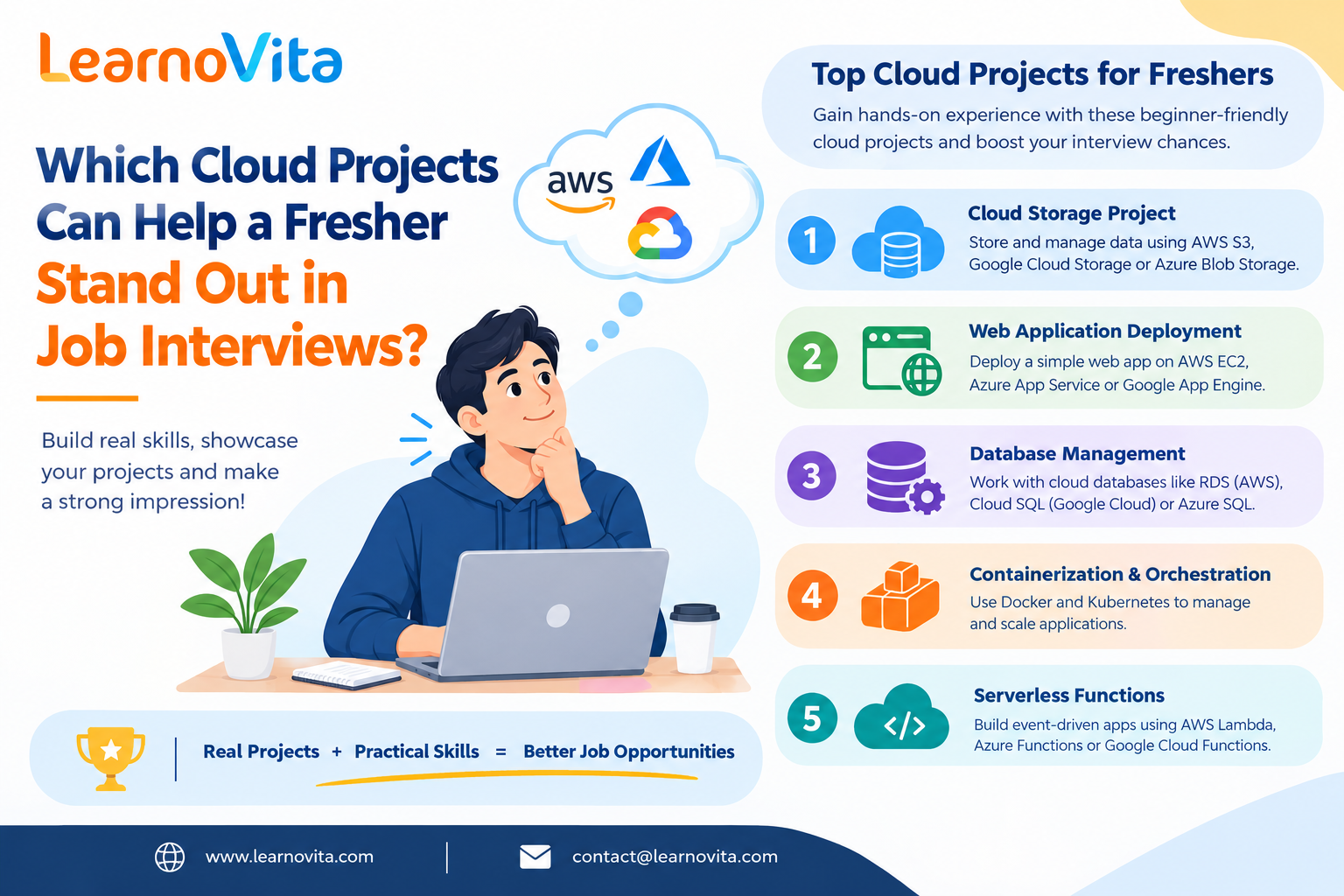
Start with a simple website or web application and deploy it on a cloud platform. You can use Amazon EC2, Azure Virtual Machines, or Google Compute Engine to create the required environment. Configure the server, install the application, manage basic networking, and make the website accessible online. Adding HTTPS, a custom domain, and basic security rules can make the project more practical. This project helps you understand how applications operate on cloud infrastructure.
Build a Small Serverless Application
Serverless computing is another useful area for a beginner project. Create a simple application using AWS Lambda, Azure Functions, or Google Cloud Functions. For example, you could build an image-processing tool, notification service, feedback processor, or basic API. Configure an event to trigger the function and connect it with other cloud services when required. This project gives you experience with event-driven applications without managing traditional servers.
Create a Cloud File Management System
Develop a basic application that allows users to upload, store, and retrieve files from cloud storage. Amazon S3, Azure Blob Storage, and Google Cloud Storage can be used for this type of project. You can experiment with file permissions, version control, lifecycle rules, and access settings. This project demonstrates your understanding of cloud storage while giving you an opportunity to explore how data can be managed securely.
Automate Your Deployment Workflow
Freshers interested in DevOps can build a project around automated deployment. Keep your application code in GitHub and create a pipeline using GitHub Actions, AWS CodePipeline, or Azure DevOps. Configure the workflow to test the code and deploy successful changes automatically. A Cloud Computing Course in Bangalore can help learners understand the connection between cloud infrastructure, source control, and deployment automation.
Connect Applications With Cloud Databases
Create a small application that stores and retrieves information from a managed cloud database. You could develop a student records application, product catalog, employee directory, or simple inventory system. Services such as Amazon RDS, Azure SQL Database, and Google Cloud SQL can be used for database management. Configure the connection, user permissions, backups, and basic security settings to make the project more complete.
Track Application Health and Performance
Monitoring is an important part of managing cloud applications. Take one of your existing projects and configure monitoring through Amazon CloudWatch, Azure Monitor, or Google Cloud Monitoring. Track metrics such as CPU usage, resource consumption, response time, and application availability. You can also create alerts when specific limits are reached. A Cloud Computing Course in Chennai can introduce learners to these monitoring concepts and help them understand how cloud environments are observed and maintained.
Practise Basic Cloud Security
Build a small cloud environment where different users have different permissions. For example, an administrator can have wider access while another user may only be allowed to work with specific storage or application resources. Explore IAM roles, authentication, security groups, encryption, and access policies. This project can help demonstrate that you understand security as part of cloud implementation rather than treating it as a separate activity.
Choose Projects That Match Your Target Role
Your projects should reflect the type of cloud job you want to pursue. If you are interested in infrastructure, focus on virtual machines, networking, storage, and monitoring. For DevOps roles, explore automation, CI/CD, and deployment pipelines. Those interested in cloud development can work with serverless functions, APIs, and managed databases. A Cloud Computing Course in Hyderabad can help beginners explore these areas and select projects according to their career interests.
Explain Your Project Decisions Clearly
Having a project on your resume is only the first step. During an interview, you may be asked why you selected a particular cloud service, how the architecture works, what problems you faced, and how you solved them. Be prepared to explain your configuration, security approach, testing process, and possible improvements. Understanding every part of your project will make it easier to answer practical interview questions.
Conclusion
Freshers do not need a large collection of complicated projects to demonstrate cloud skills. A few well-planned projects can provide practical exposure to hosting, serverless computing, storage, databases, automation, monitoring, and security. Use what you learn in a Cloud Computing Course to build projects that match your career goals, document the work clearly, and understand the technical decisions behind each implementation.

 English
 Arabic
 French
 Spanish
 Portuguese
 Deutsch
 Turkish
 Dutch
Dutch
 Italiano
 Romaian
 Portuguese (Brazil)
 Greek
Greek