


How Is RWA Tokenization Changing the Way Real-World Assets Are Owned and Traded?
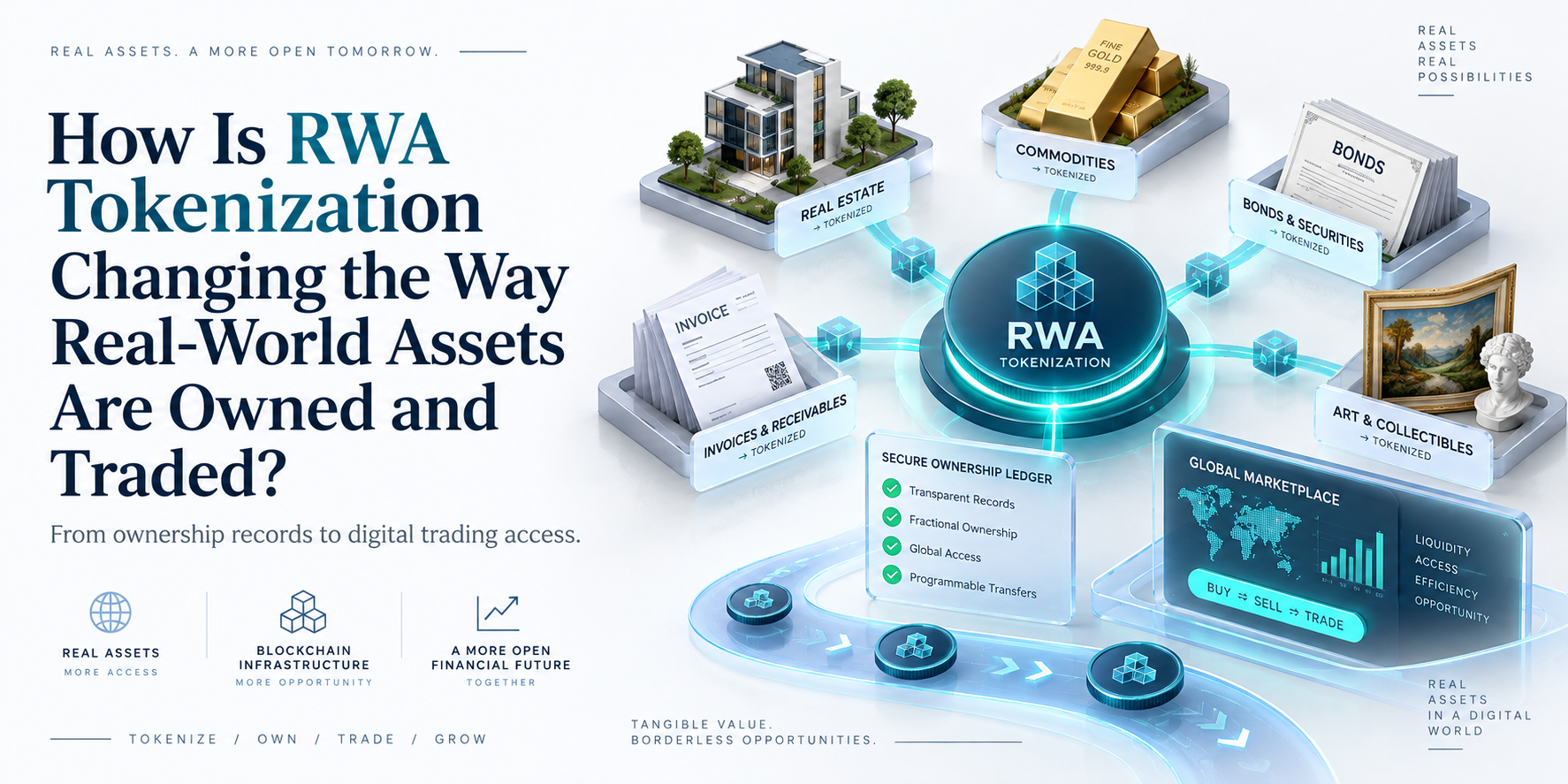
Real-world asset (RWA) tokenization is changing how ownership, investment, and trading can be structured for assets that have traditionally existed outside blockchain networks. Real estate, government bonds, private credit, commodities, funds, and other physical or financial assets can be represented through blockchain-based tokens. This creates a digital layer around ownership rights, transfer mechanisms, compliance, and transaction records.
The concept is gaining attention because traditional asset markets often involve intermediaries, lengthy settlement processes, high minimum investment requirements, and fragmented records. Blockchain infrastructure can potentially address some of these limitations by creating programmable and transparent systems for issuing and transferring asset-linked tokens.
However, tokenization is not simply a matter of putting an asset on a blockchain. The legal rights attached to a token, the connection between the digital token and the underlying asset, investor eligibility, custody, valuation, and regulatory requirements all determine whether a tokenized market can function effectively.
Understanding the Shift From Traditional Ownership to Tokenized Ownership
Traditional asset ownership usually depends on legal documents, registries, custodians, brokers, banks, and other centralized institutions. A property, for example, may have its ownership recorded in a government registry while financial transactions are documented separately by banks, brokers, and legal professionals.
Tokenization introduces a blockchain-based representation of an asset or an economic interest in that asset. Depending on the structure, each token can represent direct ownership, a beneficial interest, debt exposure, revenue rights, or another legally defined claim.
This distinction is important because owning a token does not automatically mean owning the underlying asset. The legal structure must define exactly what the token holder receives.
Tokenized Real-World Assets, RWA Asset Tokenization Solutions can therefore involve several interconnected layers. The blockchain handles digital records and transactions, while legal agreements, custodians, asset managers, registries, and compliance systems establish the connection between the token and the real-world asset.
The result is a model in which traditional assets can interact with blockchain-based financial infrastructure without necessarily eliminating the institutions that provide legal and operational oversight.
How Tokenization Changes the Ownership Model
One of the most significant changes is the possibility of fractional ownership. Traditional assets such as commercial buildings, private funds, artwork, or infrastructure projects can require substantial capital. Tokenization can divide an economic interest into smaller digital units.
Consider a commercial property valued at $10 million. Instead of structuring participation around a small number of investors, a tokenized model could represent the economic interest through a larger number of tokens. Investors could acquire a smaller exposure according to the legal and regulatory structure of the offering.
Fractionalization does not make the underlying asset inherently more valuable. Instead, it changes how participation can be structured.
This can create several potential benefits:
- Lower investment thresholds for eligible investors
- More precise ownership records
- Automated distribution of certain payments
- Easier transfer of digital ownership interests
- Greater visibility into transaction histories
- Programmable compliance requirements
The ownership model can also become more dynamic. Smart contracts can encode rules for transfers, distributions, voting rights, or other functions. Instead of relying entirely on manual processing, some operational activities can be triggered automatically when predefined conditions are met.
Blockchain Creates a Shared Transaction Layer
Traditional asset transactions often involve multiple databases maintained by different organizations. Reconciling these records can take time and introduce operational complexity.
Blockchain networks provide a shared ledger where transactions can be recorded according to the rules of the network and application. Once properly recorded, transaction history can be easier for authorized participants to verify.
This is particularly relevant to asset markets because ownership transfers require reliable records.
For example, a tokenized bond platform could record the issuance of securities, investor transfers, coupon-related activity, and redemption events through blockchain infrastructure. Smart contracts could enforce predefined rules while authorized participants retain appropriate compliance controls.
The blockchain therefore acts less like a replacement for every existing institution and more like a common digital infrastructure connecting different parts of the asset lifecycle.
Trading Can Become More Programmable
Tokenization also changes how assets can be transferred. In conventional markets, a transaction may require coordination among buyers, sellers, brokers, custodians, clearing systems, and settlement institutions.
A blockchain-based system can combine certain transaction and settlement functions within programmable infrastructure.
For example, a smart contract can be designed to release a token only after the required payment has been received. Another contract could restrict transfers to verified wallets. Distribution contracts could automatically calculate and distribute income according to token ownership.
This programmability can reduce manual intervention in certain processes. It can also make compliance rules part of the transaction architecture rather than treating compliance as an entirely separate administrative procedure.
However, this does not mean every tokenized asset can trade freely 24/7. Regulatory restrictions, investor eligibility requirements, transfer limitations, market liquidity, and platform rules can still determine when and how tokens can be traded.
Real Estate Is a Major Example of the Transformation
Real estate illustrates the potential impact of tokenization particularly well because property is traditionally illiquid and transaction-heavy.
Buying or selling property can involve legal checks, title verification, financing, intermediaries, documentation, and settlement procedures. Tokenization can create a digital representation of ownership or an economic interest in a property through a legally structured entity.
For example, a property could be placed within a special-purpose entity, with investors receiving tokens representing defined interests in that structure. Rental income could then be distributed according to token ownership, subject to the relevant legal arrangements.
Tokenization may also allow investors to participate in different types of property exposure without purchasing an entire building. Commercial offices, residential developments, hotels, warehouses, and other properties can potentially be structured into tokenized investment products.
The key advantage is not merely digitization. The more important change is the ability to connect ownership records, investor management, payments, compliance, and transfer mechanisms within a coordinated digital infrastructure.
Government Bonds Demonstrate Another Important Use Case
Government securities have become another important area for asset tokenization. Tokenized treasury products can represent interests in short-term government debt while using blockchain infrastructure for issuance, transfers, and recordkeeping.
This market has expanded considerably in recent years. Industry data has shown strong growth in tokenized U.S. Treasury products as investors and financial institutions explore blockchain-based settlement and access mechanisms.
The attraction comes partly from the combination of a familiar underlying asset and blockchain-based infrastructure. Instead of creating an entirely new asset class, tokenization can place an existing financial instrument into a digital environment.
This approach demonstrates an important principle of RWA tokenization: the blockchain does not necessarily replace the underlying asset. It can provide a new mechanism for representing, managing, transferring, and interacting with rights associated with that asset.
Tokenization Can Improve Settlement Efficiency
Settlement is one of the areas where blockchain-based asset infrastructure can create measurable operational changes.
Traditional securities transactions can involve a separation between trade execution and final settlement. Different intermediaries may maintain separate records, and reconciliation can create additional operational work.
Tokenized assets can potentially support atomic or near-real-time settlement. In a properly designed system, the transfer of an asset token and the corresponding payment can occur according to predefined conditions.
This could reduce counterparty exposure and shorten settlement timelines in certain markets.
Nevertheless, settlement speed depends on the complete infrastructure surrounding the tokenized asset. Blockchain confirmation is only one component. Banking rails, custody systems, legal processes, compliance checks, and asset servicing still affect the overall transaction experience.
Liquidity Is an Opportunity, Not a Guarantee
One of the most frequently discussed benefits of tokenization is improved liquidity. Tokenizing an illiquid asset can make its ownership interest easier to transfer digitally, but the existence of tokens does not automatically create buyers.
Liquidity depends on market depth, investor demand, regulatory accessibility, trading venues, pricing transparency, and the quality of the underlying asset.
A tokenized property may be technically transferable but still have limited liquidity if only a small number of investors are interested in purchasing it.
This distinction is essential for understanding the actual impact of tokenization. Blockchain can reduce some barriers associated with transferring ownership interests, but it cannot manufacture demand.
Successful tokenized markets therefore need more than smart contracts. They require reliable asset sourcing, compliant onboarding, investor protection, transparent valuation, custody, market infrastructure, and sufficient participation.
Smart Contracts Add Automation to Asset Management
Smart contracts are another major component of tokenization. They are blockchain-based programs that execute predefined logic when specified conditions are met.
In an RWA platform, smart contracts can support activities such as:
- Token issuance
- Ownership transfers
- Investor eligibility checks
- Revenue distributions
- Voting mechanisms
- Redemption processes
- Transaction restrictions
- Fee calculations
Suppose investors hold tokens representing an economic interest in a rental property. A properly structured system could calculate each investor's share of distributable income based on token holdings.
Automation can reduce repetitive administrative work. At the same time, smart contracts must be carefully designed and audited because coding errors can affect financial transactions.
Compliance Becomes Part of the Technology
RWA tokenization cannot be separated from regulation. Real-world assets are governed by laws relating to securities, property ownership, taxation, investor protection, anti-money laundering requirements, identity verification, and financial services.
This means tokenized platforms increasingly need compliance mechanisms integrated into their architecture.
Know Your Customer (KYC) and Anti-Money Laundering (AML) procedures can be connected with wallet permissions. Transfer restrictions can prevent tokens from moving to unauthorized addresses. Investor categories can determine which assets or markets a participant can access.
This approach is sometimes described as compliance by design. Instead of treating regulation as a process that occurs outside the platform, developers can incorporate certain regulatory requirements directly into the transaction workflow.
The exact requirements vary significantly by jurisdiction and asset type, so tokenization projects require appropriate legal and regulatory analysis before deployment.
What Changes for Investors?
For investors, tokenization can change how they discover, access, hold, and transfer asset interests.
A digital wallet can potentially provide a single interface for managing multiple tokenized assets. Investors may be able to view holdings, transaction histories, distributions, and other information through an online dashboard.
Tokenization can also create opportunities for more flexible portfolio construction. An investor could potentially combine exposure to real estate, private credit, government securities, commodities, and other assets within a digital portfolio.
But investors still face conventional risks. Asset prices can decline, issuers can fail, markets can become illiquid, and legal structures can introduce complexity. Blockchain transparency does not eliminate investment risk.
There are also technology risks, including smart contract vulnerabilities, wallet security issues, operational failures, and problems connecting blockchain records with real-world asset ownership.
The Growing Market Signals Increasing Institutional Interest
The growth of tokenized assets has moved the concept beyond experimental blockchain projects. Industry research during 2025 and 2026 has documented increasing activity across tokenized treasuries, private credit, funds, commodities, equities, and real estate.
For example, CoinDesk Research reported that tokenized assets reached approximately $28.9 billion in May 2026, with tokenized U.S. Treasuries accounting for around $16.2 billion. These figures illustrate the increasing presence of traditional financial assets within blockchain-based markets.
The broader trend suggests that financial institutions are exploring tokenization not only as a retail investment mechanism but also as infrastructure for issuance, settlement, collateral management, and asset servicing.
The long-term significance may therefore extend beyond fractional ownership. Tokenization could become part of the underlying infrastructure through which certain financial and physical assets are issued and managed.
Challenges That Could Shape the Next Stage
Despite its potential, RWA tokenization faces several challenges.
The first is legal enforceability. A blockchain record is useful only when the legal system recognizes the rights represented by the token.
The second is interoperability. Different platforms may use different blockchain networks, token standards, identity systems, and compliance frameworks. Connecting these systems remains technically and commercially challenging.
The third is reliable asset verification. Investors need confidence that the token actually corresponds to the stated underlying asset. Independent audits, custodial arrangements, legal documentation, valuation procedures, and reporting can help address this issue.
The fourth is liquidity. Tokenized markets need sufficient buyers and sellers to function efficiently.
Finally, user experience remains important. Investors accustomed to conventional financial platforms may not want to manage complex wallet infrastructure or blockchain transactions directly. Platforms that abstract unnecessary technical complexity while preserving transparency could play an important role in adoption.
The Future of Asset Ownership and Trading
RWA tokenization is gradually shifting the concept of asset ownership from static records toward programmable digital ownership infrastructure.
Instead of viewing tokenization simply as a method of creating digital representations, it is more useful to see it as a way of connecting ownership, compliance, payments, custody, trading, and asset management within a unified digital environment.
The strongest applications are likely to emerge where blockchain solves a genuine operational problem. Real estate, government securities, private credit, funds, and other traditionally fragmented markets can benefit when tokenization improves transparency, reduces administrative friction, or enables more flexible ownership structures.
The technology alone, however, is not enough. Legal certainty, regulatory compliance, investor protection, asset verification, cybersecurity, and sustainable market demand will determine whether tokenized markets achieve meaningful adoption.
Conclusion
RWA tokenization is changing the way real-world assets can be represented, owned, managed, and traded by connecting traditional assets with programmable blockchain infrastructure. Fractional ownership, transparent records, automated transactions, faster settlement, and digitally integrated compliance can create new possibilities for asset markets. At the same time, successful tokenization requires strong legal frameworks, secure technology, verified assets, regulatory alignment, and genuine market liquidity. Businesses exploring this model can work with experienced blockchain developers to build secure and compliant platforms, and Blockchain App Factory provides best services for RWA tokenization, smart contract development, investor dashboards, wallet integration, and related blockchain infrastructure.
FAQs
1. What is RWA tokenization?
RWA tokenization is the process of representing ownership or economic rights associated with real-world assets through blockchain-based digital tokens.
2. Can tokenization make real-world assets easier to trade?
It can make certain ownership interests easier to transfer digitally, but actual liquidity depends on investor demand, regulation, market infrastructure, and asset characteristics.
3. What assets can be tokenized?
Potential assets include real estate, government bonds, private credit, commodities, investment funds, equities, and other assets with clearly defined ownership or economic rights.
4. Do tokenized assets eliminate traditional intermediaries?
Not necessarily. Legal entities, custodians, asset managers, brokers, compliance providers, and other institutions may still be required depending on the asset and jurisdiction.
5. What role do smart contracts play in RWA tokenization?
Smart contracts can automate functions such as token issuance, transfers, distributions, eligibility rules, voting, and redemption according to predefined conditions.

 English
 Arabic
 French
 Spanish
 Portuguese
 Deutsch
 Turkish
 Dutch
Dutch
 Italiano
 Russian
 Portuguese (Brazil)
 Greek
Greek