


Why Edge Clearance Matters in Packaging Inserts
Why Edge Clearance Matters in Packaging Inserts
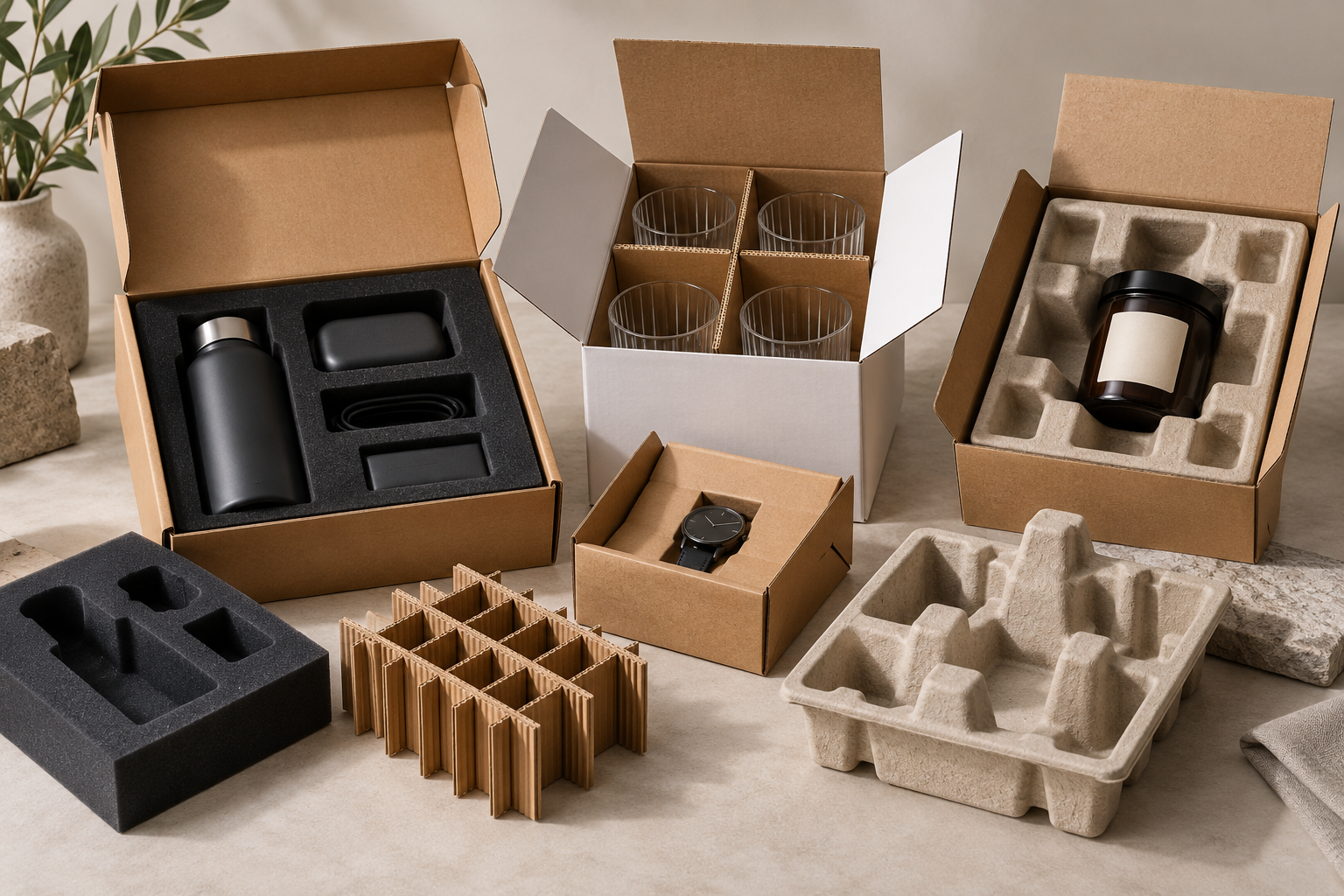
Packaging inserts do more than hold a product in one position. The amount of space between the product, the insert, and the outer walls of the box also affects how the package responds to pressure, vibration, and impact. The different insert materials and structures can be found through Inserts Hub, where cardboard, foam, corrugated, molded pulp, and other insert formats are covered.
This surrounding space is commonly considered during insert planning because a product positioned too close to the outer wall may receive more force when a box is dropped or compressed. At the same time, leaving excessive unused space can allow components to shift or increase the overall dimensions of the package.
What Edge Clearance Means in Packaging
Edge clearance is the distance between a packed product and the inner walls, corners, top, or bottom of its outer box.
The required distance is not always the same on every side. A lightweight plastic item may need less surrounding space than a glass container, electronic part, or other item that can be damaged by impact.
Insert material also affects this distance. Foam can compress under pressure, while folded cardboard and corrugated structures usually manage force in a different way. Molded pulp may use ribs, walls, and shaped cavities to create separation between the product and the outer box.
Because these materials behave differently, the physical space around the product should be considered together with the insert structure.
Why Products Should Not Sit Against Box Walls
When a product touches an outer wall directly, there is little material between the product and an external force.
During handling, boxes can experience drops, stacking pressure, vibration, and contact with other packages. If the product is positioned directly against one side of the box, part of this force can transfer to the item.
An insert creates a controlled gap and provides another structural layer between the product and the shipping environment.
This is particularly relevant around corners. Box corners may experience concentrated pressure when packages are dropped at an angle. Positioning fragile parts away from these areas can reduce direct contact with the affected section of the box.
Edge Clearance and Foam Inserts
Foam inserts often use cavities cut according to the general dimensions of the packed item.
However, cavity size is only one part of the layout. The designer also needs enough foam between the cavity and the outside edge of the insert.
A very thin foam wall may compress quickly or tear if the packed product is heavy. Wider foam sections can provide more material to absorb movement before the product reaches the outer box.
The required thickness depends on factors such as
-
Product weight
-
Product shape
-
Fragility
-
Foam density
-
Box dimensions
A deep cavity also needs enough foam below the product. If the bottom layer is too thin, downward impact can transfer through the insert more easily.
Clearance in Cardboard Insert Structures
Cardboard inserts manage product position differently from foam.
Instead of surrounding an item with thick cushioning material, cardboard inserts may use folded panels, locking tabs, raised platforms, slots, or internal walls.
These structures can keep an item away from the outer walls while using relatively little material.
For lightweight products, folded sections can create controlled spacing between the item and the box. Heavier objects may require additional support sections so the cardboard does not collapse or bend excessively.
The direction of the paperboard folds also matters because pressure applied along one direction can affect the structure differently than pressure applied from another direction.
Corrugated Inserts and Impact Space
Corrugated inserts contain a fluted layer between liner sheets. This structure can provide separation while also resisting compression.
When corrugated material is used around a product, the flutes and folded sections can create a buffer between the packed item and the outer carton.
A corrugated insert may use side walls, partitions, platforms, or folded supports. These components can create clearance without requiring the product to sit directly against the shipping box.
For heavier products, the design should also consider how weight is distributed across the bottom of the insert. Concentrating all weight on a narrow area may place more stress on the material.
Clearance Between Multiple Products
Edge clearance is not limited to the space between a product and the outer box.
It also applies to the distance between multiple items packed inside the same container.
Glass jars, bottles, electronic components, candles, and similar products may damage each other if they can make direct contact. Dividers and multi-cavity inserts can maintain separation between individual items.
The spacing should account for both normal movement and possible compression of the insert material.
A divider that appears wide enough while the package is stationary may behave differently when weight is placed on top of the box or when the package experiences repeated vibration.
Product Shape Changes Clearance Requirements
Products with irregular shapes need particular attention because the nearest point to the box wall may not be obvious from basic length and width measurements.
A bottle may have a wider shoulder than its base. A device may contain buttons, handles, corners, or projecting parts. Glass containers may include caps that extend beyond the main body.
Measurements should therefore consider the complete product rather than only its main body.
The widest, tallest, and most exposed points usually determine where additional spacing may be necessary.
Too Much Space Can Also Cause Problems
More clearance is not automatically better.
If an insert leaves excessive room around the product, the outer box may become larger than necessary. Uncontrolled gaps inside the insert can also allow the item to move.
The purpose of clearance is to create controlled separation rather than empty space.
The product should remain supported by the insert while maintaining enough distance from areas where outside pressure or impact could reach it directly.
Evaluating Clearance Before Production
Physical testing can help identify problems that may not be obvious from a drawing.
A sample package can be examined for movement, compression, contact with box walls, and pressure on exposed product areas. The package can also be handled from different directions to see whether the product remains separated from the outer structure.
Attention should be given to the bottom, corners, side walls, and top of the package because each area may experience a different type of force.
Measurements, material behavior, product weight, and insert structure all work together. Edge clearance is therefore not simply unused space inside a box. It is part of the physical relationship between the product, insert, and outer packaging.

 English
 Arabic
 French
 Spanish
 Portuguese
 Deutsch
 Turkish
 Dutch
Dutch
 Italiano
 Russian
 Portuguese (Brazil)
 Greek
Greek