


5 Key Limit Switch Specifications to Check Before Choosing One
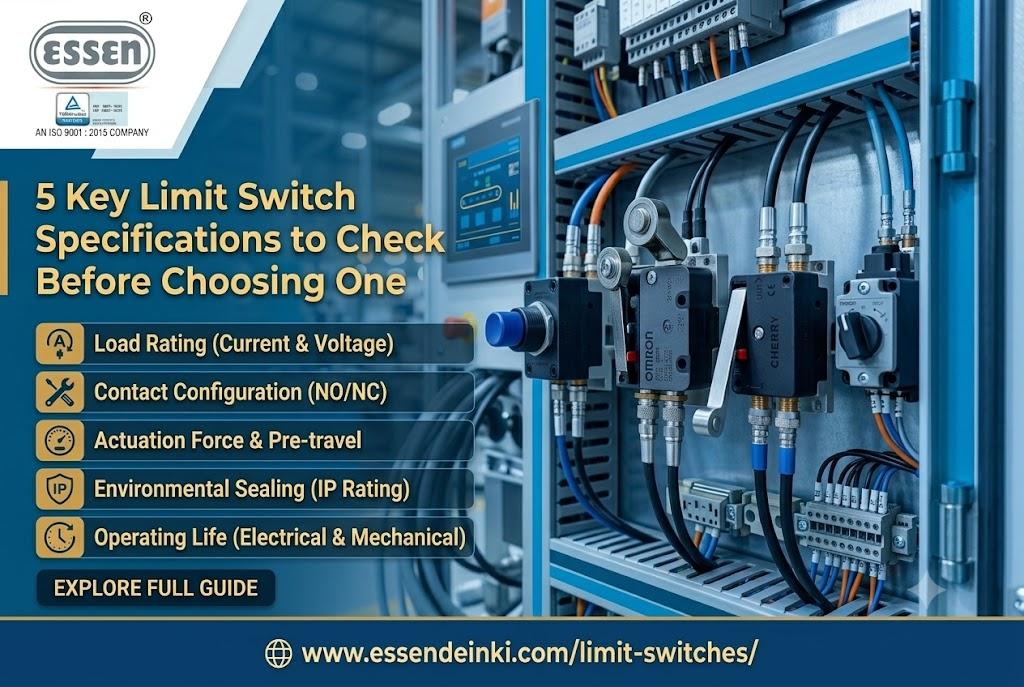
Choosing the right Limit Switches for an industrial application requires more than checking the size or appearance of the component. A limit switch may be responsible for detecting machine position, controlling movement, stopping equipment at the end of a travel cycle, or supporting an interlocking function. The wrong specification can affect switching reliability, service life, and overall machine performance.
Before selecting a limit switch, it is important to compare the specifications with the actual requirements of your equipment. Here are five key specifications worth checking.
1. Electrical Rating
The electrical rating is one of the first specifications to review when choosing Limit Switches. It indicates the voltage and current the contacts are designed to handle under specified conditions.
For example, ESSEN Deinki's LS Series lists ratings of up to 10A at 500V AC, along with specified DC ratings for non-inductive loads. The actual load type should always be considered because resistive and inductive circuits can place different demands on switch contacts.
Check the operating voltage, current, AC or DC supply, and load characteristics before selecting a model.
2. Contact Arrangement and Switching Mechanism
The contact arrangement determines how the switch interacts with the electrical circuit. Depending on the application, you may require configurations such as 1NO + 1NC, 1NO + 2NC, 2NO + 1NC, or 2NO + 2NC.
The switching mechanism is equally important. Normal-action and snap-action designs can have different operating characteristics. ESSEN Deinki's LS Series offers multiple contact configurations and snap-action options for industrial control applications.
Consider how the switch needs to behave when the actuator is operated and which contacts your control circuit requires.
3. Actuator Type and Operating Force
The actuator is the part of the Limit Switches that comes into contact with the moving machine component. Common options include push rods, pin plungers, roller plungers, and roller levers.
The right actuator depends on the direction and type of movement in your equipment. A roller lever, for example, can be useful when the machine component moves across the actuator, while a plunger may be better suited to direct mechanical contact.
Operating force should also be checked. ESSEN Deinki models have different actuating-force specifications depending on their construction and actuator configuration.
4. Protection Rating and Operating Environment
Industrial equipment may operate around dust, moisture, vibration, temperature changes, and other demanding conditions. This makes the protection rating an important consideration.
For applications requiring greater protection against dust and water, a suitable enclosed design may be necessary. For example, ESSEN Deinki's LS-V miniature limit switches are designed with IP65 protection, while the LS-J heavy-duty range offers IP67 protection.
Temperature should also be considered. The selected switch should have an operating temperature range appropriate for the environment where it will be installed.
5. Mechanical and Electrical Life
A limit switches may operate thousands or even millions of times during its service life. Therefore, mechanical and electrical life ratings are important when selecting a model for frequently operated machinery.
Mechanical life refers to the expected number of mechanical operations, while electrical life relates to switching under specified electrical conditions.
ESSEN Deinki's LS Series specifies a typical mechanical life of up to 15 million switching cycles, while the LS-V Series specifies up to 10 million mechanical operations and 300,000 electrical operations at full rated load.
Final Thoughts
Selecting the right Limit Switches means looking beyond basic dimensions. Electrical rating, contact arrangement, actuator type, operating force, environmental protection, and service life can all influence whether a switch is suitable for a particular machine.
ESSEN Deinki offers different limit switch categories, including all-purpose, oil-tight, heavy-duty, miniature, loom, and precision limit switches. Comparing these specifications with your application's actual requirements can help you choose a suitable configuration for reliable industrial operation.
Explore the ESSEN Deinki Limit Switches range to review available configurations and specifications.

 English
 French
 Spanish
 Portuguese
 Deutsch
 Turkish
 Dutch
Dutch
 Italiano
 Russian
 Romaian
 Portuguese (Brazil)
 Greek
Greek