


Chatbot Market Growth Reflects a Shift Toward Instant and Intelligent Service
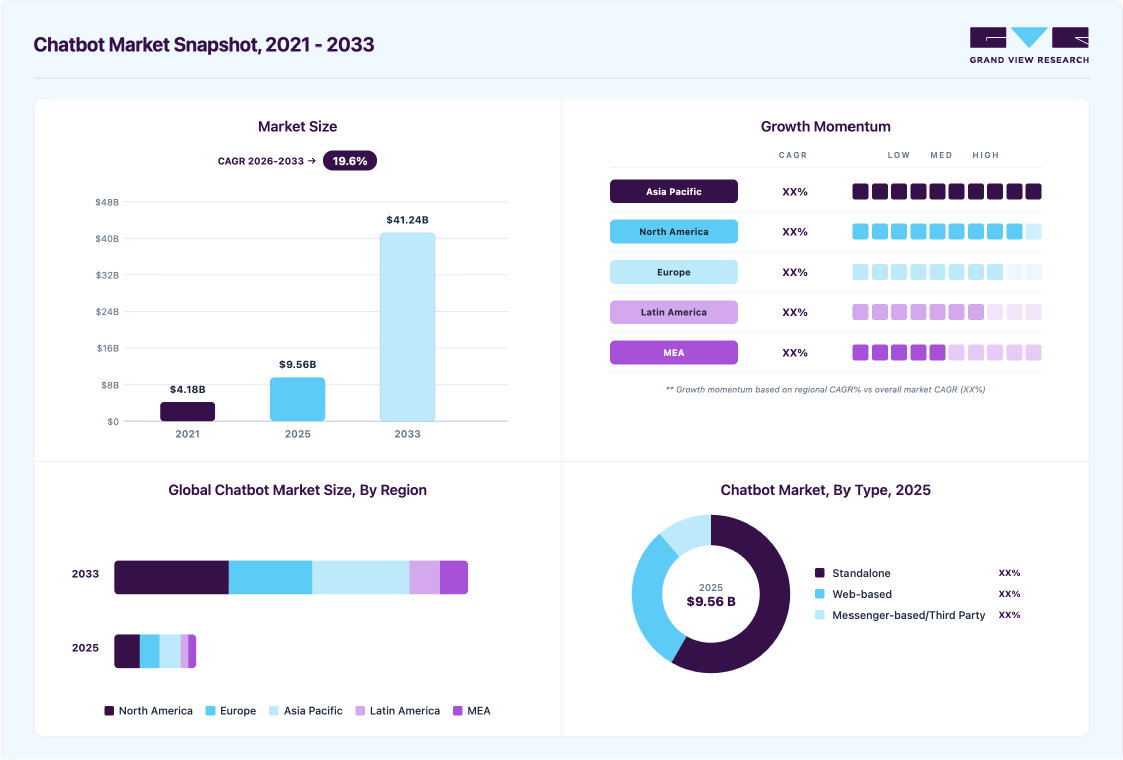
The chatbot market is entering a faster phase of expansion as businesses use artificial intelligence, machine learning, and natural language processing to improve digital interactions. The market was estimated at USD 9.6 billion in 2025 and is projected to grow from USD 11.8 billion in 2026 to USD 41.2 billion by 2033, reflecting a CAGR of 19.6% from 2026 to 2033. Growth is being supported by demand for faster service, automation, and scalability.
Chatbot Market Growth Builds on AI and Digital Engagement
Businesses across customer service, e-commerce, banking, healthcare, retail, and telecom are increasingly deploying AI-powered chatbots. These systems provide 24/7 support, handle high volumes of inquiries, reduce response times, and automate routine interactions. Natural language processing and machine learning are improving contextual understanding and response accuracy, allowing chatbots to address more complex requirements.
Consumer preferences for instant and personalized interactions are adding to adoption. Companies are using chatbots for customer support, lead generation, product recommendations, appointment scheduling, technical support, and transaction assistance. Cloud-based AI platforms and digital transformation initiatives are accelerating integration across websites, mobile applications, and messaging services.
Market Size and Forecast Highlight Strong Expansion
The chatbot market is estimated at USD 9.6 billion in 2025, with the market expected to reach USD 11.8 billion in 2026 and USD 41.2 billion by 2033. Its projected CAGR of 19.6% from 2026 to 2033 reflects continued investment in conversational intelligence and automated engagement.
Solution and Standalone Formats Maintain Leading Positions
By offering, the solution segment led the market and held a revenue share of over 61.8% in 2025. AI-powered platforms are being used for customer service, lead generation, and employee support.
By type, standalone chatbots held the leading position with a revenue share of over 58.2% in 2025. Web-based chatbots are also gaining popularity because they can be deployed through browsers and accessed across devices.
Mobile Applications and Sales Functions Expand Chatbot Use
Mobile applications accounted for the highest revenue in 2025. Mobile-first digital interactions are encouraging businesses to integrate chatbots into applications for real-time assistance, recommendations, and service delivery.
Sales and marketing accounted for the highest revenue share among business functions in 2025. Chatbots support lead generation, marketing campaigns, customer relationship management, personalized recommendations, and lead nurturing. Finance-related chatbot use is also expanding as institutions seek automated support for financial planning, account management, and personalized investment assistance.
Customer Service and Retail Applications Drive Adoption
Customer service dominated the chatbot market in 2025. Businesses are using chatbots to automate interactions, provide 24/7 support, reduce operational costs, and improve response times. E-commerce and hospitality businesses use these systems to manage frequent questions and high volumes of requests.
Retail and e-commerce dominated by vertical in 2025. Chatbots support product searches, personalized recommendations, order tracking, and post-purchase assistance. Payment processing is another growing application, with chatbots helping with bill payments, fund transfers, and transaction updates as mobile payments and online banking expand.
Technology Progress and Omnichannel Strategies Shape the Outlook
Generative AI and natural language processing are improving chatbot accuracy, contextual understanding, and interaction quality. Omnichannel engagement strategies are also creating opportunities by connecting websites, mobile applications, social media, and messaging services. Consistent conversations across these channels can reduce response gaps and support a connected customer journey.
Data privacy remains an important restraint. Chatbots may process personal, financial, and behavioral information, creating concerns around unauthorized access, data leakage, security vulnerabilities, and regulatory compliance. Encryption, secure infrastructure, and continuous monitoring can add implementation complexity, particularly in regulated industries.
Regional and Competitive Market Perspective
North America accounted for the largest market share at 31.3% in 2025, supported by investment in AI and automation and adoption across sectors such as retail and banking. Specialized vendors serve niche requirements alongside larger technology companies with scalable platforms and integrated ecosystems.
FAQ
How big is the chatbot market?
The chatbot market was estimated at USD 9.6 billion in 2025 and is projected to reach USD 11.8 billion in 2026 and USD 41.2 billion by 2033.
What trends are shaping the chatbot market?
Generative AI, natural language processing, omnichannel engagement, mobile applications, personalized interactions, and expanding automation are shaping chatbot market development.
Key Chatbot Companies:
· Amazon Web Services, Inc.
· D-Wave Quantum Inc.
· Fujitsu
· Google LLC
About us:
Grand View Research, a market research and consulting company, provides syndicated research reports, customized research reports, and consulting services. Grand View Research database is used by the world's renowned academic institutions and Fortune 500 companies to understand the global and regional business environment. Our database features thousands of statistics and in-depth analysis on 46 industries in 25 major countries worldwide.

 English
 Arabic
 French
 Spanish
 Portuguese
 Deutsch
 Turkish
 Dutch
Dutch
 Italiano
 Romaian
 Portuguese (Brazil)
 Greek
Greek