


Microsoft Dynamics 365 Business Central for Inventory and Supply Chain Management
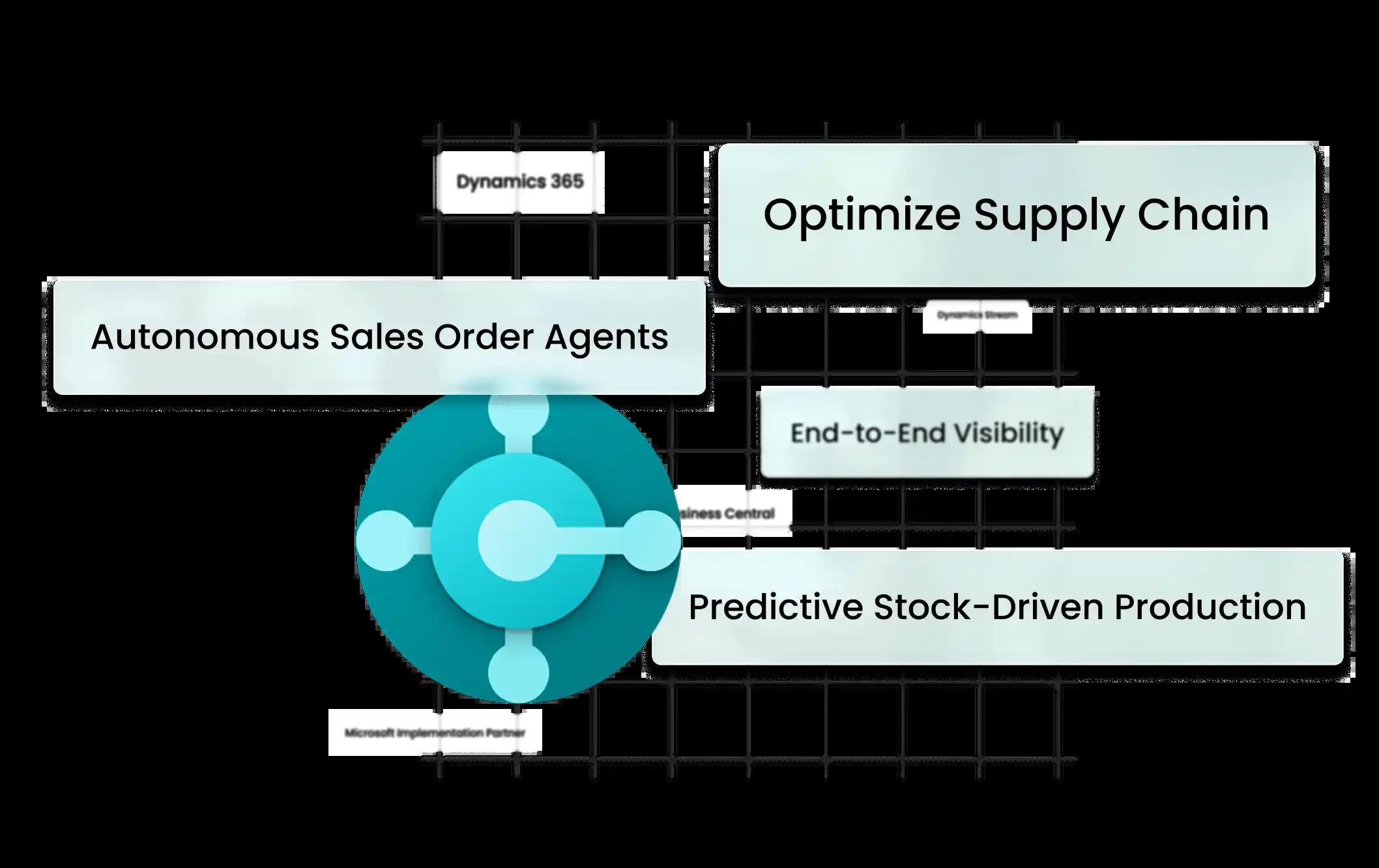
Managing inventory becomes increasingly complex as a business grows. More products, suppliers, warehouses, sales channels, and customer orders create more data that needs to be tracked accurately.
For businesses looking to connect purchasing, inventory, sales, warehousing, and financial processes, Microsoft Dynamics 365 Business Central provides an integrated ERP environment designed to support these operations.
Microsoft states that Business Central supports inventory, purchasing, warehouse management, supply chain processes, and inventory forecasting.
Why Inventory Management Becomes Difficult as Businesses Grow
Small businesses can sometimes manage inventory through spreadsheets or basic accounting software. However, as product volumes and transaction numbers increase, these approaches can become difficult to maintain.
Common challenges include:
-
Inaccurate stock counts
-
Overstocking
-
Stock shortages
-
Multiple warehouse locations
-
Manual purchase tracking
-
Difficult inventory reconciliation
-
Limited visibility into product availability
-
Delayed reporting
An ERP platform can connect these activities and provide a centralized view of inventory.
Centralized Inventory Management With Business Central
Business Central allows organizations to create and manage inventory items and track transactions associated with purchases, sales, transfers, and adjustments.
Businesses can also organize inventory across different locations.
This can be useful for organizations operating:
-
Multiple warehouses
-
Distribution centers
-
Retail locations
-
Regional storage facilities
-
Manufacturing sites
Inventory can be transferred between locations while maintaining records of the movement.
Manage Inventory Across Multiple Locations
A growing company may have inventory stored in different cities, warehouses, or facilities.
Business Central supports multiple inventory locations and transfer processes, allowing organizations to maintain visibility across their distribution network.
For example, a company might maintain separate inventory for:
-
Main warehouse
-
Regional warehouse
-
Retail location
-
Manufacturing facility
This centralized approach can make it easier to understand where products are located and how much stock is available.
Connect Purchasing With Inventory
Purchasing decisions are closely connected to inventory levels.
When purchasing and inventory information are managed separately, employees may need to manually compare purchase orders with stock levels.
Business Central connects purchasing and inventory processes, helping businesses manage vendor information, purchase orders, receipts, and inventory transactions through an integrated system.
This can provide purchasing teams with better context when deciding what needs to be ordered.
Improve Inventory Visibility
Inventory visibility is important for both operations and customer service.
When sales teams can access current product availability, they can make more informed decisions about customer orders.
Microsoft's Business Central documentation describes functionality for viewing item availability by location and across different demand and supply scenarios.
This can help organizations understand whether inventory is available, reserved, incoming, or located elsewhere.
Manage Warehouse Operations
Inventory management does not stop at knowing how many products a company owns.
Businesses also need to know where items are stored and how they move through the warehouse.
Business Central supports warehouse processes involving receiving, storing, picking, putting away, transferring, and shipping goods.
Microsoft also describes warehouse technology as a way to improve inventory visibility, operational consistency, productivity, and data-driven decision-making.
Support Barcode-Based Warehouse Processes
Modern warehouses often need fast and accurate methods for identifying and moving products.
Business Central supports warehouse processes that can incorporate barcode scanners and structured pick-and-put-away activities.
This can help warehouse teams reduce manual data entry and improve the accuracy of physical inventory operations.
Inventory Forecasting and Replenishment
Businesses need to maintain enough inventory to meet demand without unnecessarily tying up capital in excess stock.
Business Central includes inventory forecasting capabilities and can support replenishment based on demand and availability. Microsoft currently highlights AI-powered sales and inventory forecasting within Business Central.
Forecasting can give purchasing and operations teams additional information when planning future inventory requirements.
Connect Sales and Inventory
Inventory decisions are closely connected to customer orders.
When a customer places an order, the business needs to know whether the required products are available, where they are located, and when they can be delivered.
An integrated ERP system can connect sales transactions with inventory records.
This creates a more connected flow:
Customer Order → Inventory Availability → Picking → Shipment → Invoice
Connecting these steps can reduce the need to manually transfer information between separate systems.
Inventory Analytics
Simply collecting inventory data is not enough. Businesses also need to analyze it.
Business Central provides inventory analytics and reporting capabilities that can help organizations monitor inventory performance.
Organizations can use inventory information to investigate areas such as:
-
Stock levels
-
Inventory valuation
-
Product availability
-
Inventory movements
-
Location-level stock
-
Demand
-
Replenishment requirements
These insights can support operational planning.
How Business Central Supports the Supply Chain
Supply chain operations involve multiple connected activities.
A typical process might look like:
Supplier → Purchase Order → Receiving → Warehouse → Inventory → Customer Order → Picking → Shipping
Business Central can connect many of these processes through one ERP environment.
This can give organizations a more complete view of how products move through the business.
Who Can Benefit From Business Central Inventory Management?
Business Central can be relevant for organizations involved in:
-
Wholesale
-
Distribution
-
Retail
-
Manufacturing
-
Ecommerce
-
Professional services with inventory requirements
-
Product-based businesses
Microsoft notes that Business Central supports common processes for small and medium-sized companies while also supporting more complex areas such as manufacturing and directed warehouse management.
Implementing Microsoft Dynamics 365 Business Central
Technology alone does not automatically solve inventory problems.
Businesses need to configure locations, item records, units of measure, warehouse processes, purchasing rules, workflows, and reporting according to their requirements.
That makes implementation an important part of an ERP project.
Microsoft Dynamics 365 Business Central implementation can help organizations bring these processes into a structured ERP environment.
Final Thoughts
Effective inventory management requires more than knowing how many products are available.
Businesses need visibility into purchasing, warehouse movements, sales demand, product availability, and inventory costs.
Microsoft Dynamics 365 Business Central connects many of these processes within one ERP platform, giving businesses a centralized environment for managing inventory and supply chain operations.
For growing organizations, implementing an integrated ERP system can provide a foundation for more connected inventory and supply chain management.

 English
 Arabic
 French
 Spanish
 Portuguese
 Deutsch
 Turkish
 Dutch
Dutch
 Italiano
 Russian
 Romaian
 Portuguese (Brazil)