


ERP Is Becoming an Action System for AI Agents. What Businesses Need to Fix First
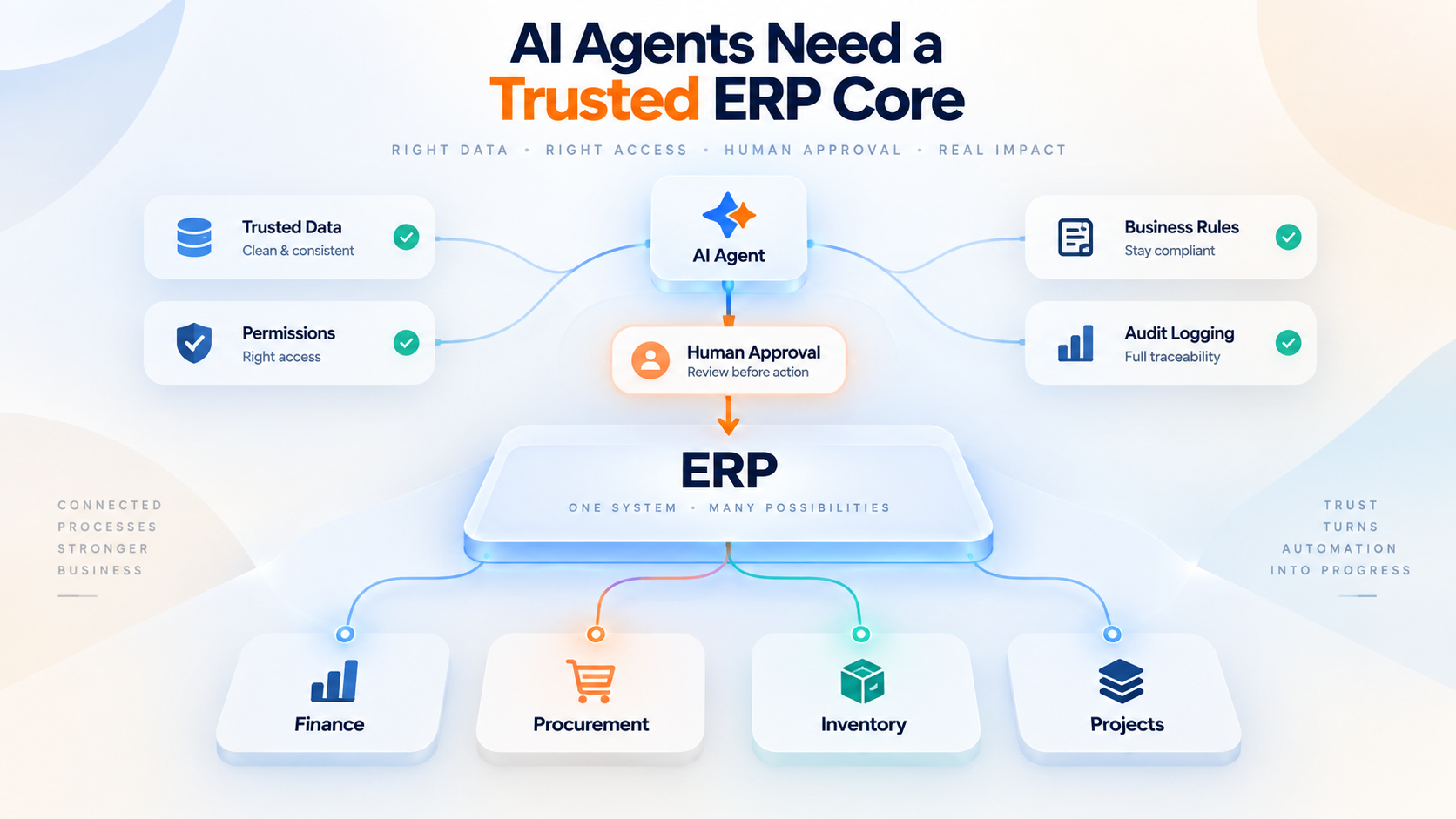
ERP systems have spent decades recording transactions, enforcing business rules, and connecting finance, procurement, inventory, projects, and operations. In 2026, their role is expanding again. AI agents are beginning to interact directly with ERP data and business logic, investigate exceptions, recommend actions, and complete controlled tasks.
That shift changes the work involved in erp consulting services. ERP readiness now includes data ownership, API access, permissions, workflow design, approval controls, and deciding which business actions an AI agent should be allowed to perform.
The direction is already visible across major ERP platforms.
Microsoft’s Dynamics 365 ERP MCP server can expose nearly all data and business logic available through Finance and Operations applications to AI agents, including extensions and environment customizations. The capability reached general availability in January 2026.
ERP Is Becoming an Action System for AI Agents. What Businesses Need to Fix FirstSAP is also moving agent execution directly into ERP. On September 22, SAP is demonstrating production capabilities for finance, supply chain, and spend processes inside SAP Cloud ERP Private. The company says its broader autonomous suite includes more than 200 agents and over 50 Joule assistants.
Oracle’s current ERP roadmap includes agents for cash processing, budget adjustment, capital expenditure planning, billing operations, asset management, project billing, reconciliation, and other finance processes.
The common direction is clear. ERP is becoming an operating environment for agents.
ERP data quality now affects automated decisions
Traditional ERP data problems could often be corrected by employees before a transaction moved forward.
Agent based processes can move faster.
Imagine an agent responsible for resolving an invoice exception.
It may need to check:
- supplier information
- purchase orders
- received quantities
- invoice values
- approval status
- payment terms
- account combinations
If supplier data is duplicated or purchase order information is incomplete, the agent receives unreliable context.
That creates a simple rule for ERP teams:
Do not automate decisions around data that employees do not already trust.
Before adding agents, organizations should identify which system owns each important record, who can modify that information, and what happens when values conflict.
Permissions need to become more specific
AI agents also create a new access problem.
An employee working in finance may have broad ERP permissions because their role involves several responsibilities.
An agent assigned to reconcile bank transactions may need only a small part of that access.
Giving the agent the employee’s complete permission set would create unnecessary risk.
Agent access should be designed around the task.
A reconciliation agent might receive permission to:
- read bank statement information
- retrieve open invoices
- suggest potential matches
- create a draft reconciliation
It may require human approval before posting a financial transaction.
This separation becomes increasingly important as ERP agents gain the ability to take actions rather than simply answer questions.
Business rules should stay inside controlled ERP processes
AI models are useful for interpreting information and handling ambiguity.
Important financial and operational controls should still be enforced by deterministic software.
Consider a purchasing agent.
The agent may decide that inventory levels justify ordering more materials.
ERP controls should still enforce:
- supplier eligibility
- purchasing limits
- approved pricing
- budget availability
- authorization thresholds
- restricted categories
The agent proposes or initiates the action.
The ERP system determines whether the action satisfies business policy.
This separation creates a safer architecture for agent driven automation.
Exceptions may become the best starting point
Companies do not need to automate an entire ERP process immediately.
Exception handling can be a better starting point.
Oracle’s upcoming Cash Processing Agent illustrates this approach. The agent can help teams prioritize cash processing and liquidity conditions requiring attention, investigate exceptions conversationally, and resolve selected issues with user confirmation.
This model makes sense because many ERP teams spend significant time investigating exceptions such as:
- unmatched payments
- invoice discrepancies
- missing purchase information
- inventory shortages
- failed integrations
- incorrect account combinations
- project billing issues
Agents can gather context and prepare recommended actions while employees retain control over sensitive decisions.
ERP architecture needs better observability
When an employee changes a transaction, most ERP systems record the user and action.
Agent activity needs similar traceability.
A useful audit trail should answer:
Who requested the task?
Which agent performed it?
Which ERP records were accessed?
Which tools were called?
What recommendation was made?
Was approval required?
What changed in the system?
This becomes especially important when one agent interacts with several modules during a single task.
Without strong logs, investigating an incorrect automated decision can become difficult.
ERP integration strategy is also changing
ERP integrations traditionally connect one application to another.
For example:
CRM → ERP
ERP → warehouse
ERP → banking system
Agent based systems introduce another access route.
An agent may need controlled access to several systems during one workflow.
Microsoft’s ERP MCP capability addresses this directly by providing a standardized interface through which AI agents can access Finance and Operations data and business logic.
This makes integration governance more important.
Organizations need to know which tools are exposed, what each tool can do, which agent may call it, and what approval rules apply.
ERP modernization should now include agent readiness
A useful ERP readiness assessment in 2026 should examine more than feature gaps.
Teams should review:
- Data ownership and quality
- Role and permission design
- API availability
- Integration dependencies
- Approval workflows
- Exception handling
- Audit requirements
- Agent access boundaries
- Recovery procedures
- Human escalation rules
These areas determine whether AI can participate safely in operational processes.
The next ERP advantage comes from controlled action
ERP vendors are moving quickly toward agent enabled finance, procurement, supply chain, and project management.
Oracle is already listing dozens of AI agent and agentic application capabilities across ERP and supply chain. Microsoft is exposing ERP business logic through MCP. SAP is moving its autonomous ERP capabilities from announcement into live execution scenarios.
For businesses, the opportunity is significant.
Agents can reduce the effort required to investigate exceptions, retrieve information, coordinate tasks, and prepare operational decisions.
The quality of those results will depend heavily on the ERP foundation underneath them.
Clean data, clear permissions, reliable integrations, explicit policies, and strong approval controls are becoming core requirements for the next generation of ERP systems.

 English
 Arabic
 Spanish
 Portuguese
 Deutsch
 Turkish
 Dutch
Dutch
 Italiano
 Russian
 Romaian
 Portuguese (Brazil)
 Greek
Greek