


Fiberglass Market Size, Share, Growth & Industry Outlook 2026-2034
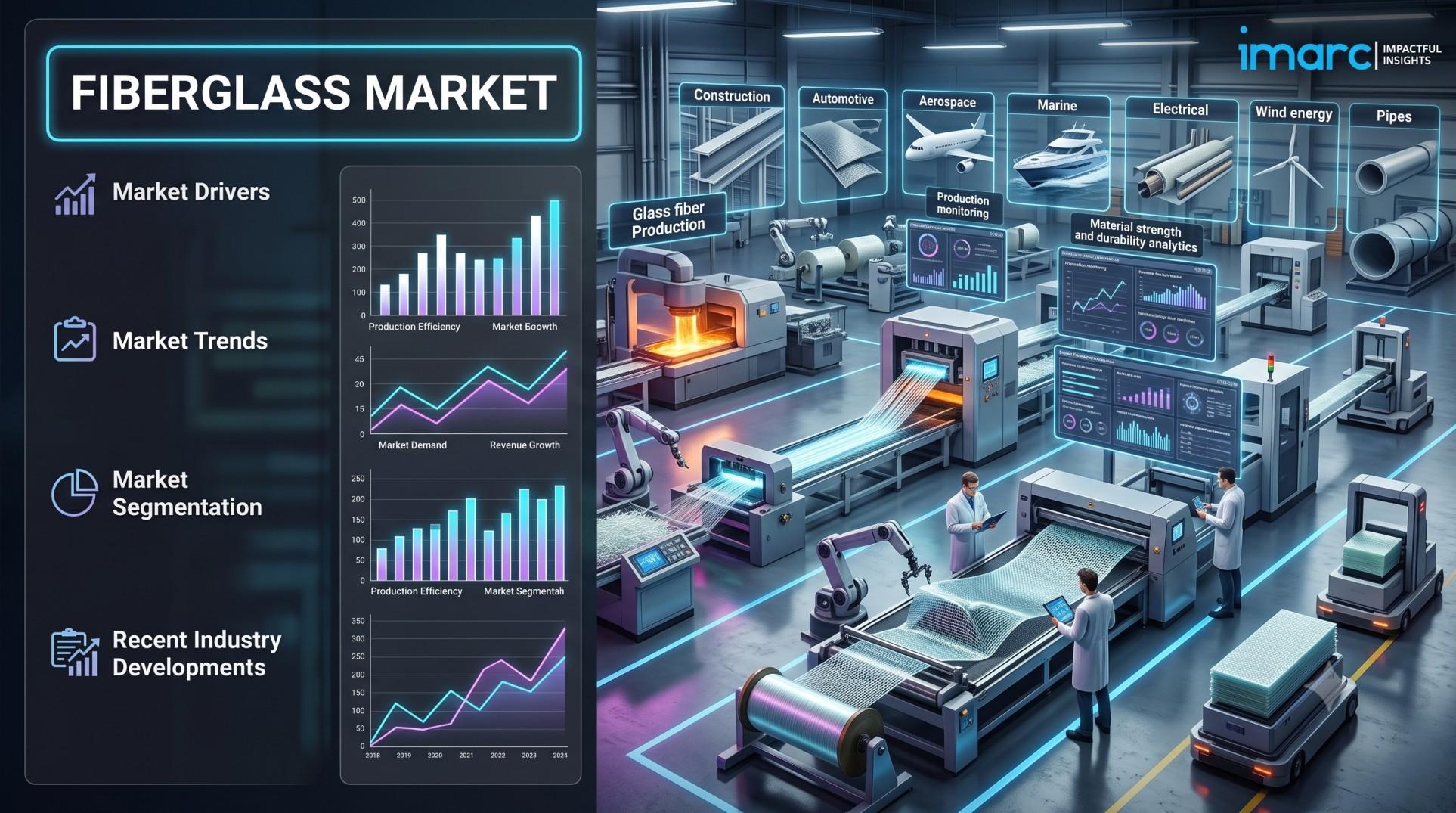
IMARC Group, a leading global market research and management consulting firm, has published its latest market intelligence report on the fiberglass market. The global fiberglass market size was valued at USD 13.3 Billion in 2025. Looking forward, IMARC Group estimates the market to reach USD 18.1 Billion by 2034, exhibiting a CAGR of 3.43% during 2026-2034., driven by expanding construction activity, the automotive and aerospace industries' rising need for lightweight materials, growing renewable energy installations, and an increasing focus on environmentally friendly production methods. Asia Pacific currently dominates global consumption, holding a market share of over 48.6 percent, anchored by China's position as the world's largest fiberglass producer.
The broader momentum behind this market reflects a structural convergence of infrastructure growth, energy transition, and materials innovation. Rapid urbanization and smart city initiatives are increasing the use of fiberglass in advanced construction materials, while electric vehicle manufacturers are turning to fiberglass for lightweight structural components and battery enclosures. Offshore wind energy expansion continues to drive consumption of fiberglass in turbine blades, and fiberglass composites are increasingly integrated into hydrogen storage tanks as part of the broader energy transition. At the same time, a distinct new demand driver has emerged from the electronics and AI infrastructure buildout, where high performance electronic grade glass fiber cloth is becoming a critical input for printed circuit boards used in advanced computing hardware. This combination of legacy demand from construction and transportation alongside fast growing demand from electronics and renewables is reshaping capital allocation across the fiberglass value chain.
Fiberglass Market at a Glance
- Current market size: USD 13.3 Billion
- Projected market size: USD 18.1 Billion
- Growth Rate 2026-2034: CAGR of 3.43%
- Leading glass fiber type: E-Glass, accounting for around a 67.6 percent share
- Leading application: Composites, accounting for around a 63.2 percent share
- Leading end user: Automotive
- Dominant region: Asia Pacific, with over 48.6 percent market share
How AI is Reshaping the Future of the Fiberglass Market
- Electronic grade glass fiber demand surge: Taiwan Glass approved a furnace expansion and new yarn production line worth approximately USD 71.4 million in May 2026 specifically to meet rising demand for low dielectric constant glass fiber cloth, citing accelerating AI and advanced communications applications as the primary growth driver.
- AI driven PCB substrate innovation: As AI servers and high density computing hardware require increasingly sophisticated printed circuit boards, manufacturers across China are scaling ultra fine electronic yarn and low-Dk electronic cloth capacity, with several premium capacity lines under construction through 2026 and 2027 to serve this segment.
- Smart manufacturing in furnace operations: Leading glass fiber producers are increasingly applying digital monitoring and automated process control across furnace and forming operations to improve yield consistency and reduce energy intensity, a shift that is becoming a competitive differentiator as capacity expansion accelerates industry wide.
Grab a sample PDF of this report: https://www.imarcgroup.com/fiberglass-market/requestsample
Fiberglass Market Trends and Drivers
The core driver of demand remains the expanding construction industry, particularly across emerging economies where fiberglass is widely used for insulation, roofing, and structural reinforcement. India's construction industry remains the third largest employer in the country and a major contributor to its economic output, while China's construction market continues to account for a substantial share of global construction activity, together anchoring sustained volume demand for fiberglass products.
A parallel structural driver is the global shift toward renewable energy and lightweight transportation, reinforced by international climate commitments. Fiberglass is extensively used in wind turbine blade manufacturing due to its high strength, durability, and corrosion resistance, and global wind power capacity additions continue to expand steadily, according to industry tracking bodies. This is complemented by the automotive industry's emphasis on lightweight materials, where fiberglass is replacing heavier metals in body panels and structural components to improve fuel efficiency and reduce emissions.
This dual momentum from renewable energy and lightweight transportation is now being reinforced by a third driver: regulatory and sustainability tightening across major economies. Governments worldwide are pushing for energy efficient buildings, recyclable materials, and reduced embodied carbon in construction, a dynamic that is increasingly shaping capacity investment decisions across the competitive landscape covered in the sections below.
Global Regulatory, Trade, and Sustainability Landscape Shaping Demand
- EU Energy Performance of Buildings Directive: The revised directive entered into force in 2024 with a transposition deadline into national law by May 2026, requiring EU countries to develop national building renovation plans and setting minimum energy performance standards that are expected to accelerate demand for fiberglass insulation across the region.
- EU Renovation Wave Strategy: The European Commission's strategy targets renovating 35 million buildings and at least doubling the annual rate of energy renovation, with an estimated additional investment need of over 275 billion euros per year to meet 2030 emissions targets, directly supporting fiberglass insulation demand.
- US green building adoption standards: Industry reporting shows a large and growing share of American companies now prioritizing green building practices, reinforcing demand for energy efficient fiberglass insulation and composite materials across new construction and retrofit projects.
- Formaldehyde free manufacturing shift: Regulatory and market pressure toward healthier indoor air quality is prompting fiberglass insulation manufacturers to eliminate formaldehyde based binders entirely from their production lines, reshaping compliance requirements across the insulation segment.
Key Government Schemes and Policy Programs Supporting the Industry
- India, Production Linked Incentive Scheme for Solar PV Modules: With a total outlay of Rs 24,000 crore, this scheme is driving domestic solar manufacturing capacity expansion, indirectly supporting fiberglass demand through the composite materials used in solar mounting structures and balance of system components.
- India, PLI Scheme overall progress: Across all 14 sectors, the PLI programme has driven investment exceeding Rs 2.4 lakh crore and cumulative exports surpassing Rs 15.2 lakh crore as of early 2026, with the broader manufacturing push benefiting composite material and construction input producers including fiberglass.
- United States, green building and manufacturing support: Federal and state level incentives tied to energy efficiency retrofits continue to support fiberglass insulation demand, reinforced by private investment such as MST Rebar's over USD 15.5 million facility in North Carolina to produce corrosion resistant fiberglass rebar for infrastructure applications.
- European Union, Chemical Strategy for Sustainability: Part of the European Green Deal, this strategy is accelerating the shift toward recyclable and lower emission construction materials, directly reinforcing demand for fiberglass insulation and composite panels across member states.
- China, glass fiber capacity policy support: China continues to account for roughly 70 percent of global glass fiber production capacity, supported by continued state backed industrial expansion, with major new electronic glass fiber and cloth production lines under construction through 2026 to serve both domestic and export demand.
Fiberglass Industry Segmentation
Analysis by Glass Product Type:
- Glass Wool
- Direct and Assembled Roving
- Yarn
- Chopped Strand
- Others
Direct and assembled roving leads the market, valued for its superior tensile strength and compatibility with pultrusion, filament winding, and weaving processes used extensively across wind energy, automotive, and aerospace applications.
Analysis by Glass Fiber Type:
- E-Glass
- A-Glass
- S-Glass
- AR-Glass
- C-Glass
- R-Glass
- Others
E-Glass leads with around a 67.6 percent share, owing to its balanced mechanical, electrical, and chemical properties that make it the preferred reinforcement across automotive, aerospace, wind energy, and construction applications.
Analysis by Resin Type:
- Thermoset Resin
- Thermoplastic Resin
Thermoset resins, particularly polyester and epoxy variants, remain the dominant choice for fiberglass applications given their corrosion resistance and mechanical strength, while thermoplastic resins are gaining share due to their recyclability and ease of processing.
Analysis by Application:
- Composites
- Insulation
Composites lead with around a 63.2 percent share, leveraging fiberglass's strength, durability, and lightweight properties across aerospace, automotive, wind energy, marine, and construction applications.
Analysis by End User:
- Construction
- Automotive
- Wind Energy
- Aerospace and Defense
- Electronics
- Others
Automotive leads the end user segmentation, driven by fiberglass's role in reducing vehicle weight to meet emission regulations while supporting battery enclosures and thermal management in electric vehicles.
Regional Analysis:
- Asia Pacific: China, Japan, India, South Korea, Australia, Indonesia, and others
- North America: United States, Canada
- Europe: Germany, France, United Kingdom, Italy, Spain, Russia, and others
- Latin America: Brazil, Mexico, and others
- Middle East and Africa: Saudi Arabia, UAE, and others
Asia Pacific holds the largest share at over 48.6 percent, led by China's position as the world's largest fiberglass producer, supported by low manufacturing costs and large scale industrial applications across construction, automotive, and electronics.
Competitive Landscape
The competitive environment is shaped by continuous investment in research and development to improve fiberglass strength, durability, and performance, alongside an active pace of mergers, acquisitions, and strategic collaborations aimed at expanding manufacturing footprint and customer reach. The report profiles major companies including Asahi Fiber Glass Co. Ltd., Braj Binani Group, China Jushi Co. Ltd., Chongqing Polycomp International Corp., Compagnie De Saint-Gobain S.A., Johns Manville, Knauf Insulation, Nippon Electric Glass Co. Ltd., Owens Corning, PFG Fiber Glass Corporation, Taishan Fiberglass Inc., and Taiwan Glass Industry Corporation.
China Jushi holds an estimated dominant position in the market, reflecting its large scale glass fiber capacity and technological innovation across product lines. Owens Corning remains a clear global leader in the broader fiberglass segment, leveraging its long standing expertise and geographic footprint across construction, transportation, and wind power applications, while Taiwan Glass is rapidly scaling investment in electronic grade glass fiber cloth to capture demand from AI and advanced electronics manufacturing.
Market Concentration Analysis
- The global fiberglass market is relatively concentrated, with the top ten global manufacturers accounting for approximately 79 percent of total industry revenue, indicating significant scale advantages among established players.
- The top five players alone control an estimated 50 to 55 percent of the market, with China Jushi holding a leading position given its extensive production capacity and technological innovation across coarse yarn, electronic yarn, and specialty glass products.
- Regional specialization is emerging alongside scale concentration, with Chinese producers dominating standard E-glass volume production while specialty players such as Nippon Electric Glass and Saint-Gobain compete on higher value electronics and advanced composite applications where technical qualification matters more than price.
What Does The Full Report Cover?
- Historical performance and outlook across glass product type, glass fiber type, resin type, application, and end user segments
- Detailed breakdown of regional and country level market dynamics
- Porter's Five Forces analysis covering competitive rivalry, supplier power, and buyer power
- Profiles of major players with strategic positioning and product portfolio analysis
- Assessment of key market drivers, restraints, and emerging opportunities
- Impact analysis of sustainability and regulatory trends on manufacturing strategy
- Strategic recommendations for stakeholders across the value chain
Recent News and Developments in Fiberglass Market
- May 2026: Taiwan Glass approved furnace expansion and maintenance projects at its Taoyuan and Changhua plants, with total planned investment of approximately USD 71.4 million aimed at meeting rising demand for low dielectric constant glass fiber cloth driven by AI and advanced communications applications.
- December 2025: Knauf Insulation became the first fiberglass insulation manufacturer in North America with a completely formaldehyde free product portfolio, with plans to remove all formaldehyde using equipment during 2026 as part of its sustainability commitment.
- November 2025: AGY announced a USD 12.1 million investment to expand its low dielectric constant and low dissipation factor fiberglass capacity in Aiken County, South Carolina, expected to create 80 new jobs.
- October 2025: MST Rebar Inc. invested over USD 15.5 million to establish its first US fiberglass rebar manufacturing facility in Bladenboro, North Carolina, a 56,000 square foot plant producing corrosion resistant composite rebar.
- October 2025: Marvin Windows and Doors launched a new 400,000 square foot manufacturing plant for fiberglass windows and doors in Kansas, United States.
- July 2026: Fibrosan broke ground on a new fiberglass reinforced polymer manufacturing facility in Cassopolis, Michigan, with Phase 1 expected to create 35 jobs and a planned Phase 2 expansion that could roughly triple production capacity.
Note: If you require specific details, data, or insights that are not currently included in the scope of this report, we are happy to accommodate your request. As part of our customization service, we will gather and provide the additional information you need, tailored to your specific requirements. Please let us know your exact needs, and we will ensure the report is updated accordingly to meet your expectations.
Key Questions This Report Answers
- How big is the fiberglass market currently, and what is its growth outlook?
- Which glass fiber type, application, and end user segments hold the largest market share?
- Which region dominates global fiberglass consumption, and why?
- How is AI driven demand for electronic grade glass fiber reshaping the industry?
- What regulatory and sustainability trends are shaping fiberglass insulation and composite demand?
- Which companies lead the competitive landscape, and how concentrated is the market?
- What government schemes and policy programs are supporting industry growth across major regions?
About Us
IMARC Group is a global management consulting firm that helps the world's most ambitious changemakers to create a lasting impact. The company provides a comprehensive suite of market entry and expansion services. IMARC offerings include thorough market assessment, feasibility studies, company incorporation assistance, factory setup support, regulatory approvals and licensing navigation, branding, marketing and sales strategies, competitive landscape and benchmarking analyses, pricing and cost research, and procurement research.
Media and Sales Contact
IMARC Group
Email: sales@imarcgroup.com
United States: +1-201-971-6302
India: +91-120-433-0800
United Kingdom: +44-753-714-6104

 English
 Arabic
 French
 Spanish
 Portuguese
 Deutsch
 Turkish
 Dutch
Dutch
 Italiano
 Russian
 Portuguese (Brazil)
 Greek
Greek