


Google Business Profile Management: What Is Holding Your Profile Back?
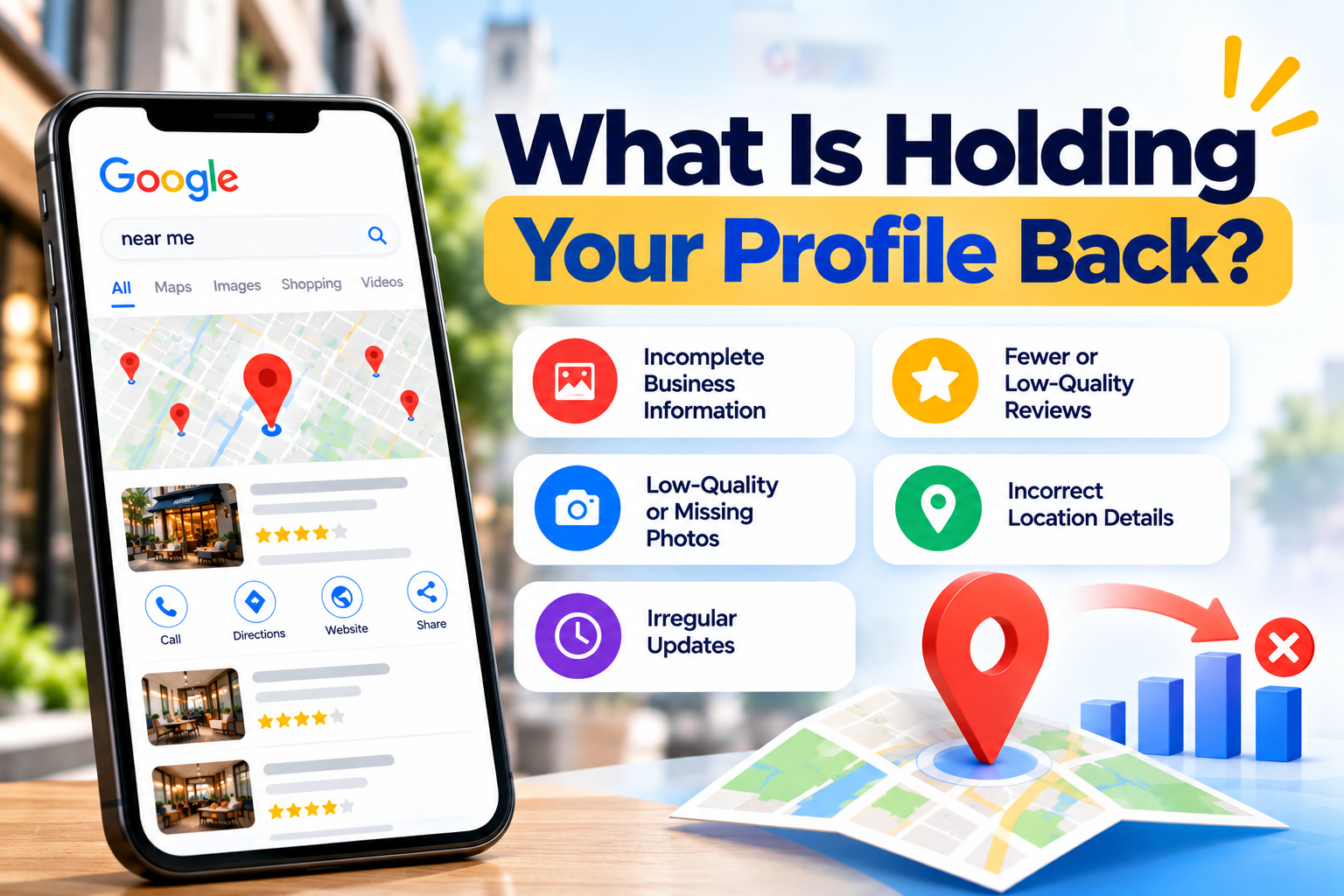
Your Google Business Profile is verified, your business appears on Google Maps, and your basic information has been added. Still, the profile may not be attracting the visibility, interactions, calls, or inquiries you expected.
The problem may not be one major mistake. Often, several smaller issues prevent a profile from performing effectively. Incomplete information, unsuitable categories, outdated hours, limited reviews, unclear services, weak photos, or a poor website experience can all create obstacles between discovering your business and contacting it.
Effective Google Business Profile management involves identifying these obstacles and improving the areas that matter to both customers and local search. Businesses looking for structured support can also explore Google Business Profile Management and Local SEO services for profile optimization, review management, local visibility monitoring, and ongoing improvements.
So, what could actually be holding your profile back?
Your Business Information Is Not Giving Customers Enough Clarity
Start with the basics.
When someone discovers your business on Google, can they immediately understand who you are, what you offer, where you operate, and how to contact you?
Review your business name, address or service area, phone number, website, opening hours, and other relevant profile details.
Incomplete information creates unnecessary uncertainty.
Outdated information can be even more damaging to the customer experience. If someone calls an old phone number, visits during incorrect opening hours, or clicks a broken website link, your profile has failed to help them even though they successfully discovered your business.
Regularly checking these details should therefore be a basic part of profile management.
Your Categories Do Not Clearly Represent the Business
Categories help Google understand the nature of your business.
Your primary category should accurately represent your main business activity. Additional categories can be selected when they genuinely describe other important areas of the business.
A common mistake is selecting too many loosely related categories because they appear connected to desirable keywords.
Categories are not designed to function as a keyword list.
Ask a simple question: if a potential customer saw only your primary category, would they understand what type of business you operate?
If the answer is no, your category selection deserves another review.
Customers Cannot Clearly Understand Your Services
Getting discovered is only the beginning.
A customer still needs to decide whether you provide what they need.
Suppose someone discovers a healthcare provider but cannot determine whether a particular treatment is available. Another customer might find a home service company but see no clear information about the type of work it performs.
Both may return to Google and choose another business.
Make sure your important services or products are accurately represented using appropriate profile features where available. Your website should then provide more detailed information.
Avoid filling service descriptions with repeated search terms. Write for the person trying to make a decision.
Clear information removes uncertainty and makes it easier for customers to take the next step.
Your Reviews Are Not Building Enough Confidence
Reviews can influence how potential customers evaluate a local business.
Google also states that review count and review scores can factor into local search ranking.
If your business receives very few reviews while established local competitors have a stronger history of genuine customer feedback, this may be an area worth improving.
Create a simple process for asking real customers to share honest feedback. Google provides review links and QR code options that businesses can use to make this process easier.
Avoid purchasing reviews or offering incentives specifically for positive ratings.
Pay attention to responses as well.
Generic replies copied across every review can feel impersonal. Respond naturally to positive feedback and handle concerns professionally.
Reviews should help potential customers understand real experiences with your business.
Your Photos Are Not Helping Customers Evaluate You
Photos are sometimes treated as decoration, but they can answer practical customer questions.
What does the storefront look like? What is the environment like? What products are available? What can customers expect when they arrive?
The answers will depend on your business.
A restaurant may benefit from genuine food and interior photos, while a retail shop may show products and its storefront. A clinic might show its reception and facilities where appropriate.
Use clear and authentic images that accurately represent the business.
Avoid depending entirely on promotional graphics or heavily edited visuals. Potential customers often want to see what the real business looks like before they decide to visit.
Your Business Name Is Being Used as an SEO Field
Adding keywords to the business profile name may look like an easy way to increase relevance, but your business name is not a place for inserting additional SEO phrases.
Google's guidelines state that the profile name should reflect the business's real-world name.
For example, if your genuine name is “ABC Dental Care,” adding phrases such as “Best Dentist Dental Clinic Near Me” simply for search visibility does not accurately represent the business.
Use the appropriate profile sections and your website to explain services and other relevant information.
Good Google Business Profile management should make information more accurate, not manipulate it.
Your Website Is Creating a Disconnect
Customers often move from a Google Business Profile to the company's website before making contact.
What happens when they arrive?
If your profile presents one set of services, but the website contains outdated or incomplete information, customers may become uncertain.
Your website should clearly explain important services, contact information, locations, and the next steps customers can take.
It should also provide a good mobile experience because local customers may be searching from their phones.
Check important links from your business profile regularly.
A profile can successfully generate website visits, but those visits have limited value if customers arrive on confusing, outdated, or broken pages.
Your Profile Makes the Next Step Difficult
A potential customer has found your business, read the information, viewed your photos, and checked your reviews.
Now what?
The next action should be easy.
Depending on the business, customers may want to call, visit the website, request directions, make a reservation, book an appointment, or complete an inquiry.
Review this journey yourself.
Does the phone number work? Is the correct location displayed? Does the website have a clear contact option? Is an important enquiry form difficult to complete on mobile?
Small points of friction can prevent interested searchers from becoming genuine leads.
The goal is not simply to attract profile views. It is to make useful customer actions straightforward.
You Are Looking at Rankings From Only One Location
Another issue may be how you measure your profile rather than the profile itself.
Google explains that local results are mainly based on relevance, distance, and prominence.
Distance means your visibility can change depending on where the person searching is located.
Your business might appear strongly near its physical location but become less visible several kilometers away.
Checking a keyword from one device in one location therefore does not provide a complete picture of local search visibility.
Evaluate performance across the geographic areas that actually matter to your business, and remember that there is no single fixed Google Maps ranking that every customer sees.
You Are Making Changes Without Looking at Performance
Profile optimization should not become a cycle of making random changes and waiting to see what happens.
Use available performance information to understand how customers interact with your business.
Look beyond rankings.
Depending on your business and available data, consider website visits, calls, direction requests, bookings, inquiries, and other meaningful actions.
Different patterns can point to different problems.
If visibility is limited, investigate relevance, geographic reach, competition, and overall local presence. If visibility is strong but customer actions are weak, examine reviews, photos, service clarity, website experience, and contact options.
The right solution depends on where customers are being lost.
Your Profile Is Being Treated as a One-Time Setup
Businesses change continuously.
Opening hours change. New services are introduced. Phone numbers are updated. Websites are redesigned. New reviews arrive. Old photos stop representing the current customer experience.
A profile that was accurate one year ago may no longer be accurate today.
This is why Google Business Profile management should be an ongoing process.
Review important information regularly and make updates when genuine business changes occur.
The purpose is not to constantly edit the profile for activity. It is to ensure that customers continue receiving accurate, useful, and current information.
Final Thoughts
When a Google Business Profile is not delivering the results you expect, avoid searching for one hidden ranking trick.
Instead, identify what may actually be holding the profile back.
It could be unclear business information, unsuitable categories, weak service descriptions, limited genuine reviews, unhelpful photos, an outdated website, difficult contact options, or simply unrealistic expectations about geographic rankings.
Effective Google Business Profile management addresses these issues as part of the complete customer journey.
Help people find your business, understand what you offer, trust the information they see, and easily take the next step.
A stronger profile is not simply one that appears in more searches. It is one that provides potential customers with the accurate information and confidence they need to move from discovery to meaningful action.

 English
 Arabic
 French
 Spanish
 Portuguese
 Deutsch
 Turkish
 Dutch
Dutch
 Russian
 Romaian
 Portuguese (Brazil)
 Greek
Greek