


How to Check Company Directors and Their Roles Using MCA Master Data
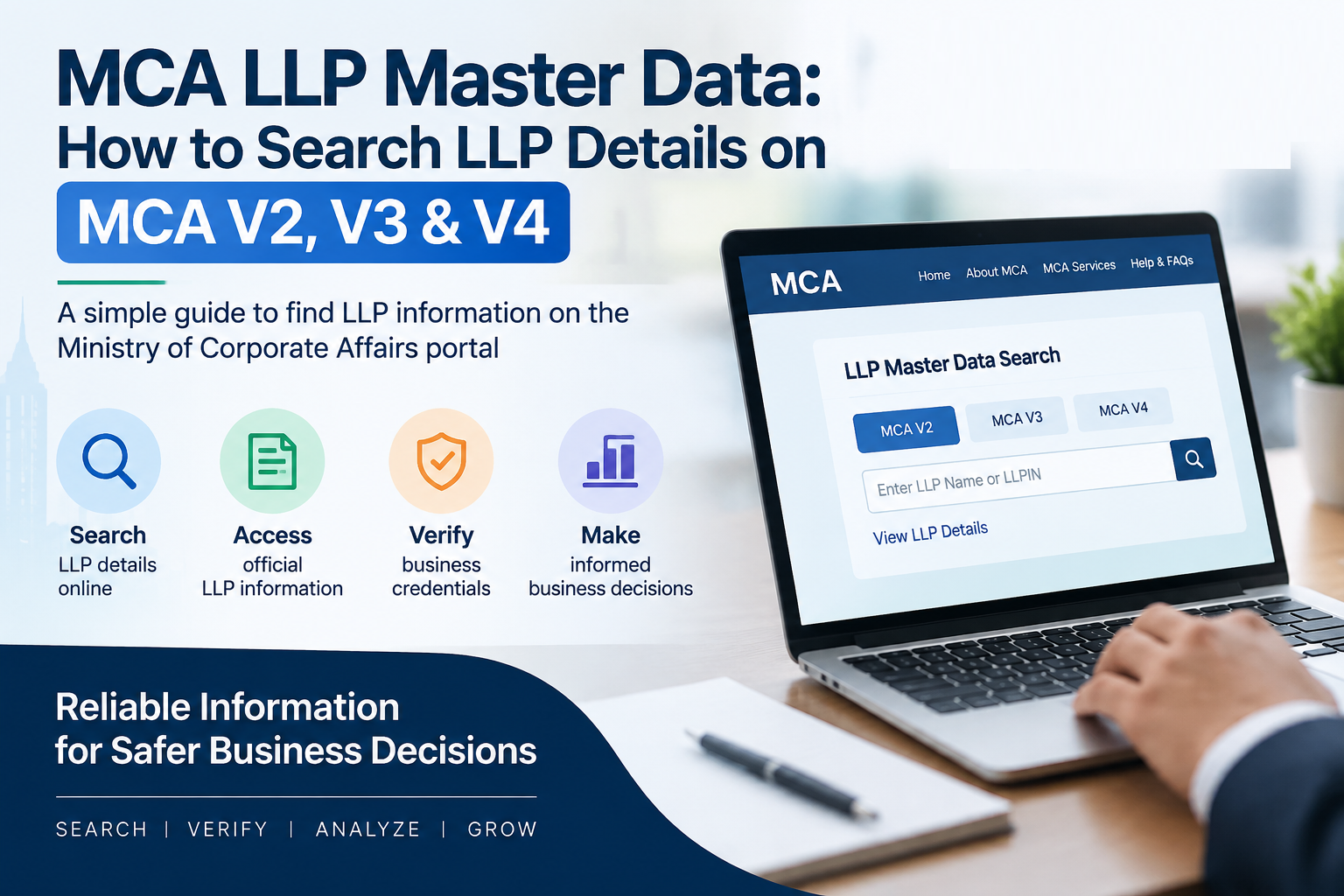
When evaluating a company for lending, investment, vendor onboarding, partnership, or business transactions, knowing who manages the company is as important as understanding its financial position. Directors influence strategic decisions, financial management, compliance, and corporate governance. For this reason, businesses and financial institutions often need to verify the identity and roles of company directors before making important decisions.
MCA Master Data provides a practical starting point for checking registered company information and identifying directors associated with a company. By reviewing this information, banks, NBFCs, fintech companies, lenders, insurers, and enterprises can strengthen their corporate due diligence and make more informed decisions.
What Is MCA Master Data?
MCA Master Data refers to core corporate information available through the Ministry of Corporate Affairs (MCA) database. It contains key details relating to registered companies and can be searched using information such as the company name or Corporate Identity Number (CIN).
Depending on the company and available records, users can find information such as:
- Company name and CIN
- Company status
- Date of incorporation
- Registered office details
- Authorised and paid-up capital
- Details of directors
- Other basic statutory information
For director verification, this database can help establish which individuals are officially associated with a company and provide an initial view of their registered roles.
Why Check Company Directors and Their Roles?
Director information is useful in several areas of business and financial risk management. A company may appear financially stable, but understanding its management structure can reveal important information for further review.
1. Strengthen Business Due Diligence
Before entering into a major business relationship, companies can check whether the individuals representing a business are officially registered as directors. This helps validate information supplied during onboarding.
2. Support Credit Assessment
Banks and NBFCs can use director information as one component of a broader credit assessment. Management structure, company history, financial information, and other risk indicators can be reviewed together rather than relying on a single data point.
3. Improve Vendor Onboarding
Enterprises dealing with suppliers and service providers can verify company management details before approving vendors. This can reduce the risk of relying on incorrect or outdated corporate information.
4. Understand Corporate Governance
Changes in directors can sometimes be relevant to understanding a company's governance and management structure. A change should not automatically be treated as a negative signal; instead, it can indicate that additional context or documentation may be appropriate.
How to Check Company Directors Using MCA Master Data
The process is relatively straightforward when you have the company's legal name or CIN.
Step 1: Identify the Company
Start with the company's registered legal name or CIN. Avoid relying only on a brand or trade name because multiple businesses may use similar commercial names.
Step 2: Access the MCA Company Information
Use the official MCA website and navigate to the relevant company or LLP information services. Search for the entity using its available identification details.
Step 3: Review the Master Data
Once the correct company is located, review its MCA Master Data. Check the registered company name, CIN, incorporation information, current status, and other available corporate details.
Step 4: Examine Director Information
Review the director-related information available for the company. Depending on the records presented, this may help identify the individuals associated with the company and their registered positions.
Step 5: Cross-Check Important Details
For high-value transactions, director information should not be treated as the only source of verification. Compare it with information provided by the company, official filings, financial records, KYC documentation, and other reliable sources where appropriate.
What Should You Look for in Director Information?
Simply finding a director's name is only the beginning. For meaningful due diligence, businesses should consider the wider corporate context.
Important areas include:
- Director identity: Does the name match the information supplied by the company?
- Role: Is the individual listed in the relevant director or management capacity?
- Company association: Is the individual connected to other entities that require review?
- Changes over time: Have there been recent additions or resignations?
- Corporate status: Is the company currently active according to available MCA information?
- Supporting information: Does other documentation align with the registered corporate information?
This approach helps turn basic company data into a more useful input for risk assessment.
Role of MCA Master Data in Financial Risk Management
For financial institutions, director verification can form part of a broader company risk assessment process.
For example, consider an NBFC assessing a loan application from an SME. The applicant provides details of two directors. The NBFC can use MCA Master Data to verify the company's registered information and compare the management details with the application.
If the information differs, the discrepancy does not necessarily mean that the application should be rejected. Instead, it can trigger a request for clarification or additional documentation. This creates a more structured approach to underwriting and reduces dependence on manually supplied information.
Similarly, a fintech company onboarding businesses for a financial product can use corporate data as one layer in its automated verification workflow.
Best Practices for Director Verification
Organizations should follow a consistent process when checking company directors.
Use Multiple Sources
MCA records are valuable, but effective due diligence may require financial, legal, ownership, litigation, regulatory, and other relevant information.
Check Data Recency
Corporate information can change. Director appointments, resignations, company status, and other details should be checked against the latest available records relevant to the decision.
Standardize Verification
Banks, lenders, enterprises, and fintech companies can create standardized workflows for company and director verification. This makes onboarding more consistent and easier to audit.
Investigate Discrepancies
Differences between MCA records and information submitted by an applicant should be documented and investigated rather than overlooked.
Conclusion
Checking company directors and their roles is an important part of corporate due diligence, credit assessment, and business verification. MCA Master Data provides a useful foundation for understanding a company's registered identity and management structure.
However, director information should be interpreted within the wider context of financial, legal, ownership, compliance, and operational information. For banks, NBFCs, fintech companies, lenders, insurers, and enterprises, combining MCA data with broader risk intelligence can support more reliable decisions while improving the efficiency of verification and onboarding processes.
Frequently Asked Questions
How can I check company directors online?
You can use the Ministry of Corporate Affairs' company information services to search for a registered company using its legal name or CIN and review the available corporate information.
What information does MCA Master Data provide about a company?
MCA Master Data can provide core corporate information such as the company's CIN, name, incorporation details, status, registered office information, capital details, and available director information.
Can MCA Master Data be used for director verification?
Yes. It can be used as an important source for checking registered director information. For comprehensive verification, organizations should also use relevant KYC and other reliable sources.
Why is director verification important for lenders?
Director verification helps lenders compare applicant-provided information with registered corporate records. It can support underwriting, due diligence, fraud-risk controls, and corporate identity verification.
Is checking directors enough for company due diligence?
No. Director information is only one part of due diligence. A comprehensive review may also consider financial performance, ownership, legal matters, regulatory information, credit history, and other relevant risk indicators.

 Arabic
 French
 Spanish
 Portuguese
 Deutsch
 Turkish
 Dutch
Dutch
 Italiano
 Russian
 Romaian
 Portuguese (Brazil)
 Greek
Greek