


Online Maths Classes: Build Strong Concepts and Problem-Solving Skills
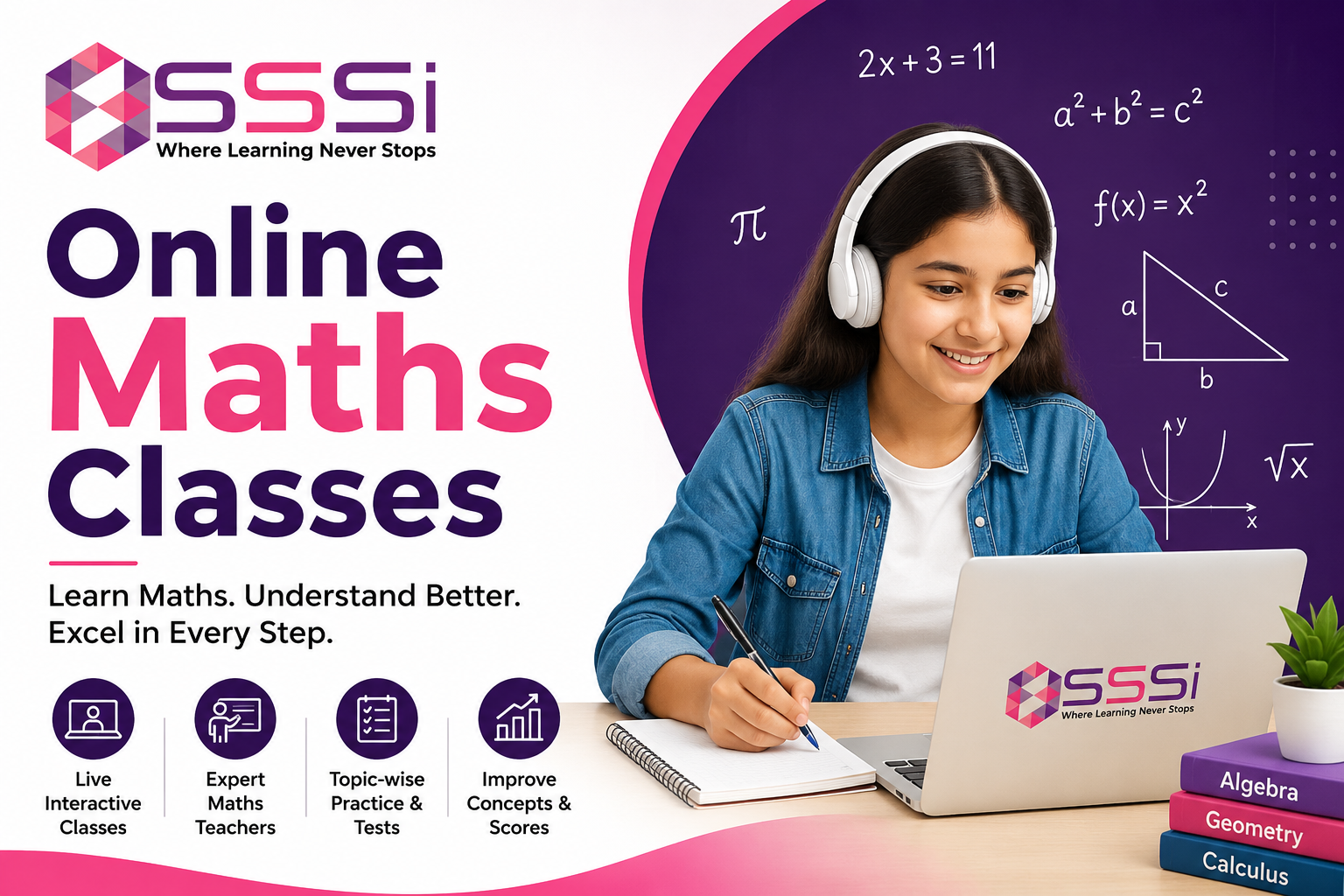
Mathematics becomes increasingly detailed as students move through school, making consistent practice and conceptual clarity important at every stage. Online Maths Classes can provide students with structured lessons, guided problem-solving, doubt support, and regular practice without limiting learning to the traditional classroom environment. From strengthening foundational concepts to preparing for senior-secondary examinations, online learning can help students approach mathematics with greater confidence and accuracy.
What Do Online Maths Classes Offer Students?
Online Maths Classes are designed to help students understand mathematical concepts, learn different problem-solving methods, and apply formulas correctly. Instead of focusing only on completing exercises, effective online learning connects concepts with practical questions and gradually develops independent problem-solving ability.
Depending on the academic level, lessons may cover areas such as:
-
Number systems and arithmetic
-
Algebra and equations
-
Geometry and mensuration
-
Data handling and statistics
-
Coordinate geometry
-
Trigonometry
-
Calculus and advanced algebra
-
Probability and mathematical reasoning
The level of difficulty changes as students progress, which makes class-specific learning important.
Building Mathematical Confidence Through Structured Learning
Many students can remember a formula but struggle to determine when and how to use it. Online tuition can address this gap by breaking complex questions into smaller steps.
A structured lesson generally allows students to:
-
Understand the underlying concept.
-
Observe a step-by-step solution.
-
Attempt similar questions independently.
-
Identify mistakes.
-
Practise different variations of the same concept.
This approach can be particularly useful when students encounter chapters that require both conceptual understanding and repeated practice.
Strengthening Core Concepts During Middle-School Learning
The middle-school stage is important because students begin working with more complex algebraic expressions, geometry, rational numbers, equations, and data-related concepts.
Students looking for Maths classes for class 7 can receive support with concepts that form a bridge between elementary mathematics and more advanced school-level topics. Learning how to simplify expressions, solve equations, understand geometric relationships, and interpret mathematical information can make later topics easier to approach.
At this stage, the objective should not simply be to finish chapters. Students should also learn how to read a question carefully, identify the required method, and explain their reasoning.
Developing Better Problem-Solving Skills
As mathematics becomes more analytical, students need to move beyond memorising procedures. They need to recognise patterns and select appropriate methods.
For students taking Maths classes for class 9, topics can involve algebraic identities, linear equations, coordinate geometry, triangles, circles, statistics, and other concepts that demand logical thinking.
Online lessons can help students compare different approaches to a problem and understand why a particular method works. This is especially useful for questions where several steps are required before reaching the final answer.
Preparing for Important Academic Milestones
Mathematics becomes even more significant when students approach board-level preparation. At this stage, understanding the syllabus, practising different question formats, and improving calculation accuracy become essential parts of preparation.
Maths classes for class 10 can help students organise their preparation around important concepts, chapter-wise practice, revision, and examination-oriented problem solving.
Regular practice can also help students identify areas where they frequently lose marks, such as:
-
Incorrect application of formulas
-
Calculation mistakes
-
Incomplete steps
-
Misreading questions
-
Weak time management
-
Skipping important reasoning
Addressing these issues during preparation can improve consistency when solving examination papers.
Moving From Formula-Based Learning to Mathematical Reasoning
Senior-secondary mathematics introduces students to concepts that require greater analytical ability. Simply remembering formulas is often insufficient because questions may require students to connect multiple concepts.
Through Maths classes for class 11, students can work on topics such as sets, functions, algebra, coordinate geometry, sequences and series, limits, derivatives, statistics, and probability, depending on their curriculum.
At this level, students benefit from understanding the relationship between concepts. For example, learning a formula becomes more meaningful when students understand how it is derived, where it can be applied, and what information is required before using it.
Developing Accuracy for Advanced Mathematical Topics
Class 12 mathematics requires students to handle advanced concepts while maintaining accuracy across lengthy and multi-step questions. Consistent revision becomes increasingly important because different chapters can involve interconnected mathematical skills.
With Maths classes for class 12, students can receive structured support for advanced topics, practice different question types, revise important formulas, and work on examination preparation.
A useful preparation strategy at this stage is to divide study time between three activities:
-
Concept revision for understanding important principles
-
Question practice for developing application skills
-
Timed tests for improving speed and accuracy
This balance can help students prepare more effectively than relying entirely on last-minute revision.
How Online Maths Classes Can Make Practice More Effective
Mathematics requires active participation. Watching a solution is not the same as solving a problem independently. Students should therefore use online classes as a starting point for practice rather than treating lessons as passive learning.
A productive learning cycle can look like this:
Learn → Solve → Check → Correct → Practise Again
After learning a concept, students can attempt questions without immediately looking at the solution. If an answer is incorrect, they can identify whether the problem occurred because of a conceptual misunderstanding, calculation error, or incorrect method.
Keeping track of recurring mistakes can also help students decide which topics need additional revision.
Using Technology to Improve Mathematical Learning
Online learning provides opportunities to make mathematics more interactive. Digital whiteboards, visual explanations, screen-based problem solving, online assignments, and instant doubt discussions can make difficult concepts easier to follow.
Visual tools can be particularly useful for topics involving graphs, geometric figures, coordinate systems, and functions. Students can also revisit explanations when they need additional clarification instead of relying entirely on their classroom notes.
What Should Students Look for in Online Maths Classes?
The quality of an online mathematics programme depends on more than simply having live classes. Students and parents can consider several factors before choosing a programme.
Conceptual Teaching
Lessons should explain the reasoning behind formulas and methods instead of encouraging students to memorise solutions.
Regular Practice
Mathematics improves through application. Assignments and practice questions should provide opportunities to use newly learned concepts.
Doubt Support
Students should have a way to clarify questions when they become stuck on a particular concept or solution.
Progress Monitoring
Regular assessments can help identify strong areas as well as topics that require additional practice.
Class-Specific Learning
The content should match the student's academic level and syllabus rather than providing the same material to every learner.
Quick Tips for Students Learning Maths Online
-
Attend lessons consistently instead of depending on recorded sessions alone.
-
Keep a separate notebook for formulas and important methods.
-
Solve questions without looking at the solution first.
-
Revisit questions where mistakes occur repeatedly.
-
Practise calculations regularly to improve speed.
-
Take short timed tests before examinations.
-
Ask doubts as soon as a concept becomes unclear.
-
Revise older topics periodically so that foundational concepts remain strong.
FAQs About Online Maths Classes
Are Online Maths Classes suitable for school students?
Yes. Online Maths Classes can be structured according to different academic levels and can support students with concept learning, practice, doubt solving, revision, and examination preparation.
Can online maths tuition help students from Classes 7 to 12?
Yes. Students from Classes 7 to 12 can use online tuition for age-appropriate mathematics topics, from foundational algebra and geometry to advanced senior-secondary concepts.
How can students improve their maths performance through online classes?
Students can combine regular lessons with independent practice, revision, doubt solving, and timed assessments. Consistent application is important for improving mathematical accuracy.
Is practising maths necessary after attending an online class?
Yes. Understanding a solved example does not guarantee that a student can solve a new problem independently. Regular practice helps convert conceptual understanding into problem-solving ability.
Can online maths classes support board exam preparation?
They can support board preparation through syllabus-focused teaching, revision, practice questions, doubt solving, and mock assessments. Students should also practise previous examination-style questions as part of their preparation.
Conclusion
Online Maths Classes can support students throughout their academic journey by combining conceptual learning with guided practice and problem solving. The learning requirements naturally change from Class 7 to Class 12, so students benefit from instruction that matches their current syllabus and level of mathematical understanding.
Whether the goal is to strengthen fundamentals, improve problem-solving skills, prepare for board examinations, or become more confident with advanced mathematics, structured online tuition can provide students with a consistent learning environment and opportunities for regular practice.

 English
 Arabic
 French
 Spanish
 Portuguese
 Deutsch
 Turkish
 Italiano
 Russian
 Romaian
 Portuguese (Brazil)
 Greek
Greek