


Heparin Market Sees Product Development Rise Alongside Healthcare Demand
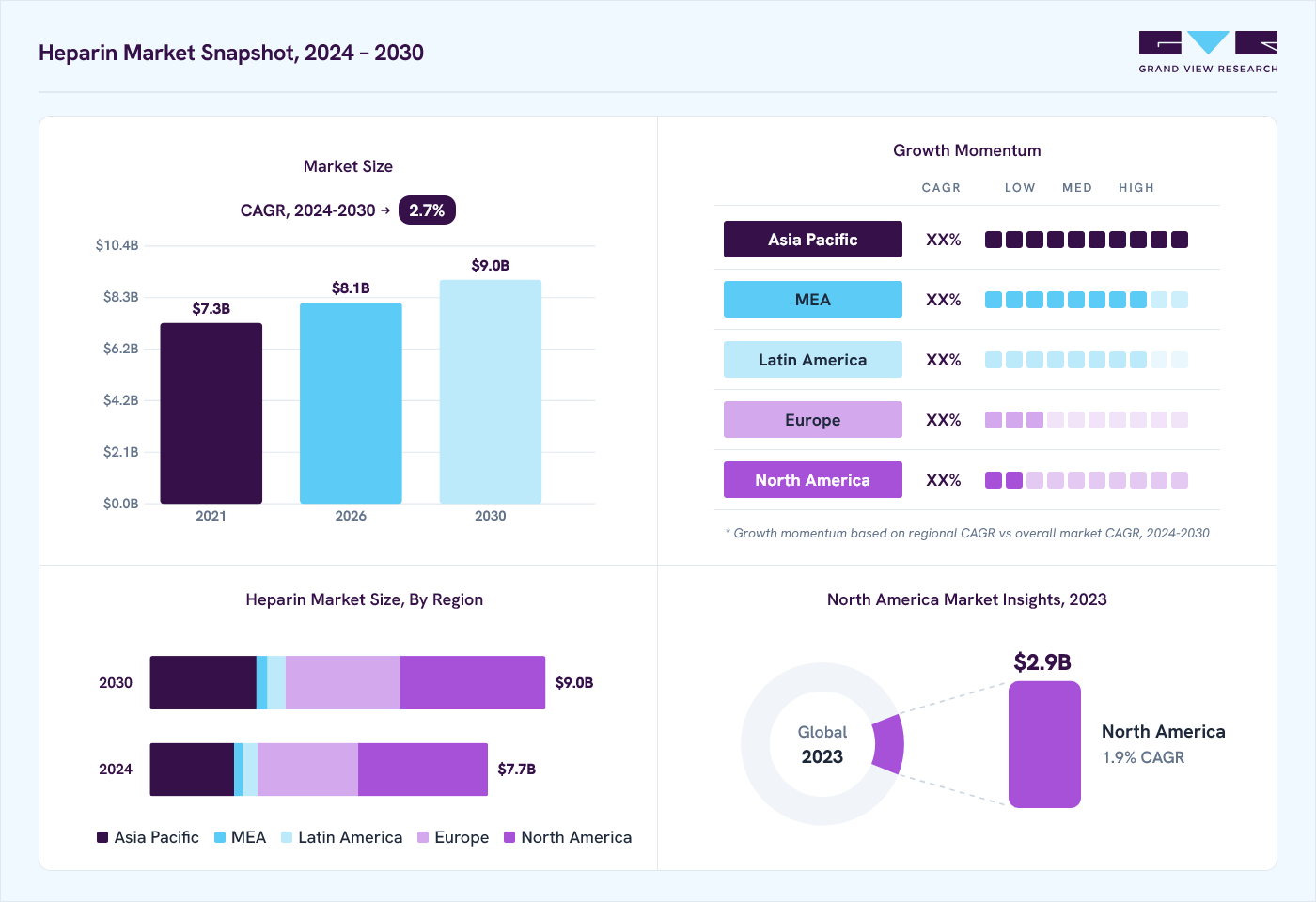
The heparin market is expanding as the prevalence of chronic diseases, cardiovascular conditions, blood transfusions, and age-related health issues increases the need for anticoagulant therapies. The market was valued at USD 7.6 billion in 2023 and is projected to grow from USD 8.1 billion in 2026 to USD 9.0 billion by 2030, registering a CAGR of 2.7% from 2024 to 2030. Rising demand for whole blood and blood components, an increasing geriatric population, and growing use of plasma in the pharmaceutical industry are supporting continued market development.
Core Market Metrics & Segmentation
The heparin market is segmented by type, route of administration, application, end-use, source, and region. By type, Low Molecular Weight Heparin (LMWH) accounted for the largest revenue share of 63.7% in 2023. LMWH is widely used for the treatment and prophylaxis of venous thromboembolic disease, deep vein thrombosis, and pulmonary embolism. Ultra-low Molecular Weight Heparin (ULMWH) is anticipated to witness the fastest CAGR from 2024 to 2030.
By route of administration, subcutaneous heparin accounted for the largest revenue share of 65.4% in 2023. Its ability to be administered at home with limited expertise supports its adoption and convenience. Intravenous administration is expected to register a significant CAGR from 2024 to 2030, particularly because its rapid onset makes it important during emergencies, surgeries, and acute conditions.
Application-wise, Coronary Artery Disease (CAD) held the largest revenue share of 23.4% in 2023. Heparin plays an important role in preventing blood clot formation and managing acute coronary events. The atrial fibrillation segment is estimated to register a significant CAGR from 2024 to 2030 as anticoagulant therapy remains important for preventing blood clot formation associated with the condition.
The outpatient segment accounted for the largest end-use share at 61.1% in 2023. Cost-effectiveness, accessibility, and reduced hospital-related expenses contribute to its position. The inpatient segment is estimated to register a significant CAGR from 2024 to 2030.
The porcine source segment dominated with a 90.0% revenue share in 2023. Porcine heparin is widely used in production, particularly for LMWH products such as enoxaparin. Bovine heparin is estimated to register the fastest CAGR over the forecast period.
Key Drivers Fueling Market Growth
The growing prevalence of chronic diseases represents an important factor behind market expansion. Cardiovascular diseases remain a major healthcare burden, creating continued demand for anticoagulants used in the management of conditions associated with blood clot formation.
Demand for whole blood and blood component transfusions is another contributor. The need for safe and adequate blood supplies creates supporting demand for heparin in transfusion-related healthcare activities. The source notes that someone in the U.S. needs blood every two seconds, highlighting the importance of maintaining reliable transfusion systems.
Population aging is also influencing market requirements. As the number of older individuals increases, healthcare systems face greater demand for interventions associated with age-related conditions. The population aged over 60 is expected to double to 2.1 billion by 2050, increasing the potential need for medical procedures in which heparin is used to prevent blood clots.
Growing pharmaceutical use of plasma is providing another avenue for demand. The source highlights Takeda's investment of about 100 billion yen (USD 754 million) in March 2023 to build a manufacturing facility for plasma-derived therapies in Osaka, Japan. Such investment reflects the increasing importance of plasma-derived products within pharmaceutical manufacturing.
Primary Market Restraints
The development of novel heparin technologies can involve substantial costs because companies invest in clinical trials and regulatory submissions to obtain approvals for pipeline products. These requirements can increase the cost associated with developing new technologies and formulations.
Safety considerations also remain relevant to product development. The market includes different heparin formulations and delivery methods designed to address specific medical requirements. However, adverse effects associated with certain heparin products include bleeding, allergic reactions, and heparin-induced thrombocytopenia.
The market is simultaneously characterized by innovation in production methods, quality assurance, formulations, and applications. Bioengineered alternatives and advanced purification techniques demonstrate efforts to improve efficacy and safety, while new dosage forms such as prefilled syringes are designed to improve convenience.
Technology, Formulation & Competitive Developments
Innovation is influencing the market through improved production methods, novel applications, and expanded product formats. Low Molecular Weight Heparins and prefilled syringes are examples of product development aimed at meeting specific medical requirements and improving patient convenience.
Companies are also pursuing mergers and acquisitions to expand geographic reach and enter new territories. Pfizer Inc., LEO Pharma A/S, Dr. Reddy’s Laboratories Ltd., and GlaxoSmithKline plc are among the companies involved in such activities.
Recent developments include the launch of Enoxaparin Sodium in June 2023, the shipment of bivalirudin injection in July 2023, FDA approval of the HEPZATO KIT in August 2023, and FDA approval of CorMedix's antimicrobial drug in November 2023. These developments reflect continued product activity across anticoagulant and related healthcare applications.
Regional Market Outlook
North America dominated the heparin market with a 38.6% revenue share in 2023. Rising patient awareness, high disease burden, government measures, technological advancements, improvements in healthcare infrastructure, and the presence of key companies are supporting the market in the region.
Asia Pacific is anticipated to witness the fastest CAGR from 2024 to 2030. Cardiovascular diseases represent a substantial health burden across the region, creating continued demand for anticoagulant therapies. The source notes that around 330 million individuals in China are affected by various cardiovascular conditions.
The regional landscape therefore reflects different growth dynamics, with established healthcare infrastructure supporting current market leadership in one region while increasing healthcare needs and cardiovascular disease burdens contribute to faster expansion elsewhere.
Key Heparin Companies:
· 3M
· Medline Industries, LP.
· Welch Allyn (Hill-Rom Holdings, Inc.)
· Eko Health, Inc.
About us:
Grand View Research, a market research and consulting company, provides syndicated research reports, customized research reports, and consulting services. Grand View Research database is used by the world's renowned academic institutions and Fortune 500 companies to understand the global and regional business environment. Our database features thousands of statistics and in-depth analysis on 46 industries in 25 major countries worldwide.

 Arabic
 French
 Spanish
 Portuguese
 Deutsch
 Turkish
 Dutch
Dutch
 Italiano
 Russian
 Romaian
 Portuguese (Brazil)
 Greek
Greek