


Nurse Call Systems Move Beyond Buttons Toward Intelligent Care Platforms
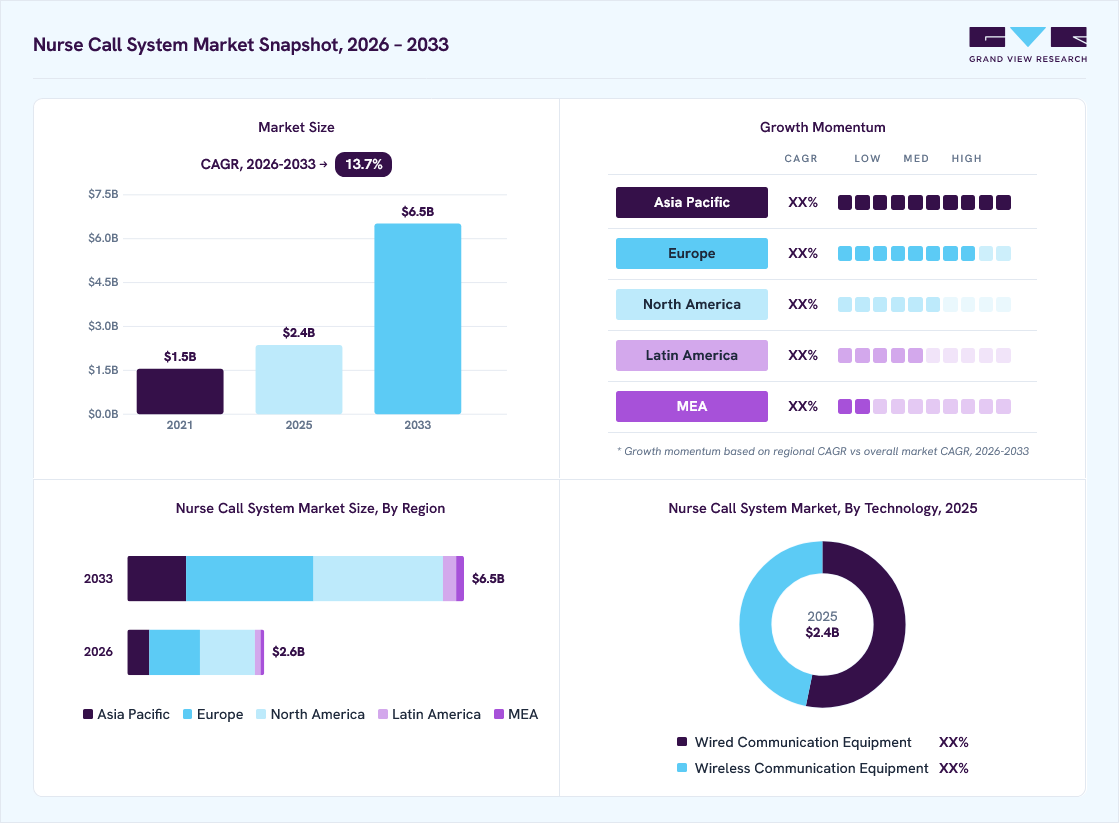
The nurse call systems market is evolving from conventional bedside communication into a broader healthcare communication platform that supports patient safety, caregiver coordination, workflow management, and real-time response. The market was valued at USD 2.4 billion in 2025 and is projected to grow from USD 2.6 billion in 2026 to USD 6.5 billion by 2033, registering a CAGR of 13.7% from 2026 to 2033. Rising healthcare infrastructure development, digitalization, increasing patient volumes, and demand for integrated communication are creating strong opportunities for advanced nurse call solutions.
The Market at a Glance
Nurse call systems are being adopted across hospitals, clinics, ambulatory care centers, and long-term care facilities to strengthen communication between patients and caregivers. The technology landscape includes wired and wireless communication equipment, with wired communication equipment accounting for a 53.1% revenue share in 2025.
However, wireless communication equipment is expected to record the fastest growth over the forecast period. Its lower installation requirements, patient mobility benefits, and compatibility with increasingly connected healthcare environments are supporting adoption. The segment is projected to register a CAGR of 12.73% during the forecast period.
The type landscape is led by integrated communication systems, which held a 26.1% market share in 2025. Mobile systems are expected to witness the fastest growth, supported by greater acceptance of intuitive communication technologies and their ability to improve patient satisfaction and care efficiency. The mobile systems segment is expected to register a CAGR of 12.41% during 2023-2030.
Where the Technology Creates the Most Value
Nurse call technology is becoming increasingly connected with other hospital systems. Integration with smart beds, patient monitoring equipment, hospital information systems, mobile devices, and real-time location systems enables caregivers to access information and respond to alerts through more coordinated platforms.
The application landscape demonstrates this shift. Wanderer control accounted for the largest share at 34.3% in 2025, reflecting the importance of patient safety and monitoring. At the same time, workflow optimization is projected to record the fastest growth, with a CAGR of 12.52% during the forecast period. Reducing operating costs and improving healthcare resource allocation are important factors supporting this segment.
Fall detection and prevention is another area receiving attention as healthcare facilities seek to reduce patient falls. Nurse call systems can incorporate motion detection and monitoring capabilities, while online software can track caregiver response time, emergency calls, and patient requests.
Healthcare Infrastructure Is Creating New Demand
Expansion of healthcare infrastructure is supporting the installation of modern nurse call systems in new and upgraded facilities. Hospitals, ambulatory surgical centers, specialty clinics, and long-term care facilities are increasingly incorporating digital technologies into their infrastructure.
Digital transformation is also changing how nurse call systems function. Artificial intelligence, location-based services, predictive analytics, mobile communication applications, cloud connectivity, and Internet of Medical Things technologies are expanding the capabilities of these systems beyond simple patient-to-caregiver communication.
The growing adoption of real-time location systems is particularly relevant. RTLS can help healthcare facilities monitor the movement of attendants and equipment, supporting productivity and coordination.
The increasing number of older people and expansion of long-term care facilities are providing another demand avenue. By end use, hospitals represented the largest share at 51.2% in 2025, while long-term care facilities are expected to record the fastest growth, with a CAGR of 13.22% during the forecast period.
Why Integration and Security Matter
As healthcare organizations connect more devices, interoperability has become a major consideration. Nurse call systems increasingly need to communicate with equipment and platforms from different vendors. Differences in communication protocols can create compatibility challenges, require additional software or middleware, and increase implementation complexity.
Cybersecurity is another important consideration. Wireless connectivity, cloud platforms, IoMT technologies, and connected hospital networks increase the number of potential points requiring protection. Healthcare providers must invest in software updates, encryption, authentication, monitoring, and other security measures.
Implementation costs can also restrict adoption. Integrated systems require investments in hardware, software, infrastructure, and staff training. These requirements may create challenges for healthcare facilities with limited budgets.
Innovation Is Redefining the Competitive Landscape
The competitive environment is fragmented, with companies using product launches, partnerships, investments, and mergers and acquisitions to strengthen their positions. Prominent companies include Hill-Rom Holding, Inc., Rauland Corporation, Honeywell International, Inc., Ascom Holding AG, TekTone Sound and Signal Mfg., Inc., Austco Healthcare, Stanley Healthcare, Critical Alert Systems LLC, West-Com Nurse Call Systems, Inc., JNL Technologies, and Cornell Communications.
Recent developments demonstrate the direction of the industry. In August 2025, Medpage launched the CMEX-21 Nurse Call Adaptor Kit, integrating intelligent fall-prevention sensors with existing nurse call systems. In June 2025, Ascom's nurse call solution integrated medical device data and alarms into a unified mobility platform.
The market is therefore moving toward integrated communication ecosystems that combine nurse calling with mobility, alarm management, analytics, patient monitoring, and workflow optimization.
Regional Growth Takes Different Paths
North America dominated the market with a 40.4% revenue share in 2025. Growing awareness, favorable health reimbursement, strategic industry presence, higher healthcare costs, lower caregiver-patient population ratios, and an increasing older population are supporting demand.
Asia Pacific is expected to witness the fastest CAGR during the forecast period. A sizeable geriatric population, increasing patient flows in outpatient clinics and nursing homes, and investments in healthcare technologies are supporting regional expansion.
Europe is also benefiting from efforts to reduce medical staff burnout, improve hospital workflows, address patient falls, and encourage digital health adoption.
Key Nurse Call Systems Companies:
· Hill-Rom Holding, Inc.
· Rauland Corporation
· Honeywell International, Inc.
· Ascom Holding AG
About us:
Grand View Research, a market research and consulting company, provides syndicated research reports, customized research reports, and consulting services. Grand View Research database is used by the world's renowned academic institutions and Fortune 500 companies to understand the global and regional business environment. Our database features thousands of statistics and in-depth analysis on 46 industries in 25 major countries worldwide.

 English
 Arabic
 French
 Spanish
 Portuguese
 Deutsch
 Turkish
 Dutch
Dutch
 Italiano
 Russian
 Portuguese (Brazil)
 Greek
Greek