


Technology Investment Is Reshaping Warehouse Automation Market Opportunities
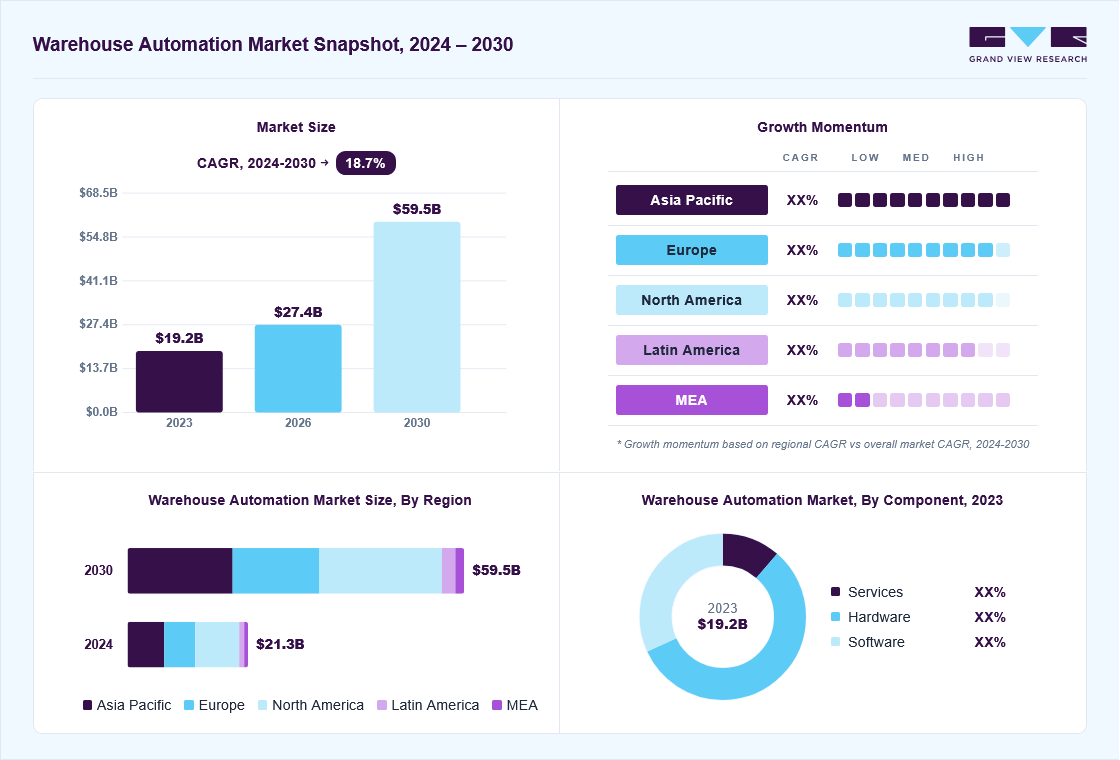
The warehouse automation market is becoming an increasingly important part of modern supply chains as businesses seek faster order processing, greater inventory accuracy, lower operating costs, and improved warehouse productivity. The market was valued at USD 19.2 billion in 2023 and is projected to grow from USD 27.4 billion in 2026 to USD 59.5 billion by 2030, expanding at a 18.7% CAGR from 2024 to 2030. The shift toward automated storage, robotics, connected systems, and software-led warehouse management is creating new opportunities across several industries.
Why Warehouses Are Moving Beyond Manual Operations
The pressure to process larger order volumes quickly is changing the role of warehouses within supply chains. E-commerce growth has increased expectations for fast and accurate fulfillment, encouraging retailers and logistics operators to adopt automated sorting systems, conveyors, robotics, and automated storage and retrieval systems.
Labor shortages are another important factor. Warehouses are increasingly using automation to reduce dependence on manual labor while maintaining continuous operations. Automated technologies can streamline inventory management, order processing, picking, packing, and material handling while reducing operational errors.
Cost efficiency also remains a major consideration. Automated storage and retrieval systems can improve warehouse-space utilization, while automation can reduce waste, optimize resources, and contribute to lower operating expenses.
Hardware Creates the Physical Foundation
Hardware dominated the market in 2023, accounting for more than 58% share of global revenue. Automated storage and retrieval systems, conveyors, robotic arms, and automated guided vehicles form the physical infrastructure required to automate warehouse activities.
The strong position of hardware reflects substantial investments required to modernize facilities and replace outdated manual systems. These technologies improve speed, accuracy, and operational efficiency. However, high initial capital requirements and ongoing maintenance costs can present challenges, particularly for smaller businesses.
Software is developing at the fastest growth rate during the 2024 to 2030 forecast period. Warehouse management systems, warehouse control systems, and integrated analytics platforms are increasingly important for coordinating automated equipment, supporting real-time decisions, and connecting warehouse operations with enterprise systems such as ERP and TMS.
Robotics and AI Are Changing the Warehouse Workflow
Robotics is one of the most visible technology trends across the market. Autonomous mobile robots and collaborative robots are being used for picking, packing, and material handling while working alongside human employees.
Artificial intelligence and machine learning add another layer of intelligence. These technologies support data analysis, predictive maintenance, and optimized decision-making. IoT connectivity enables warehouses to monitor inventory and equipment in real time, while data analytics can improve supply chain visibility.
The emergence of smart warehouses is reinforcing this technology shift. The implementation of 5G is also expected to support connected warehouse environments by enabling faster and more reliable communication between devices.
Intermediate Automation Still Holds an Important Position
Intermediate automation dominated the market in 2023. This approach combines automated processes with human intervention for tasks involving oversight and decision-making. Its ability to balance operational efficiency with investment requirements makes it attractive to businesses transitioning from manual operations.
At the same time, autonomous warehouses are projected to expand at the fastest growth rate during 2024 to 2030. These facilities rely heavily on robotics, AI-driven software, and IoT connectivity while requiring minimal human intervention. Higher initial investment is balanced by potential improvements in throughput, labor costs, and scalability.
Retail and E-Commerce Remain a Major Automation Catalyst
Retail and e-commerce dominated the application landscape in 2023 and are also the fastest-growing application area. The rapid expansion of online shopping has placed greater pressure on businesses to process orders quickly, accurately, and cost-effectively.
Healthcare is another important application area, with automated warehouse technologies supporting the tracking and distribution of pharmaceuticals, medical devices, and other critical supplies. Automated storage, temperature-controlled environments, and real-time tracking can address the precise inventory requirements associated with healthcare supply chains.
Regional Adoption Reflects Different Industrial Priorities
North America dominated the warehouse automation market in 2023 with a 36.7% share of global revenue, supported by its industrial base, logistics infrastructure, technology adoption, and e-commerce activity. Europe is emphasizing precision, safety, sustainability, and energy-efficient automation, while Asia Pacific is expected to grow at the fastest CAGR from 2024 to 2030, supported by industrialization, e-commerce expansion, logistics investments, and smart manufacturing initiatives.
FAQs
How big is the warehouse automation market?
The warehouse automation market was valued at USD 19.2 billion in 2023, is projected to reach USD 27.4 billion in 2026, and is forecast to reach USD 59.5 billion by 2030, growing at a 18.7% CAGR from 2024 to 2030.
What trends are shaping the warehouse automation market?
Robotics, artificial intelligence, machine learning, IoT, smart warehouses, 5G connectivity, automated storage, and advanced warehouse software are shaping market development. E-commerce growth, labor shortages, efficiency requirements, and pressure to reduce operating costs are also accelerating automation adoption.
Key Warehouse Automation Companies:
· DematicLegal
· Daifuku Co., Ltd.
· Swisslog Holding AG
· Honeywell International Inc.
About us:
Grand View Research, a market research and consulting company, provides syndicated research reports, customized research reports, and consulting services. Grand View Research database is used by the world's renowned academic institutions and Fortune 500 companies to understand the global and regional business environment. Our database features thousands of statistics and in-depth analysis on 46 industries in 25 major countries worldwide.

 English
 Arabic
 French
 Spanish
 Portuguese
 Deutsch
 Turkish
 Dutch
Dutch
 Italiano
 Romaian
 Portuguese (Brazil)
 Greek
Greek