


Indonesia Foreign Exchange Market Trends, Growth, and Forecast 2026-2034
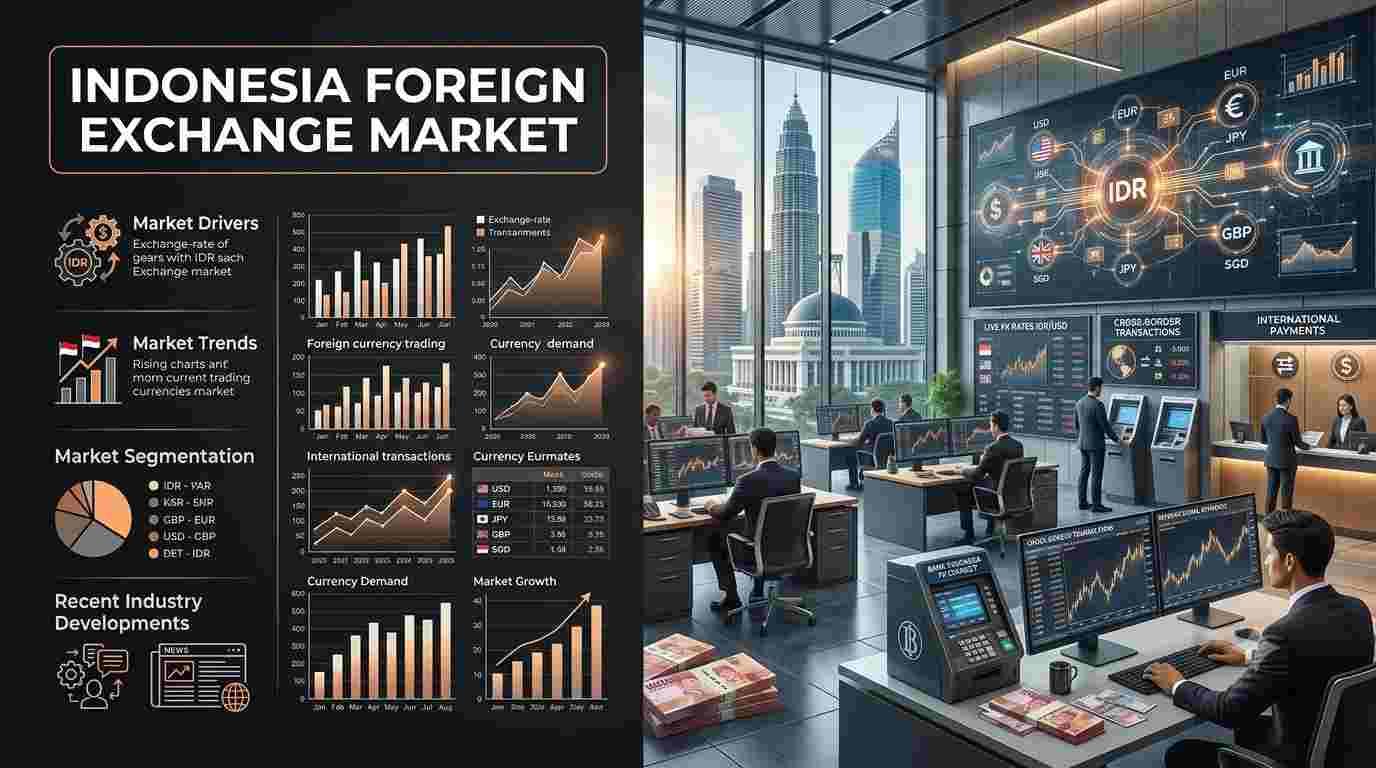
IMARC Group, a leading global market research and management consulting firm, has published its latest market intelligence report on the Indonesia Foreign Exchange Market. The Indonesia foreign exchange market size reached USD 11,853.4 Million in 2025 and is projected to reach USD 21,368.9 Million by 2034, exhibiting a growth rate of CAGR of 6.43 percent during 2026-2034. The market is fueled by increased cross-border trade, Bank Indonesia's efforts to maintain exchange rate stability, and greater participation from institutional investors, alongside growing digital platform adoption and improved regulatory transparency that have enhanced liquidity and efficiency.
Indonesia's foreign exchange market is being actively shaped by Bank Indonesia's assertive rupiah stabilization strategy, which has combined benchmark rate management with tighter transaction rules to counter persistent currency pressure and heightened global uncertainty. The rupiah closed 2024 at IDR 16,095 per USD, compared to IDR 15,397 at the end of 2023, with the central bank citing global volatility, including Middle East tensions, as a key driver of continued rupiah pressure into 2026. At the same time, the proliferation of mobile trading apps and digital platforms is democratizing forex market access, with Indonesia recording approximately 212 million internet users as of January 2025, equal to 74.6 percent of the population, drawing a broader base of millennial and tech-savvy retail participants into a market historically dominated by institutional investors. Combined with expanded hedging instruments, tightened foreign exchange purchase limits, and continued technology upgrades to transaction processing and settlement systems, these forces are reshaping the competitive landscape and setting the stage for durable, long term growth across Java, Sumatra, Kalimantan, Sulawesi, and other regions.
Indonesia Foreign Exchange Market at a Glance
- Market Size (2025): USD 11,853.4 Million
- Market Forecast (2034): USD 21,368.9 Million
- Growth Rate (2026-2034): CAGR of 6.43 percent
- Base Year: 2025, Historical Period: 2020-2025, Forecast Period: 2026-2034
- Leading Counterparty Segment: Reporting Dealers, reflecting the central role of licensed banks and financial institutions in currency transactions
- Key Stability Anchor: Bank Indonesia's Domestic Non-Deliverable Forward and swap intervention framework, actively used to manage rupiah volatility
How Digitalization and Regulatory Tightening is Reshaping the Future of the Indonesia Foreign Exchange Market
- Surge in Digital and Retail Forex Participation: The proliferation of mobile trading apps and user-friendly digital platforms has democratized forex market access, with Indonesia recording about 212 million internet users as of January 2025, drawing a growing base of millennial and tech-savvy retail participants into a market historically dominated by institutional investors.
- Fintech-Driven Trading Analytics and Execution: The rise of fintech companies offering competitive spreads and real-time trading analytics is contributing to market dynamism, increasing transaction volumes while enabling more efficient trade execution and risk management for both retail and corporate participants.
- Bank Indonesia's Expanded DNDF and Hedging Infrastructure: Bank Indonesia raised Domestic Non-Deliverable Forward sell limits by 50 percent to USD 10 million per transaction and expanded USD swap buy-sell limits to the same threshold in 2025, actively using these instruments alongside offshore Non-Deliverable Forward transactions to manage USD/IDR volatility and curb speculation.
Grab a sample PDF of this report: https://www.imarcgroup.com/indonesia-foreign-exchange-market/requestsample
Indonesia Foreign Exchange Market Trends and Drivers
Demand across the Indonesia foreign exchange market is being underpinned by increased digitalization and retail participation. Enhanced internet penetration and the growing availability of mobile trading apps are broadening the market's participant base beyond institutional investors, while regulatory initiatives promoting transparency and investor education continue to support this digital transformation.
The market's structural differentiator is exchange rate volatility driven by global economic shifts. The rupiah's performance remains intricately tied to global demand patterns and geopolitical developments, including U.S. Federal Reserve interest rate decisions, global inflationary pressures, and shifts in commodity prices such as crude oil and palm oil that significantly impact Indonesia's trade balance, heightening the importance of hedging instruments for corporates and investors.
A third driver is strengthening regulatory oversight and market infrastructure. Bank Indonesia has introduced tighter rules on foreign exchange transactions, clearer reporting requirements for corporates, and promoted hedging practices to manage currency risks, while the development of Domestic Non-Deliverable Forward instruments continues to help stabilize the rupiah without excessive reliance on foreign exchange reserves.
Government Schemes and Regulatory Initiatives Driving Demand
- Government Regulation No. 8 on Export Foreign Exchange Retention: Indonesia implemented Government Regulation No. 8 in March 2025, mandating that exporters of natural resources keep all foreign exchange earnings within the country's financial system for at least one year, intended to strengthen national foreign currency reserves and reinforce economic resilience.
- Reduced Foreign Currency Cash Purchase Threshold: Bank Indonesia lowered the maximum limit for foreign currency cash purchases against the rupiah from USD 100,000 to USD 50,000 per person per month, effective April 1, 2026, as part of efforts to support rupiah exchange rate stability amid continued market pressure.
- Expanded Domestic Non-Deliverable Forward and Swap Limits: Bank Indonesia raised Domestic Non-Deliverable Forward sell limits by 50 percent to USD 10 million per transaction and increased USD swap buy-sell limits to the same threshold, aimed at protecting the country's foreign exchange reserves, which stood at USD 151.9 billion in February 2026.
- Hedging Swap Premium Reduction for Foreign Funding: Bank Indonesia expanded the scope of underlying foreign-funding transactions eligible for a 12.5 percent reduction in hedging swap premiums, part of a broader intensification of foreign-exchange market interventions to strengthen rupiah stability against heightened global volatility.
- Bank Indonesia Benchmark Rate and Inflation Target Alignment: Bank Indonesia has held its benchmark BI Rate steady through 2026 in successive Board of Governors' Meetings, consistent with efforts to strengthen rupiah stability, maintain its 2.5 plus or minus 1 percent inflation target for 2026 and 2027, and support sustainable economic growth.
We explore the factors propelling the Indonesia Foreign Exchange Market growth, including technological advancements, consumer behaviors, and regulatory changes.
Indonesia Foreign Exchange Market Industry Segmentation
The report has segmented the market into the following categories:
Breakup By Counterparty:
- Reporting Dealers
- Other Financial Institutions
- Non-financial Customers
Reporting dealers continue to account for the bulk of forex transaction volume given their central role as licensed intermediaries, while non-financial customers are seeing growing participation as digital trading platforms broaden retail investor access.
Breakup By Type:
- Currency Swap
- Outright Forward and FX Swaps
- FX Options
Outright forward and FX swap instruments continue to see strong demand as corporates increasingly adopt hedging practices to manage currency risk, supported by Bank Indonesia's expanded Domestic Non-Deliverable Forward transaction limits.
Breakup By Region:
- Java
- Sumatra
- Kalimantan
- Sulawesi
- Others
Java anchors the market given its concentration of financial institutions, corporate treasury operations, and Jakarta's role as Indonesia's primary financial hub, while other regions continue to expand forex market participation through rising digital platform access.
Competitive Landscape
The Indonesia foreign exchange market features a mix of licensed reporting dealer banks, fintech trading platforms, and financial institutions operating under Bank Indonesia's regulatory oversight. Key players compete through digital platform innovation, competitive spreads, real-time trading analytics, and hedging product offerings, with the market structure shaped directly by Bank Indonesia's evolving transaction limits and reporting requirements for both institutional and retail participants.
Market Concentration Analysis
- Reporting dealer banks continue to account for the dominant share of Indonesia's foreign exchange transaction volume, given their licensed intermediary role and direct access to Bank Indonesia's DNDF and swap intervention mechanisms.
- Java, anchored by Jakarta, concentrates the bulk of institutional forex activity given its role as the country's primary financial and corporate treasury hub, while other regions continue to expand participation primarily through digital retail trading platforms.
- The market's retail segment is becoming increasingly less concentrated as fintech-driven mobile trading apps lower barriers to entry, broadening participation beyond the institutional investors who have historically dominated the market.
What Does The Full Report Cover?
- Historical, current, and forecast market size for the Indonesia foreign exchange market from 2020 to 2034
- Market breakup by counterparty, type, and region
- Region level analysis covering Java, Sumatra, Kalimantan, Sulawesi, and other regions
- Key growth drivers, restraints, and opportunities shaping the market
- Porter's Five Forces analysis and value chain assessment
- Competitive landscape, market structure, and player positioning
- Detailed profiles of major foreign exchange market participants operating in Indonesia
Recent News and Developments in the Indonesia Foreign Exchange Market
- March 2025: Indonesia implemented Government Regulation No. 8, mandating that exporters of natural resources keep all foreign exchange earnings within the country's financial system for at least one year, intended to strengthen national foreign currency reserves.
- March 2026: Bank Indonesia lowered the individual foreign currency cash purchase threshold from USD 100,000 to USD 50,000 per person per month, effective April 1, 2026, while raising Domestic Non-Deliverable Forward and swap transaction limits to USD 10 million.
- February 2026: Bank Indonesia Governor Perry Warjiyo assessed the rupiah as undervalued relative to Indonesia's economic fundamentals, with the currency trading at IDR 16,880 per USD on February 18, 2026, and reaffirmed the central bank's commitment to stability through NDF, spot, and DNDF market interventions.
- March 2026: UOB economists noted that Bank Indonesia's tightened foreign exchange regulations and expanded hedging facilities established since March 2025 had compressed USD/IDR implied volatility to a 12-month low of 5.5 percent, down from levels above 8 percent before the policy shift.
- August 2026: Bank Indonesia held its benchmark BI Rate at 5.75 percent amid continued rupiah pressure and global uncertainty linked to the Middle East conflict, intensifying foreign-exchange interventions through NDF and DNDF transactions to strengthen currency stability.
Note: If you require specific details, data, or insights that are not currently included in the scope of this report, we are happy to accommodate your request. As part of our customization service, we will gather and provide the additional information you need, tailored to your specific requirements. Please let us know your exact needs, and we will ensure the report is updated accordingly to meet your expectations.
Key Questions This Report Answers
- How big is the Indonesia foreign exchange market and what is its growth outlook through 2034?
- What are the key growth drivers, restraints, and opportunities in the Indonesia foreign exchange market?
- Which counterparty and type segments hold the largest share of the market?
- Which region leads the Indonesia foreign exchange market, and why?
- How are government schemes and Bank Indonesia's regulatory interventions shaping regional demand?
- Who are the key players in the Indonesia foreign exchange market, and how is the competitive landscape evolving?
- What role is digitalization playing in the future of Indonesia's foreign exchange trading and retail participation?
About Us
IMARC Group is a global management consulting firm that helps the world's most ambitious changemakers to create a lasting impact. The company provides a comprehensive suite of market entry and expansion services. IMARC offerings include thorough market assessment, feasibility studies, company incorporation assistance, factory setup support, regulatory approvals and licensing navigation, branding, marketing and sales strategies, competitive landscape and benchmarking analyses, pricing and cost research, and procurement research.
Media and Sales Contact
IMARC Group
Email: sales@imarcgroup.com
United States: +1-201-971-6302
India: +91-120-433-0800
United Kingdom: +44-753-714-6104

 English
 Arabic
 French
 Portuguese
 Deutsch
 Turkish
 Dutch
Dutch
 Italiano
 Russian
 Romaian
 Portuguese (Brazil)
 Greek
Greek