


Online Matka History: From Traditional Markets to Digital Platforms
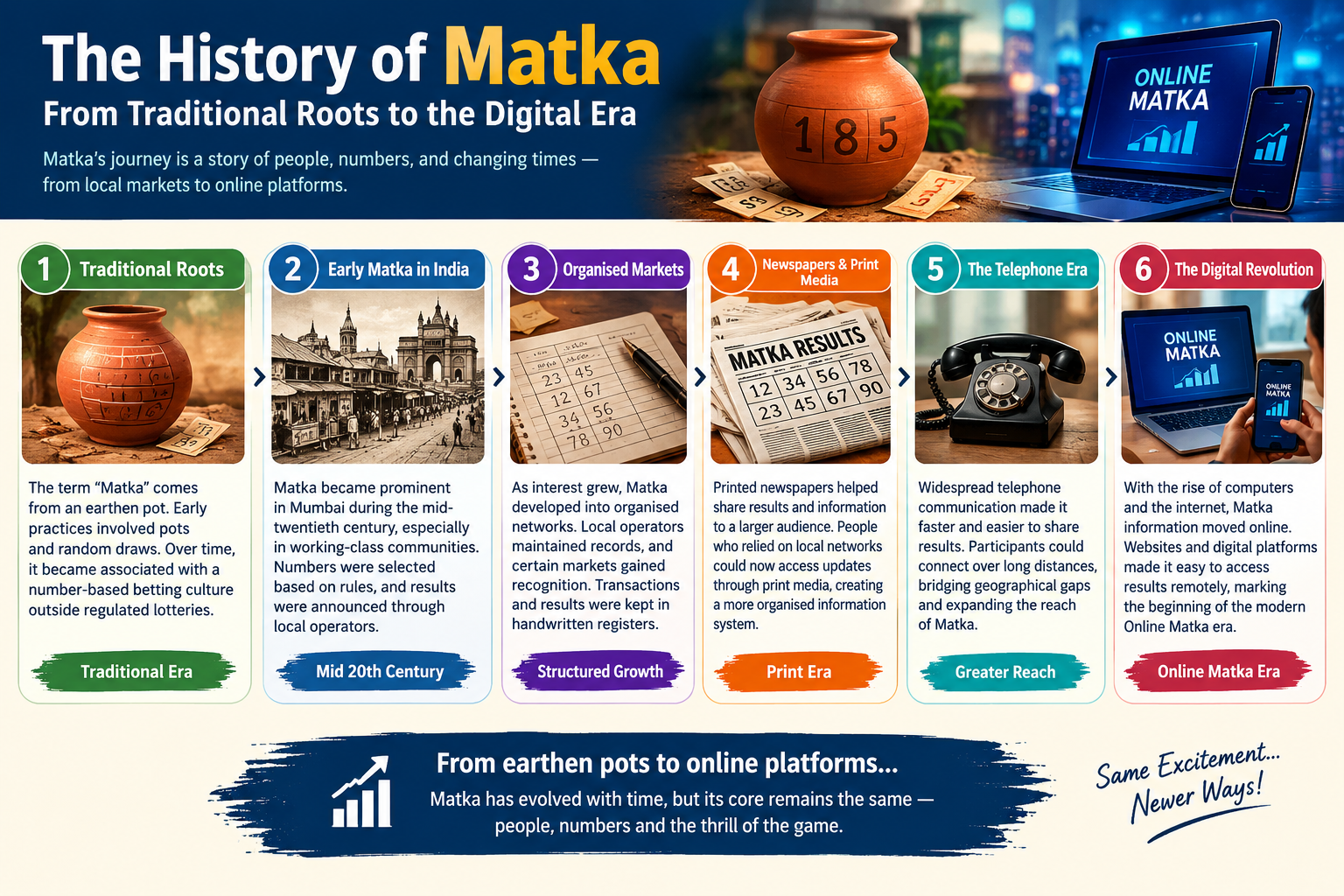
The history of Matka is closely connected with the evolution of informal betting culture in India. What began as a traditional form of number-based wagering gradually developed alongside changes in communication, technology, and entertainment. In recent decades, the arrival of the internet and smartphones has transformed how people encounter Matka-related information and platforms.
Understanding the history of Online Matka requires looking beyond modern websites and mobile applications. Its development is part of a much longer story involving traditional markets, paper-based records, changing regulations, printed result systems, telephone communication, and eventually digital technology.
What Is Matka?
The term Matka is commonly associated with a traditional number-based wagering system that became particularly prominent in India during the twentieth century. Historically, participants selected numbers according to particular rules, while results were announced through established systems.
The word “Matka” literally refers to an earthen pot. Historical accounts commonly connect the name with earlier practices involving pots and randomised draws. Over time, however, the meaning of the term became associated primarily with a broader number-based betting culture.
Matka developed outside conventional forms of regulated lottery and became part of India's informal gambling landscape. Its popularity was influenced by accessibility, word-of-mouth communication, and the growth of urban communities where such activities circulated.
The Early History of Matka in India
The development of Matka is generally associated with Mumbai, particularly with the city's working-class communities during the mid-twentieth century. Earlier forms of the activity were connected with commodity-market fluctuations and informal methods of predicting figures.
As the practice evolved, number selection and result declaration became more structured. People began participating through local operators, who maintained records and communicated results to participants.
During this period, Matka was predominantly an offline activity. There were no websites, smartphone applications, digital wallets, or online result dashboards. Information travelled through personal networks, local establishments, printed material, and other forms of direct communication.
This physical structure played an important role in shaping the culture surrounding traditional Matka.
The Rise of Organised Matka Markets
As interest increased, Matka developed into a more organised network. Local operators and participants became connected through established channels, and particular markets acquired recognition among players.
The growth of these markets also resulted in increasingly systematic record-keeping. Numbers, results, and transactions were maintained through handwritten registers and other physical records.
The emergence of organised Matka markets demonstrates an important characteristic of the activity: technology was not initially responsible for its popularity. Instead, the system developed through social networks and local communication before later adopting newer technologies.
Matka and the Role of Newspapers
Printed newspapers played an important role in the communication environment surrounding traditional Matka.
As print media expanded, results and related information could reach larger audiences. Participants who previously depended heavily on local communication networks could obtain information through printed sources.
This stage represents an important transition because it demonstrates how traditional number-based activities adapted to changing information systems.
Although newspapers were not digital platforms, they helped establish a culture in which participants expected results and information to be communicated through increasingly structured channels.
The Telephone Era
The arrival of widespread telephone communication created another significant change.
Instead of depending entirely on physical meetings or local information networks, participants and operators could communicate over telephone lines. Result information could be transmitted much more rapidly, helping connect geographically separated communities.
This period can be viewed as an intermediate stage between traditional Matka and the later Online Matka environment.
The telephone did not fundamentally change the nature of number-based wagering, but it changed the speed and geographical reach of communication.
The Emergence of Digital Technology
The most substantial transformation occurred with the growth of computers and the internet.
During the early internet era, information that had previously existed in newspapers, printed charts, or local records began appearing on websites. Digital platforms made it possible to publish information in a centralised format that users could access remotely.
This marked the beginning of a broader transition towards digital Matka platforms.
Websites could publish market information, historical results, schedules, and other content in a format that was easier to update than printed material. Search engines also changed how people discovered such information.
Instead of relying exclusively on personal contacts, users could search online for Matka-related information.
The Smartphone Revolution
The introduction and widespread adoption of smartphones accelerated digital transformation.
Mobile internet allowed users to access websites from almost anywhere. Smartphones combined several technologies that previously existed separately: internet browsing, communication, digital publishing, and applications.
As a result, Matka-related platforms increasingly adopted mobile-friendly websites and applications.
The transition from desktop computers to smartphones was particularly significant because mobile devices became the primary method through which many people access online information.
Modern platforms can provide information through responsive websites, mobile applications, notifications, and other digital interfaces.
Online Matka Platforms and Digital User Experience
The modern Online Matka environment is considerably different from the traditional market.
Traditional Matka depended heavily on physical locations and interpersonal networks. Digital platforms, by contrast, can operate through websites and mobile interfaces.
A modern digital platform may include features such as:
-
Mobile-friendly interfaces
-
Digital result publication
-
Historical information
-
Automated notifications
-
User accounts
-
Online communication systems
-
Digital payment infrastructure
-
Search and filtering tools
These technologies have fundamentally changed how information is presented and accessed.
However, the availability of these technologies does not automatically make gambling activities legal. The legal position of gambling and betting varies significantly between jurisdictions, and users need to understand the rules that apply where they live.
The Role of Digital Payments
Another important development in the history of online platforms has been the expansion of digital payments.
Internet banking, mobile payment systems, cards, and digital wallets have changed the broader online commerce environment. These technologies have also influenced how various online entertainment and wagering services operate.
The transition from cash-based transactions to digital systems has increased convenience but has also introduced additional concerns involving financial security, fraud prevention, identity verification, and responsible participation.
For any online financial activity, users should understand the payment terms, applicable laws, and security practices before providing personal or financial information.
Legal Regulation and Online Matka
The history of Matka cannot be separated from questions surrounding gambling regulation.
India does not have a single uniform legal framework that treats every form of gambling in exactly the same way. Different laws, regulations, court decisions, and state-level rules can affect how particular activities are treated.
The distinction between games of skill and games involving chance can also be legally relevant in certain contexts.
With the development of internet-based platforms, regulatory questions became more complicated because an online service can potentially be accessed across geographical boundaries.
Consequently, anyone researching Online Matka should check the current laws applicable to their particular state or country rather than assuming that an online platform is lawful simply because it is accessible through the internet.
From Physical Records to Digital Data
One of the clearest changes in Matka history is the movement from physical records to digital data.
Traditional operators relied on notebooks, printed charts, physical slips, and other paper-based records. Digital systems can store significantly larger quantities of information and retrieve it almost instantly.
This transformation reflects a broader technological trend affecting industries worldwide.
Retail, banking, entertainment, education, and communication have all moved from predominantly physical systems towards digital platforms. Matka-related information has followed a similar technological trajectory.
The Influence of Social Media
Social media has added another layer to the evolution of online Matka culture.
Platforms such as social networks and messaging services allow information to spread rapidly between users. Discussions, announcements, promotional material, and result-related information can circulate much faster than through traditional communication channels.
At the same time, social media creates additional risks involving misinformation, impersonation, fraudulent accounts, and misleading advertisements.
Users should therefore distinguish between verified information and unverified claims when encountering Matka-related content online.
The Importance of Responsible Digital Behaviour
The movement from traditional Matka markets to digital platforms has increased accessibility, but accessibility also creates responsibilities.
Online gambling-related activities can involve financial risks. Users may also encounter fraudulent websites, misleading promotions, fake applications, or requests for sensitive personal information.
Basic digital safety practices remain important. Users should avoid sharing passwords, banking credentials, one-time passwords, or other sensitive information with unknown individuals or websites.
It is equally important to understand local gambling laws and recognise that gambling can result in financial losses.
How Technology Continues to Change Matka
Technology continues to reshape online entertainment and wagering environments.
Artificial intelligence, automated notifications, data analytics, cloud computing, mobile applications, and increasingly sophisticated websites are influencing how digital platforms are developed.
At the same time, regulators and technology companies are developing stronger approaches to identity verification, fraud detection, payment security, age restrictions, and responsible-gambling measures.
The future development of online Matka-related platforms will therefore depend not only on technology but also on regulation, cybersecurity, consumer protection, and responsible digital practices.
Conclusion: From Traditional Markets to Digital Platforms
The history of Online Matka represents a broader technological journey from physical communities and handwritten records to websites, smartphones, and digital communication.
Traditional Matka developed through local networks and offline systems. Newspapers expanded the distribution of information, telephones accelerated communication, computers introduced digital records, and smartphones brought online access directly into people's hands.
Today, the term Online Matka is associated with a digital environment that is considerably different from the traditional markets of previous decades. The underlying historical connection remains important, but technology has transformed how information is distributed and accessed.
Understanding this history provides useful context for examining the development of digital platforms, while awareness of local laws, online security, financial risks, and responsible participation remains essential when navigating any gambling-related digital environment.

 English
 Arabic
 French
 Spanish
 Portuguese
 Deutsch
 Turkish
 Dutch
Dutch
 Italiano
 Romaian
 Portuguese (Brazil)
 Greek
Greek