


How Advanced Sensors Are Strengthening the Next Generation of ADAS Features
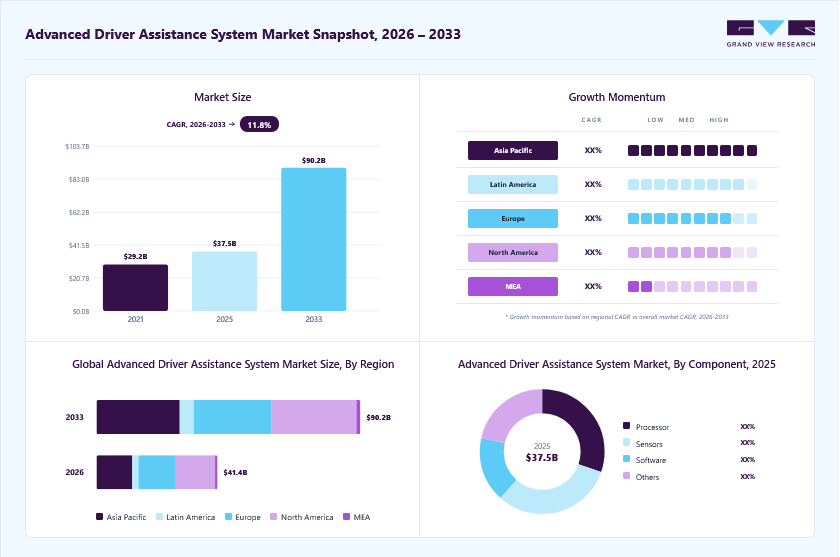
The advanced driver assistance system market is entering a period of strong expansion as automakers, regulators, and consumers place greater emphasis on vehicle safety and intelligent driving support. The market was valued at USD 37.5 billion in 2025, is estimated to reach USD 41.4 billion in 2026, and is projected to reach USD 90.2 billion by 2033, registering a CAGR of 11.8% from 2026 to 2033. Increasing road accidents, rising safety awareness, government regulations, and the growing application of ADAS in passenger vehicles are supporting market development.
Road Safety Is Moving Advanced Assistance Into the Mainstream
The rising number of road accidents and increasing awareness of driver and passenger safety are encouraging automotive manufacturers to integrate more sophisticated assistance technologies. ADAS features such as automatic emergency braking, adaptive cruise control, forward collision warnings, lane departure warning, blind spot detection, intersection assistance, and rear cross-traffic alerts are designed to provide drivers with additional support during different driving situations.
Government regulations are also influencing adoption. Mandatory safety requirements are encouraging manufacturers to incorporate assistance technologies into vehicles, while growing traffic volumes and frequent exposure to high-speed highway driving are strengthening the need for systems capable of supporting safer driving.
Adaptive Cruise Control Holds a Leading Position
Among solutions, adaptive cruise control accounted for the largest revenue share of 20.1% in 2025. Demand is being supported by increasing interest in vehicle safety, improvements in sensor and radar technologies, and regulations requiring certain safety systems in vehicles.
Blind spot detection is expected to record the fastest CAGR from 2026 to 2033. These systems use sensors to identify vehicles in a driver's blind spot and provide visual or audible warnings. Improvements in reliability and affordability are helping expand their application across vehicles.
The market also includes park assistance, lane departure warning systems, tire pressure monitoring systems, autonomous emergency braking, adaptive front lights, and other solutions.
Sensors Are Becoming the Core of Intelligent Vehicle Assistance
Sensors accounted for the largest component revenue share in 2025. They provide the information required for ADAS functions by detecting vehicles, pedestrians, lanes, objects, and potential hazards around the vehicle. Radar, LiDAR, ultrasonic, camera, and other sensor technologies can work together to support different assistance functions.
Processors are also gaining importance as ADAS systems become more sophisticated. Advanced functions require powerful processing capabilities to run algorithms that identify objects, track movement, and support driving decisions. This is creating demand for processors capable of handling increasingly complex ADAS workloads.
Passenger Vehicles Are Expanding the Application Base
Passenger cars dominated the market in 2025 and are expected to register the fastest CAGR during the forecast period. Increasing demand for advanced passenger vehicles, including electric and hybrid cars, is contributing to adoption. Consumer awareness of safety assistance capabilities and default security features is also supporting growth.
Regulatory initiatives are reinforcing this trend. The European Union's Vision Zero initiative targets the elimination of road deaths by the end of 2050 and has set a target to reduce injuries and fatalities by 50% by the end of 2030. Safety features including automatic emergency braking, lane departure warning, and attention and drowsiness detection have also become part of regulatory requirements for new passenger vehicles.
Commercial Vehicles Add Another Growth Opportunity
Commercial vehicles represent another important application area as transportation and logistics companies increasingly adopt advanced technologies. Growing activity in e-commerce, online retail, shipping and logistics, agriculture, and consumer products is supporting demand for safer and more technology-enabled commercial vehicles.
Increasing government regulations and the need for improved safety are expected to further influence the integration of ADAS across commercial vehicle fleets. At the same time, systems such as road sign recognition, night vision, and drowsiness monitoring are creating additional opportunities beyond traditional assistance functions.
Connected and AI-Based Features Are Changing ADAS
The competitive focus of the automotive industry is moving beyond basic assistive functions toward technologies designed to improve safety, comfort, control, and emergency response. Voice control, artificial intelligence, connected devices, advanced software, and sensor technologies are among the trends shaping the industry.
Manufacturers and technology companies are also expanding their portfolios. In February 2025, Elitek Vehicle Services launched the ADAS MAP solution for repairers and vehicle maintenance service providers to correctly calibrate ADAS. In January 2025, Garmin presented Unified Cabin 2025 with features including Ultra-Wide Band technology for Child Presence Detection, enhanced blind spot vision, improved computer vision, and augmented reality capabilities.
Regional Adoption Reflects Regulation and Automotive Innovation
North America accounted for the largest regional revenue share of 31.8% in 2025, supported by automotive technology development, major industry participants, infrastructure, economic conditions, and adoption of new technologies. Asia Pacific is expected to record the fastest CAGR from 2026 to 2033, supported by vehicle demand, infrastructure improvements, and manufacturing activity.
The U.S. accounted for the largest revenue share of its regional industry in 2025. In Asia Pacific, China held the largest revenue share in 2025, while India is projected to record the fastest CAGR during the forecast period. China exported nearly 1.6 million electric vehicles in 2023, while India's expanding manufacturing landscape and growing demand for advanced passenger cars are supporting market opportunities.
Key Advanced Driver Assistance System Companies:
· Altera Corporation
· Autoliv
· DENSO CORPORATION
· Continental AG
About us:
Grand View Research, a market research and consulting company, provides syndicated research reports, customized research reports, and consulting services. Grand View Research database is used by the world's renowned academic institutions and Fortune 500 companies to understand the global and regional business environment. Our database features thousands of statistics and in-depth analysis on 46 industries in 25 major countries worldwide.

 Arabic
 French
 Spanish
 Portuguese
 Deutsch
 Turkish
 Dutch
Dutch
 Italiano
 Russian
 Romaian
 Portuguese (Brazil)
 Greek
Greek