


GCC Bottled Water Market Surge: Regional Demand & Growth Outlook 2026-2034
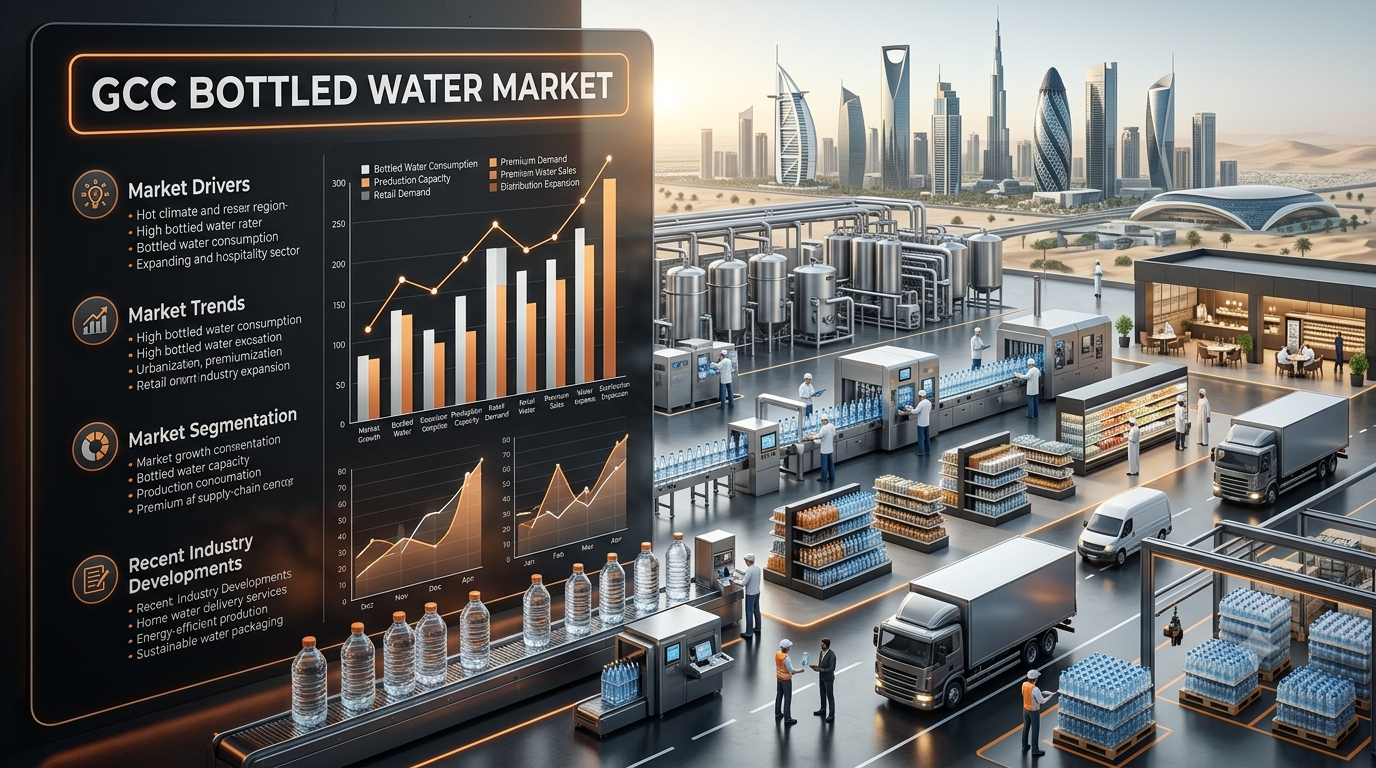
IMARC Group, a leading global market research and management consulting firm, has published its latest market intelligence report on the GCC Bottled Water Market. The GCC bottled water market size increased from USD 27.5 Billion in 2025 to USD 29.8 Billion in 2026 and is projected to reach USD 49.9 Billion by 2034, exhibiting a CAGR of 6.63% during 2026-2034. Growth is being driven by water scarcity resulting from the region's arid climate, rising health and wellness consciousness, rapid urbanization across all six GCC nations, and surging tourism and hospitality activity.
Bottled water remains one of the most structurally important consumer categories for the GCC, underpinning daily hydration for a population with negligible natural freshwater resources and near-total reliance on desalination. As Gulf governments push ahead with ambitious tourism frameworks such as Saudi Vision 2030 and UAE National Agenda 2031, regional demand for still, mineral, and premium water formats is climbing steadily across households, hospitality venues, and institutional buyers. At the same time, GCC bottled water producers are investing heavily in sustainable rPET packaging, AI-driven demand forecasting, and smart QR-enabled labeling, positioning the region as an increasingly sophisticated bottled water market rather than a purely commodity-driven one. Combined with strong government backing through tourism infrastructure investment and tightening plastic regulation, these forces are reshaping the competitive landscape and setting the stage for durable, long-term growth across Saudi Arabia, the UAE, Kuwait, Qatar, Oman, and Bahrain.
GCC Bottled Water Market at a Glance:
- Market Size (2025): USD 27.5 Billion
- Market Size (2026): USD 29.8 Billion
- Market Forecast (2034): USD 49.9 Billion
- Growth Rate (2026-2034): CAGR of 6.63%
- Base Year: 2025 | Historical Period: 2020-2025 | Forecast Period: 2026-2034
- Leading Product Segment: Still Bottled Water, at 61.3% share in 2025, driven by everyday household hydration needs across a population with no viable tap water alternative
- Leading Country Market: Saudi Arabia, commanding 34.8% of regional revenue in 2025, backed by its large population, extreme climate, and Vision 2030 tourism targets
How AI is Reshaping the Future of the GCC Bottled Water Market
- AI-Driven Demand Forecasting: Masafi and Gulfa Mineral Water both adopted AI demand planning tools that reduced excess inventory by approximately 12% in 2024, reflecting a broader industry shift toward digital shelf analytics and AI-integrated retail channel partnerships.
- Smart Manufacturing and Industry 4.0 Integration: Leading manufacturers are deploying IoT-enabled filling lines, AI-driven production scheduling, and real-time quality control sensors, with Agthia Group's Al Ain Water bottling operations in Abu Dhabi investing in automation as part of broader technology and sustainability initiatives.
- Smart Packaging and QR Code Integration: Brands are embedding QR codes and NFC-enabled labels to deliver product authentication, traceability, and real-time nutritional information directly to consumer smartphones, with adoption rising among premium GCC brands between 2023 and 2025, particularly in the UAE and Qatar.
Grab a sample PDF of this report: https://www.imarcgroup.com/gcc-bottled-water-market/requestsample
GCC Bottled Water Market Trends and Drivers:
Demand for bottled water across the GCC is being underpinned by structural water scarcity and extreme climate conditions. GCC nations record annual temperatures exceeding 48 degrees Celsius in peak summer months, and per-capita annual freshwater availability across the region remains below 100 cubic meters, far under the global average of 1,700 cubic meters, making bottled water a non-discretionary daily necessity insulated from typical discretionary spending cycles.
The region's structural differentiator is its booming tourism and hospitality sector, with the GCC welcoming over 30 million international tourists in 2024 alone. Saudi Arabia targets 150 million annual visitors by 2030 under Vision 2030, while Dubai's Tourism Strategy 2030 aims for 25 million visitors per year, generating substantial institutional water demand from hotels, resorts, airports, and convention facilities that provides a multi-year volume tailwind for branded producers.
A third driver is the rapid rise of e-commerce and quick-commerce grocery platforms. Online grocery delivery services in Saudi Arabia and the UAE registered strong revenue growth in 2024, with platforms including Noon, Careem Now, and Talabat accelerating contactless bulk and single-serve water delivery, a dynamic that is expected to see e-commerce orders represent 14-16% of total GCC bottled water distribution by 2034.
Government Schemes and National Vision Initiatives Driving Demand:
- Saudi Vision 2030 Tourism Targets: Saudi Arabia's tourism sector surpassed 100 million visitor trips in 2023, and the Kingdom is now targeting 150 million visitors by 2030 under Vision 2030, with giga-projects including NEOM, Diriyah, Red Sea Global, and Qiddiya generating sustained multi-year institutional bottled water procurement demand.
- UAE National Agenda 2031 and Dubai Tourism Strategy 2030: The UAE's National Agenda 2031 and Dubai's Tourism Strategy 2030, targeting 25 million annual visitors, are reinforcing sustained premium bottled water demand across the emirate's more than 800 four- and five-star hotels as of 2025.
- UAE Single-Use Plastic Ban: The UAE implemented a ban on select single-use plastics effective January 2024, while Saudi Arabia continues developing its extended producer responsibility framework, raising compliance costs and accelerating packaging redesign across the region's bottled water manufacturers.
- Saudi Food & Drug Authority Quality Enforcement: The Saudi Food & Drug Authority and UAE Ministry of Climate Change & Environment have increased inspection frequency and penalties against counterfeit and sub-standard bottled water products, structurally favoring established national and international brands over unregulated competitors.
- Kuwait Vision 2035 and Oman Vision 2040: Kuwait's Vision 2035 entertainment and hospitality investment programs and Oman Vision 2040's tourism diversification targets, including 11 million tourists by 2040, are generating new institutional water procurement channels across the region's secondary growth markets.
GCC Bottled Water Market Industry Segmentation:
The report has segmented the market into the following categories:
Breakup By Product Type:
- Still Bottled Water
- Carbonated Bottled Water
- Mineral Bottled Water
- Flavored Bottled Water
Still bottled water leads the product segment at 61.3% share in 2025, driven by daily hydration needs across households, offices, and HoReCa outlets, while flavored bottled water is the fastest-growing sub-category at an estimated 9.1% CAGR through 2034.
Breakup By Distribution Channel:
- Supermarkets and Hypermarkets
- Retailers (Convenience Stores)
- Specialty and Water Stores
- On-Trade (HoReCa)
- Others (E-Commerce and Direct-to-Consumer)
Supermarkets and hypermarkets dominate distribution at 48.6% share in 2025, led by chains such as Carrefour, LuLu Hypermarket, and Panda Retail, while e-commerce and direct-to-consumer channels are the fastest-growing at an estimated 11.2% CAGR through 2034.
Breakup By Country:
- Saudi Arabia
- United Arab Emirates
- Kuwait
- Qatar
- Oman
- Bahrain
Saudi Arabia holds the largest country share at 34.8% in 2025, worth approximately USD 9.6 Billion, supported by its 35-million-plus population, extreme heat, and Vision 2030 tourism infrastructure, while the UAE is forecast to be the fastest-growing GCC market at approximately 7.8% CAGR through 2034.
Competitive Landscape:
The GCC bottled water market features a mix of multinational bottlers, regional conglomerates, and established local brands. Key players include:
- Nestlé Waters (Pure Life, Perrier, S.Pellegrino)
- Agthia Group PJSC (Al Ain Water, Al Bayan, Alpin)
- Masafi
- Danone SA (Evian, Volvic, Aqua)
- Gulfa General Investments Company PJSC
- National Water Company Saudi Arabia (Tanuf)
The competitive field is moderately consolidated at the premium tier, with the top five players, Nestle Waters, Agthia Group, Masafi, Danone, and National Water Company, collectively controlling an estimated 55-60% of market revenue in 2025, while more than 150 regional, national, and private-label water brands compete for the remaining share.
Market Concentration Analysis:
- The GCC bottled water market exhibits moderate fragmentation, with the top five players, Nestle Waters, Agthia Group, Masafi, Danone, and National Water Company, collectively accounting for an estimated 55-60% of market revenue in 2025, while more than 150 regional and private-label brands share the remainder.
- Private-label water products from hypermarket chains such as Carrefour and LuLu are estimated to hold 6-8% of cumulative volume share in the UAE and Saudi Arabia, exerting structural price pressure on mid-tier branded competitors across the mass-market segment.
- Consolidation activity is expected to accelerate during 2026-2030 as sustainability packaging compliance costs and modern trade listing requirements raise the operational entry bar, favoring larger, well-capitalized producers with established certifications and distribution infrastructure.
What Does The Full Report Cover?
- Historical, current, and forecast market size for the GCC bottled water market from 2020 to 2034
- Market breakup by product type, distribution channel, and country
- Country-level analysis covering Saudi Arabia, UAE, Kuwait, Qatar, Oman, and Bahrain
- Key growth drivers, restraints, and opportunities shaping the market
- Porter's Five Forces analysis and value chain assessment
- Competitive landscape, market structure, and player positioning
- Detailed profiles of major regional and international bottled water companies
Recent News and Developments in the GCC Bottled Water Market
- June 2025: Almarai acquires 100 percent of Pure Beverages Industry Co., the Saudi bottled water joint venture linked to Nestlé Waters, for approximately SAR 1.04 billion, entering a market where the acquired business held an 8.6 percent volume share.
- February 2025: Masafi introduces 100 percent recycled PET (rPET) bottles for its mountain water, aligning packaging with circular-economy goals and reducing carbon emissions while maintaining mineral content from Hajar Mountain sources.
- May 2026: UAE-based Ma Hawa earns recognition for producing 60.75 cubic meters of potable water from atmospheric moisture in 24 hours at the Abu Dhabi Grand Prix, supporting a site-wide ban on single-use plastic drinking water bottles.
Note: If you require specific details, data, or insights that are not currently included in the scope of this report, we are happy to accommodate your request. As part of our customization service, we will gather and provide the additional information you need, tailored to your specific requirements. Please let us know your exact needs, and we will ensure the report is updated accordingly to meet your expectations.
Key Questions This Report Answers
- How big is the GCC bottled water market and what is its growth outlook through 2034?
- What are the key growth drivers, restraints, and opportunities in the GCC bottled water market?
- Which product type and distribution channel segments hold the largest share of the market?
- Which country leads the GCC bottled water market, and why?
- How are government tourism initiatives and plastic regulations shaping regional demand?
- Who are the key players in the GCC bottled water market, and how is the competitive landscape evolving?
- What role is AI and smart packaging playing in the future of GCC bottled water production?
About Us
IMARC Group is a global management consulting firm that helps the world's most ambitious changemakers to create a lasting impact. The company provides a comprehensive suite of market entry and expansion services. IMARC offerings include thorough market assessment, feasibility studies, company incorporation assistance, factory setup support, regulatory approvals and licensing navigation, branding, marketing and sales strategies, competitive landscape and benchmarking analyses, pricing and cost research, and procurement research.
Media and Sales Contact
IMARC Group
Email: sales@imarcgroup.com
United States: +1-201-971-6302
India: +91-120-433-0800
United Kingdom: +44-753-714-6104

 English
 Arabic
 French
 Spanish
 Portuguese
 Deutsch
 Turkish
 Dutch
Dutch
 Italiano
 Russian
 Romaian
 Greek
Greek