


How Should You Choose Between Ethical Hacking, SOC, Cloud Security, and Cybersecurity Analysis?
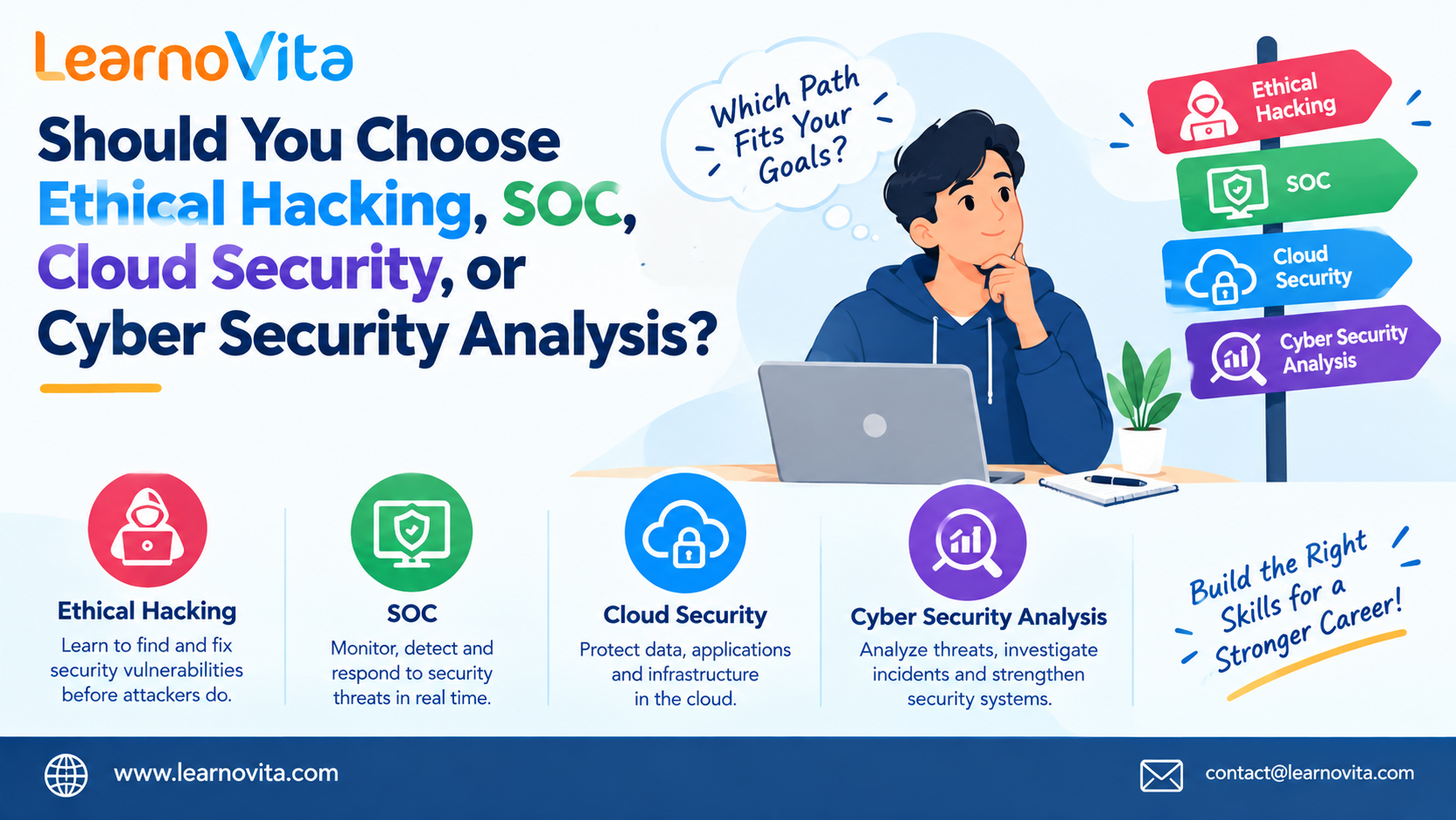
Cybersecurity has many specialized career paths, and beginners may find it difficult to decide where to focus their learning. Ethical hacking, Security Operations Center operations, cloud security, and cybersecurity analysis are four areas that involve different responsibilities, technologies, and skill sets. Although they share common cybersecurity fundamentals, each specialization approaches security from a different perspective. Understanding these differences can help learners plan their training and explore the area that interests them. Professionals can strengthen their cybersecurity skills through flexible and industry-focused Cyber Security Online Training.
What Does Ethical Hacking Focus On?
Ethical hacking involves authorized security testing to discover vulnerabilities in networks, applications, systems, and infrastructure. Professionals may conduct reconnaissance, vulnerability assessments, penetration tests, and web application security checks. Beginners interested in this area can learn networking, Linux, operating systems, web technologies, scripting, and security testing techniques. Practical labs can help learners understand how vulnerabilities are identified, tested, and reported safely.
What Skills Are Important for SOC Operations?
SOC professionals monitor security environments to identify suspicious activity and potential cyber incidents. Their work may include reviewing alerts, analyzing logs, investigating unusual behavior, correlating events, and escalating incidents according to security procedures. Knowledge of SIEM platforms, endpoint security, networking, threat detection, and incident response can support these responsibilities. Learners who enjoy continuous monitoring and security investigations can explore SOC-related roles.
What Does a Cloud Security Specialist Handle?
Cloud security focuses on protecting cloud infrastructure, applications, workloads, identities, and data. Professionals may work with access controls, cloud configurations, network security, encryption, monitoring, vulnerability management, and compliance requirements. Knowledge of AWS, Microsoft Azure, or Google Cloud can provide useful context for this specialization. Learners interested in cloud platforms and security can combine these skills to understand how modern cloud environments are protected.
What Are the Responsibilities of a Cybersecurity Analyst?
Cybersecurity analysts help organizations examine and manage potential security threats and vulnerabilities. Their responsibilities may include reviewing alerts, analyzing vulnerabilities, investigating suspicious events, monitoring security controls, and documenting security findings. Some roles also involve supporting incident response and recommending improvements to security practices. Learners who enjoy investigation, analysis, and identifying potential risks can explore this career direction.Enrolling in a Cyber Security Course in Bangalore enables aspiring professionals to gain hands-on knowledge of cybersecurity tools, vulnerabilities, and security practices.
Why Are Networking and Operating Systems Important?
Networking and operating system fundamentals support many cybersecurity activities. Beginners should understand IP addresses, TCP/IP, DNS, ports, protocols, routing, firewalls, VPNs, Linux, and Windows basics. These concepts help learners understand how systems communicate, how attacks can affect environments, and how security controls work. Cyber Security Course in Chennai helps learners develop practical skills in network security, threat detection, ethical hacking, and data protection.
How Do Scripting and Security Tools Support Cybersecurity?
Scripting can help security professionals automate repetitive activities, analyze information, and assist with investigations. Beginners can explore Python, Bash, or PowerShell depending on their intended specialization. They can also practice with tools used for vulnerability assessment, network analysis, log monitoring, security testing, and threat investigation. Developing an understanding of when and why to use a tool is important for building practical cybersecurity knowledge.
How Can Beginners Explore Different Cybersecurity Roles?
Learners can understand these specializations by exploring their typical activities. Ethical hacking emphasizes authorized security testing, SOC operations focus on monitoring and investigating security events, cloud security concentrates on protecting cloud resources, and cybersecurity analysis involves examining threats, vulnerabilities, and incidents. Introductory projects and hands-on labs can provide exposure to each area before a learner chooses a focused path. Join the best Cyber Security course in Hyderabad and learn to protect systems from real-world threats.
Conclusion:
Ethical hacking, SOC operations, cloud security, and cybersecurity analysis represent different career directions within cybersecurity. Ethical hackers focus on vulnerability testing, SOC professionals monitor and investigate security activity, cloud security specialists protect cloud environments, and cybersecurity analysts examine threats and security risks. Beginners can start with networking, operating systems, cybersecurity concepts, scripting, and practical exercises before developing deeper skills in the specialization that aligns with their interests and career plans.

 English
 French
 Spanish
 Portuguese
 Deutsch
 Turkish
 Dutch
Dutch
 Italiano
 Russian
 Romaian
 Portuguese (Brazil)
 Greek
Greek