


Specialty Egg Market Anticipated to Surpass USD 68.4 Billion by 2036
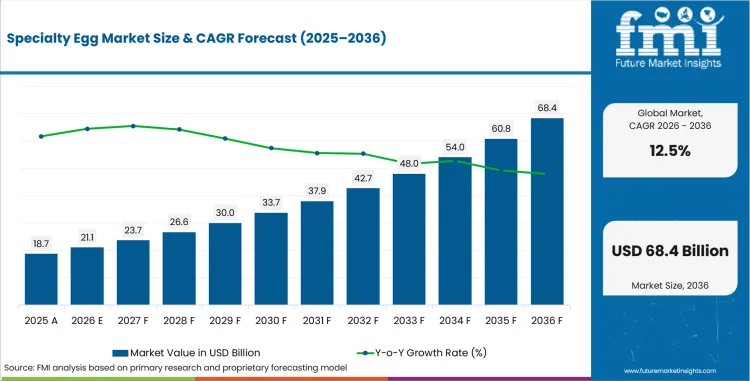
Specialty Egg Market as Consumers Shift Toward Premium and Certified Egg Products
The global Specialty Egg Market is entering a period of accelerated expansion as consumers, retailers, and food producers increasingly shift toward cage-free, organic, and nutritionally enhanced egg products. According to Future Market Insights, the market is projected to increase from USD 21.1 billion in 2026 to USD 68.4 billion by 2036, expanding at a 12.5% CAGR during the forecast period. The market was valued at approximately USD 18.7 billion in 2025.
The growth is being shaped by three interconnected forces: increasing consumer willingness to pay for premium eggs, retailer commitments toward cage-free sourcing, and regulatory changes affecting poultry housing standards. At the segment level, cage-free eggs are expected to account for 58.0% of the product segment in 2026, while shell eggs are projected to represent 72.0% of the form segment. Omega-enriched eggs lead the nutritional profile category with an estimated 56.0% share.
Explore detailed Liquid Egg Market forecasts, segmentation, regional analysis, and competitive insights: https://www.futuremarketinsights.com/reports/sample/rep-gb-14345
Analyst Perspective
"Egg producers that invest in certified cage-free and organic flock capacity ahead of retailer and regulatory deadlines are likely to capture supply agreements that lock in premium pricing through the forecast period."
- Nandini Roy Choudhury, Principal Consultant, Future Market Insights**
Why Is the Specialty Egg Market Growing?
The central market question is no longer whether consumers will purchase specialty eggs, but how quickly premium, certified, and functionally differentiated egg formats will replace conventional offerings across retail and foodservice channels.
Consumer willingness to pay a premium for cage-free, organic, and omega-enriched eggs is creating a structural shift in egg procurement. Specialty products increasingly appeal to consumers seeking higher perceived standards for animal welfare, production practices, nutritional characteristics, and product quality.
Retailer sourcing strategies are also accelerating this transition. Binding cage-free commitments from major retailers are encouraging producers to expand certified flock capacity, while state-level housing requirements are contributing to changes in conventional egg supply.
At the same time, specialty eggs benefit from their position as an everyday food staple. Unlike many premium food categories, eggs can incorporate functional and ethical attributes without requiring consumers to change established eating habits.
Cage-Free Eggs Account for 58% of the Product Segment
In 2026, cage-free eggs are expected to represent 58.0% of the product segment.
Their leading position reflects the growing influence of retailer sourcing commitments, animal-welfare expectations, and regulatory requirements affecting laying-hen housing.
Cage-free production has consequently become a major investment area for egg producers seeking access to premium retail contracts. Producers with sufficient certified flock capacity can serve retailers that have established cage-free sourcing targets while potentially participating in higher-value specialty categories.
The transition also creates opportunities for producers to differentiate through certification, traceability, flock management, packaging, and brand positioning.
Shell Eggs Lead the Product Form
Shell eggs are expected to account for 72.0% of the form segment in 2026.
Their dominance reflects the continuing importance of retail cartons as the primary consumer-facing format for specialty eggs.
Specialty attributes such as cage-free production, organic certification, and omega enrichment can be communicated directly through carton labeling and packaging. This makes shell eggs particularly suitable for premiumization within conventional grocery shopping environments.
The continued strength of shell eggs also demonstrates that specialty positioning does not necessarily require a new product format. Instead, producers can add value through production methods, certifications, nutritional characteristics, and transparent sourcing information.
Omega-Enriched Eggs Lead Nutritional Profile Demand
Omega-enriched eggs are projected to account for 56.0% of nutritional profile demand in 2026.
The segment benefits from growing consumer interest in functional nutrition and the ability to incorporate nutritional attributes into familiar everyday foods.
Omega enrichment allows egg producers and brands to differentiate products beyond conventional claims related to production systems. This creates opportunities for premium positioning while responding to consumers looking for foods associated with specific nutritional benefits.
The broader specialty egg category therefore combines multiple value propositions, including animal-welfare attributes, organic certification, nutritional enhancement, and premium quality.
Retail and Household Consumers Drive Specialty Egg Demand
Retail and household consumers are expected to represent 48.0% of end-use demand, making the grocery channel an important growth engine for specialty egg products.
Premiumization in grocery egg aisles is allowing retailers to segment consumers according to preferences for cage-free, organic, omega-enriched, and other specialty characteristics.
Packaging plays an important role in this environment. Cartons can communicate certification, nutritional claims, production methods, and brand identity at the point of purchase.
For producers, this creates a direct connection between production investment and retail value. Certified flock capacity, consistent supply, recognizable branding, and retailer relationships can become important competitive assets.
USA Leads Growth Through 2036
Country-level growth varies across major specialty egg markets, with the USA projected to expand at a 13.1% CAGR through 2036.
Growth in the USA is being supported by retailer cage-free commitments, state-level legislation affecting laying-hen housing, and continued consumer premiumization across grocery egg categories.
Europe also maintains significant specialty egg penetration. EU cage-free regulations and established organic certification frameworks have contributed to the transition toward alternative housing systems and specialty production.
These markets demonstrate that specialty egg adoption is being shaped by a combination of consumer preferences, retailer procurement strategies, regulatory requirements, certification systems, and producer investment.
What Are the Key Challenges?
Despite strong growth prospects, specialty egg producers face several operational and commercial considerations.
The transition toward certified cage-free and organic production requires investment in housing infrastructure, flock management, certification, and supply-chain capabilities. Producers must balance these investments with production economics and changing retail requirements.
Supply consistency is another important consideration. Retailers require reliable volumes and standardized quality, making certified flock capacity a critical competitive factor.
The market also faces the challenge of communicating premium attributes clearly to consumers. Cage-free, organic, omega-enriched, and other specialty claims need to be supported by appropriate certification and transparent labeling to maintain consumer confidence.
Competitive Landscape: From Certified Production to Premium Brands
The competitive environment includes large-scale egg producers, established specialty egg brands, organic producers, and emerging companies focused on differentiated production systems.
Companies profiled by FMI include Cal-Maine Foods, Inc., Vital Farms, Inc., Happy Egg Co., Egg Innovations, Pete and Gerry’s Organic Eggs, Kipster, Handsome Brook Farms, The Happy Egg Company, Farmer Focus, NestFresh, and Blue Sky Family Farms.
Competitive differentiation increasingly depends on certified flock capacity, retailer supply agreements, production infrastructure, brand recognition, organic and cage-free credentials, nutritional differentiation, and supply-chain reliability.
The market therefore extends beyond the production of eggs. Companies capable of combining certified production with strong retail relationships and recognizable specialty brands can participate across a broader portion of the premium egg value chain.
Read the complete Specialty Egg Market report: https://www.futuremarketinsights.com/reports/specialty-egg-market
What Does the Specialty Egg Market Look Like by 2036?
The market's projected rise to USD 68.4 billion by 2036 reflects a broader transformation in consumer expectations surrounding egg production and purchasing.
Specialty eggs are increasingly being evaluated not only as premium food products but also as a response to changing expectations around animal welfare, certification, nutrition, transparency, and responsible sourcing.
The next stage of market development will depend on how effectively producers and brands balance certified production capacity, supply reliability, production costs, nutritional differentiation, regulatory requirements, and consumer willingness to pay.
For egg producers, the commercial opportunity lies in developing supply systems capable of meeting the growing requirements of retailers and consumers without compromising operational efficiency.
Frequently Asked Questions
What is the Specialty Egg Market size in 2026?
The global market is expected to reach approximately USD 21.1 billion in 2026.
How large will the Specialty Egg Market be in 2036?
Future Market Insights projects the market to reach approximately USD 68.4 billion by 2036.
What is the expected CAGR of the Specialty Egg Market?
The market is projected to expand at a 12.5% CAGR from 2026 to 2036.
Which product segment leads the market?
Cage-free eggs are expected to hold the leading position, accounting for 58.0% of the product segment in 2026.
Which form dominates specialty egg demand?
Shell eggs are projected to lead with 72.0% of the form segment in 2026.
Which nutritional profile leads the market?
Omega-enriched eggs are expected to account for 56.0% of nutritional profile demand in 2026.
Which country shows the fastest growth?
The USA is projected to grow at a 13.1% CAGR through 2036.
Final Outlook
The Specialty Egg Market Outlook points toward a major expansion of premium, certified, and nutritionally differentiated egg products. With the market projected to grow from USD 21.1 billion in 2026 to USD 68.4 billion by 2036, opportunities are emerging across cage-free production, organic eggs, omega-enriched products, premium shell eggs, certification, and specialized retail offerings.
The companies positioned to capture this opportunity will need to demonstrate more than production capacity. They will need to build certified flock infrastructure, dependable supply networks, retailer relationships, strong brand recognition, and differentiated nutritional or production attributes.
About Future Market Insights (FMI)
Future Market Insights, Inc. (FMI) is an ESOMAR-certified, ISO 9001:2015 market research and consulting organization, trusted by Fortune 500 clients and global enterprises. With operations in the U.S., UK, India, and Dubai, FMI provides data-backed insights and strategic intelligence across 30+ industries and 1200 markets worldwide.
For Press & Corporate Inquiries
Rahul Singh
AVP - Marketing and Growth Strategy
Future Market Insights, Inc.
+91 8600020075
For Sales: sales@futuremarketinsights.com
For Media: Rahul.singh@futuremarketinsights.com
For Web: https://www.futuremarketinsights.com/

 English
 Arabic
 French
 Spanish
 Portuguese
 Deutsch
 Turkish
 Dutch
Dutch
 Russian
 Romaian
 Portuguese (Brazil)
 Greek
Greek