


AI Transformation in UK Retail Leadership
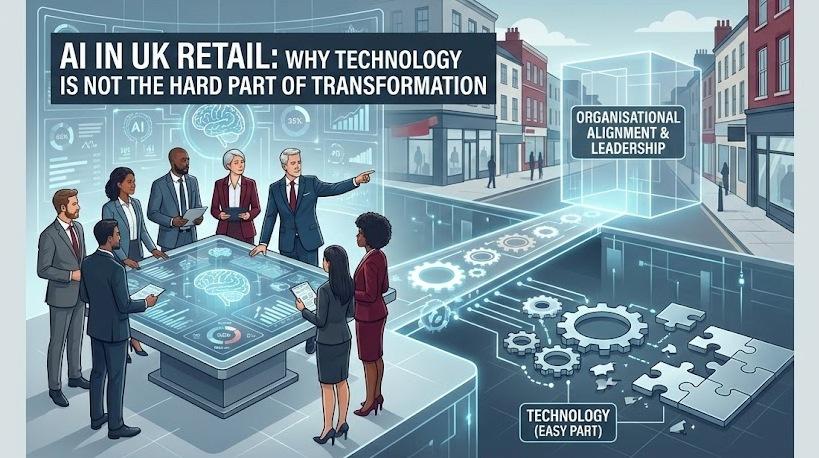
AI in UK Retail: Why Technology Is Not the Hard Part of Transformation
Across the United Kingdom, retail boards are asking the same question: How do we use AI to improve performance without destabilising the business?
From demand forecasting and pricing optimisation to workforce scheduling and personalised marketing, artificial intelligence is now embedded in strategic plans. Yet many retailers are discovering that while the technology is impressive, the transformation required to realise value is far more complex.
The real challenge is not algorithms. It is leadership clarity, organisational alignment and disciplined execution.
The Current UK Retail Reality
UK retail is operating under sustained pressure. Inflationary aftershocks, fragile consumer confidence, labour cost increases and margin compression have created an unforgiving environment. Add to this the structural shift to omnichannel models and the competitive intensity of digital-first operators, and the case for change becomes obvious.
Boards are therefore investing heavily in digital platforms and AI-enabled tools. However, too often these investments are positioned as technology upgrades rather than enterprise-wide change programmes.
This distinction matters.
Technology projects can be delegated. Transformation cannot.
AI as a Leadership Test, Not an IT Initiative
In my experience, AI programmes expose leadership weaknesses quickly. They force difficult questions:
-
Who owns the commercial outcome?
-
How do we redesign decision rights?
-
Which roles genuinely add value in an automated environment?
-
Are we prepared to stop legacy activities?
When these questions are avoided, AI becomes an overlay rather than a catalyst for performance improvement.
This is where many organisations seek support from a business transformation consultancy. Not for technical deployment, but to confront the organisational implications that accompany technological change.
The Cultural Fault Line
AI alters how decisions are made. Merchandising intuition is supplemented by predictive analytics. Store labour planning becomes algorithm-driven. Pricing autonomy narrows.
Without deliberate attention to leadership and culture, resistance emerges in subtle ways:
-
Data is questioned when it challenges established judgement
-
Exceptions proliferate
-
Local managers revert to previous habits
-
Accountability becomes blurred
A capable culture change consultant will focus less on communications campaigns and more on behavioural reinforcement: incentives, performance metrics, and visible leadership modelling.
Culture shifts when leaders act differently, not when they announce new values.
Organisation Design: The Overlooked Lever
AI-enabled transformation inevitably disrupts structure. Yet many UK retailers attempt to preserve legacy organisational models while introducing new digital capabilities.
This creates friction.
For example:
-
Data teams sit separately from commercial functions
-
Store operations report through historic hierarchies
-
Technology roadmaps are disconnected from trading cycles
Effective organisation design consulting addresses three critical dimensions:
1. Decision Architecture
Who decides on pricing changes generated by AI?
At what threshold does human intervention occur?
What escalation mechanisms exist?
2. Capability Placement
Are data scientists embedded within trading teams, or isolated centrally?
Do store leaders understand how algorithms influence staffing models?
3. Performance Governance
Are AI-driven outcomes linked directly to executive scorecards?
Is there a clear line of sight between analytics and EBIT?
Retailers that treat design as a secondary consideration invariably struggle during strategy implementation.
The Illusion of Pilot Success
A common pattern in UK retail is the “successful pilot trap”. An AI initiative works well in a limited region or category. Encouraged by early metrics, leadership announces a national roll-out.
Momentum builds — until scale introduces complexity:
-
Legacy systems fail to integrate
-
Capability gaps become obvious
-
Store-level engagement declines
-
Data quality varies across regions
Transformation at scale demands breakthrough leadership. It requires executives who are prepared to make structural trade-offs and remain consistent under pressure.
This is the point at which some organisations turn to specialist advisers, including firms such as Egremont Group, to challenge internal assumptions and test leadership alignment. The value lies not in external authority, but in disciplined questioning.
Retail-Specific Execution Challenges
For multi-site retail operations, transformation complexity multiplies. Unlike single-site or purely digital businesses, retail must align:
-
Head office strategy
-
Regional management
-
Store-level execution
-
Supply chain integration
When AI is introduced into forecasting or replenishment systems, frontline teams must trust outputs. If store managers feel detached from decision logic, they create workarounds. These workarounds, while well-intentioned, undermine system integrity.
This is why consulting for retail increasingly centres on behavioural alignment rather than technical configuration.
The Human Consequence of Automation
AI initiatives often promise labour efficiency. Yet reducing hours or reshaping roles without a clear narrative damages morale. Retail colleagues are acutely sensitive to perceived cost-cutting disguised as innovation.
Boards must therefore confront two realities:
-
Automation will change workforce structures.
-
Ambiguity destroys trust faster than change itself.
Transparent communication, coupled with credible retraining pathways, distinguishes sustainable transformation from short-term margin engineering.
Breakthrough Leadership in Practice
What does effective leadership look like during AI-driven change?
It is not charismatic rhetoric. It is operational discipline.
Breakthrough leadership in retail transformation typically involves:
-
Publicly backing data-driven decisions, even when unpopular
-
Simplifying strategic priorities to prevent overload
-
Holding senior teams accountable for behavioural consistency
-
Visiting stores to observe execution realities firsthand
Leaders who remain distant during transformation quickly lose legitimacy.
A breakthrough leadership management consultancy perspective often emphasises one uncomfortable truth: culture follows consequences. If incentives reward short-term trading wins over system adoption, AI initiatives stall.
From Investment to Impact
Significant capital is flowing into AI across UK retail. However, return on investment depends on three interdependent elements:
-
Clear strategic intent
-
Coherent organisation design
-
Disciplined strategy implementation
Neglect any one of these, and transformation becomes fragmented.
Retail management consultants increasingly report that the greatest risk is not technological failure but leadership fatigue. Continuous change without visible results erodes executive confidence. Boards then pivot prematurely to the next initiative.
Consistency, not novelty, drives performance improvement.
Executive Conclusion: What UK Retail Boards Must Do Now
AI is neither a silver bullet nor a passing trend. It is a structural shift in how retail decisions are made. But technology alone will not deliver transformation.
Boards and CEOs must:
-
Treat AI as an enterprise-wide change programme
-
Align organisation design with strategic intent
-
Reinforce new behaviours through incentives and governance
-
Commit to disciplined, staged strategy implementation
Above all, leaders must recognise that transformation is a leadership responsibility, not a systems upgrade.
In the current UK retail climate, competitive advantage will belong to organisations that combine technological capability with behavioural coherence. The retailers that succeed will not be those who invest fastest, but those who align leadership, culture and structure most effectively.
That is the real test of transformation.

 Arabic
 French
 Spanish
 Portuguese
 Deutsch
 Turkish
 Dutch
Dutch
 Italiano
 Russian
 Romaian
 Portuguese (Brazil)
 Greek
Greek