


Kraft Paper Prices 2026: What Does the Latest Price Chart Show?
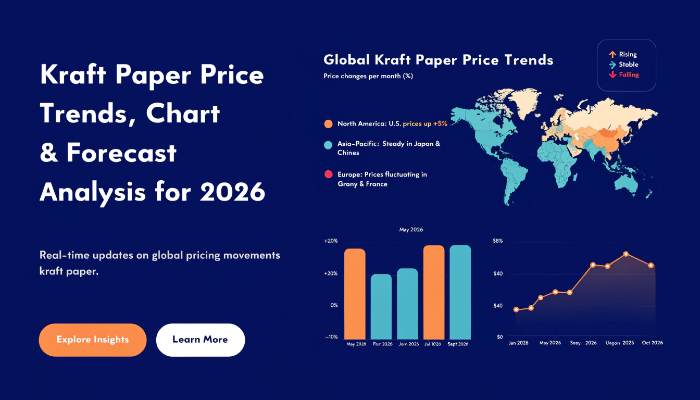
Global Kraft Paper Prices Outlook – Q2 2026
Kraft Paper Prices 2026 showed a wide regional pricing spread during Q2, reflecting differences in production costs, pulp availability, packaging demand, and trade flows. The verified Q2 benchmarks ranged from USD 881/MT in Argentina to USD 1482/MT in France, while China stood at USD 921/MT, Thailand at USD 998/MT, and the United Kingdom at USD 1393/MT. IMARC Group's Q2 2026 price-tracking database and methodology indicate that regional conditions remained highly differentiated across key kraft paper markets. Procurement teams can use the Kraft Paper Price Chart to compare benchmark levels, evaluate supplier quotations, and monitor sourcing-cost differences. The Q2 pricing structure also highlights the importance of pulp costs, energy expenses, freight rates, packaging demand, and regional supply availability when assessing procurement budgets.
Kraft Paper Prices Q2 2026: Regional Price Snapshot
- China: USD 921/MT
- France: USD 1482/MT
- Argentina: USD 881/MT
- Thailand: USD 998/MT
- United Kingdom: USD 1393/MT
The Q2 spread between France and Argentina was USD 601/MT, indicating significant differences in regional production economics and delivered costs. France and the UK recorded substantially higher benchmarks than China, Thailand, and Argentina. The variation reflects differences in pulp sourcing, energy expenses, manufacturing capacity, freight exposure, currency conditions, and downstream packaging demand. For buyers, regional benchmarking remains important when comparing offers across international suppliers.
Q2 2026 Kraft Paper Prices: What Do Regional Benchmarks Show?
North America Kraft Paper Prices: USA
A separate Q2 2026 USA benchmark was not included in the verified dataset. Therefore, no country-specific price or percentage movement is assigned to the United States. Buyers in North America should assess kraft paper costs against regional pulp prices, packaging demand, imported material availability, freight, and domestic production conditions.
Asia-Pacific Kraft Paper Prices: China And Thailand
China was assessed at USD 921/MT, while Thailand reached USD 998/MT in Q2 2026. The supplied dataset does not provide separate figures for Japan or India. The difference between the two reported Asian benchmarks indicates variation in regional manufacturing economics, raw-material access, export exposure, and downstream packaging demand.
South America Kraft Paper Prices: Argentina
Argentina recorded USD 881/MT in Q2 2026, the lowest benchmark among the five supplied markets. The lower level relative to France and the UK indicates different regional cost and supply conditions. Domestic demand, pulp availability, currency movements, logistics, and export activity can influence procurement costs in the market.
Supply And Demand Overview – Q2 2026
Kraft paper demand remained closely linked to packaging, e-commerce, food and beverage distribution, industrial shipping, and consumer goods. Corrugated packaging and paper-based transport materials continue to represent important demand channels, while supply conditions depend on pulp availability, mill operating rates, inventories, and recycled-fiber access.
Production economics remained influenced by energy and raw-material costs. Freight and trade flows also affected delivered prices, particularly for buyers dependent on imported grades. Differences in local production capacity and downstream demand contributed to the wide price range recorded across the supplied Q2 benchmarks.
Kraft Paper Price Trend 2026: What Changed from the Previous Quarter?
The verified dataset supplied for this report contains Q2 2026 benchmark prices but does not include Q1 values. As a result, an exact quarter-on-quarter percentage change cannot be calculated without introducing unsupported figures. The Q2 data nevertheless shows a clear regional price hierarchy, with France at USD 1482/MT and the UK at USD 1393/MT positioned considerably above China, Thailand, and Argentina.
For procurement analysis, quarterly comparisons should use consistent product grades, delivery locations, specifications, and pricing terms. This avoids misleading movements caused by differences in product mix or market coverage.
Kraft Paper Price Chart 2026: Where Are Regional Prices Positioned?
The Q2 pricing curve places France at USD 1482/MT, followed by the United Kingdom at USD 1393/MT, Thailand at USD 998/MT, China at USD 921/MT, and Argentina at USD 881/MT. The USD 601/MT gap between the highest and lowest reported benchmarks highlights substantial regional cost differences.
The Kraft Paper price history chart should therefore be interpreted alongside pulp costs, mill utilization, freight, inventory levels, and packaging demand. These variables can create different pricing conditions even when global demand trends are broadly similar.
Kraft Paper Price Forecast 2026: What Could Happen Next?
Over the next 12 months, kraft paper pricing is likely to remain sensitive to pulp costs, recycled fiber availability, mill operating rates, packaging consumption, energy prices, freight expenses, and trade conditions. Stronger demand from corrugated packaging and industrial shipping could support prices, while increased production capacity or weaker orders could place pressure on benchmarks.
Procurement managers should track regional pricing monthly and compare supplier quotations against relevant local benchmarks. Contract mechanisms that allow periodic price reviews can also help manage exposure to changes in pulp and energy costs.
What Factors Are Affecting Kraft Paper Prices Quarterly?
Pulp is one of the most important cost variables because virgin kraft paper production relies heavily on wood-based fiber inputs. Recovered paper availability is also important for mills producing recycled grades. Changes in fiber costs can influence producer margins and selling prices.
Energy expenses affect paper mills through pulping, drying, and other energy-intensive processes. Freight rates, port conditions, fuel costs, and currency movements can further influence delivered prices. On the demand side, corrugated boxes, food packaging, e-commerce shipments, industrial packaging, and consumer-goods distribution remain important consumption drivers.
Mill shutdowns, maintenance schedules, capacity additions, inventory changes, and trade flows can also create short-term regional supply differences.
What Is Kraft Paper and Where Is It Used?
Kraft paper is a strong paper product manufactured primarily from wood pulp through the kraft pulping process. Its high strength and durability make it suitable for packaging and industrial applications.
Common uses include paper bags, sacks, wrapping materials, corrugated packaging components, food packaging, industrial liners, and shipping materials. For procurement teams, kraft paper pricing directly affects packaging costs and can influence the margins of manufacturers and distributors that use large volumes of paper-based packaging.
What Happened in the Kraft Paper Market During Q2 2026?
Q2 2026 pricing showed substantial differences among the five reported markets. France recorded the highest benchmark at USD 1482/MT, followed by the UK at USD 1393/MT. Thailand and China were below USD 1000/MT, while Argentina recorded USD 881/MT. The widespread points to differences in regional supply conditions, pulp economics, logistics, manufacturing costs, and packaging demand.
FAQs: Kraft Paper Prices and Market Outlook
What Was the Kraft Paper Price Trend in Q2 2026?
The supplied Q2 2026 dataset shows substantial regional price differences, ranging from USD 881/MT in Argentina to USD 1482/MT in France. A precise quarter-on-quarter percentage change cannot be established because corresponding Q1 benchmarks were not provided.
What Does the Kraft Paper Price Chart Show for Q2 2026?
The chart places France at USD 1482/MT, the United Kingdom at USD 1393/MT, Thailand at USD 998/MT, China at USD 921/MT, and Argentina at USD 881/MT. This represents a USD 601/MT difference between the highest and lowest reported benchmarks.
What Could Influence Kraft Paper Prices Over the Next 12 Months?
Pulp and recovered-fiber costs, energy prices, mill capacity, packaging demand, freight rates, inventories, and trade flows are likely to remain important pricing variables. Changes in production availability or downstream packaging consumption could alter regional benchmarks.
How IMARC Group Helps Track Kraft Paper Prices
IMARC Group tracks kraft paper pricing across key markets using structured price-monitoring methodologies. Its Q2 2026 benchmarks provide procurement teams with comparable regional reference points for supplier evaluation and cost planning. The data can support purchasing negotiations, budgeting, sourcing decisions, and market monitoring. Going forward, pulp availability, packaging demand, energy costs, production capacity, and freight conditions will remain important variables for assessing the kraft paper pricing outlook.
Browse More Related Reports:
- PET Resin Price Trend Analysis: https://www.imarcgroup.com/pet-resin-price-trend
- HDPE Pipe Price Trend Analysis: https://www.imarcgroup.com/hdpe-pipe-price-trend
Contact Us:
IMARC Group
134 N 4th St., Brooklyn, NY 11249, USA
Email: sales[@]imarcgroup.com
Tel No:(D) +91 120 433 0800
United States: +1-201971-6302

 Arabic
 French
 Spanish
 Portuguese
 Deutsch
 Turkish
 Dutch
Dutch
 Italiano
 Russian
 Romaian
 Portuguese (Brazil)
 Greek
Greek