


A2 Milk Market Anticipated to Surpass USD 9.3 Billion by 2036, Advancing at 10.9% CAGR
A2 Milk Market Conventional Products Lead Nature Segment at 92.0%
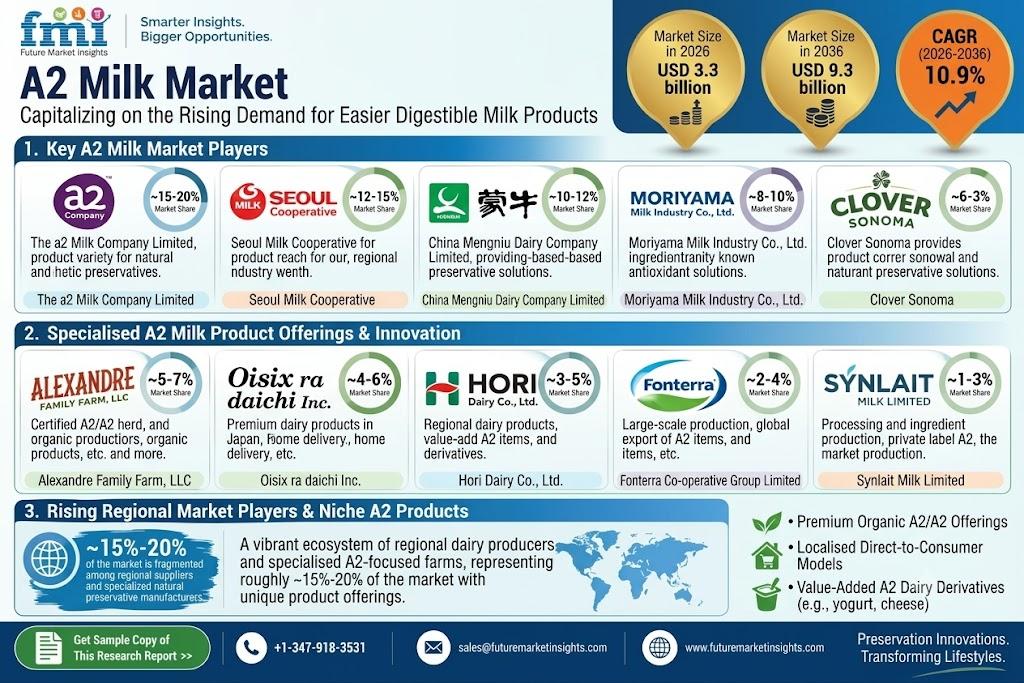
The global A2 milk market is forecast to increase from USD 3.3 billion in 2026 to USD 9.3 billion by 2036, expanding at a 10.9% CAGR during the 2026-2036 forecast period, according to Future Market Insights. The market stood at USD 3.0 billion in 2025. Growth is being supported by consumer interest in milk containing A2 beta-casein and by growing differentiation between A2 milk products and lactose-free dairy products, which address different milk components.
Get detailed market forecasts, competitive benchmarking, and pricing trends:
https://www.futuremarketinsights.com/reports/sample/rep-gb-13124
Regional Segment Leaders
As this is a global A2 Milk Market report, the segment analysis reflects nature, product forms, production practices, and geographic demand across key dairy markets.
• Conventional - 92.0% of Nature Segment revenue in 2026: Conventional A2 milk is expected to dominate because A2 herd segregation can utilize wider eligible cattle populations without requiring organic certification, supporting broader production and commercial availability.
• Liquid - 84.0% of Form Segment revenue in 2026: Liquid A2 milk leads demand due to regular household consumption, replenishment purchasing, and clear shelf-level differentiation from conventional milk and other specialty dairy products.
• Japan - 12.0% CAGR through 2036: Japan is expected to record strong growth as certification and A1 beta-casein testing support consumer-facing A2 liquid milk products across established retail channels.
Market Growth Context
The A2 Milk Market is developing around consumer interest in differentiated cow-milk products containing A2 beta-casein. Verified A2 protein identity is becoming an important consideration as producers seek to maintain product differentiation from conventional milk while providing clear information about the specific milk protein profile.
The distinction between A2 milk and lactose-free dairy products remains important for manufacturers and retailers. A2 milk refers to the beta-casein profile of the milk, while lactose-free products are processed to reduce or remove lactose. Consumer communication therefore needs to distinguish the protein claim from lactose removal when positioning A2 products.
Conventional products are expected to account for 92.0% of nature demand in 2026. The segment benefits from broader eligible herd pools because A2 segregation does not require organic certification. This provides producers with greater flexibility in sourcing and maintaining commercial-scale milk supply.
Liquid products are projected to hold an 84.0% share of form demand in 2026. Household consumption and regular replenishment support liquid milk sales, while visible shelf positioning allows consumers to distinguish A2 products from other dairy choices.
Powder formats provide an additional route for storage, ingredient conversion, and distribution. However, maintaining verified A2 identity remains important throughout production and processing. Genotyping, herd selection, segregated handling, testing, and final product controls can therefore influence the ability of producers to maintain consistent A2 identity claims.
Regional operating conditions differ across dairy markets. Japan is expected to expand at a 12.0% CAGR through 2036, supported by certification practices and A1 beta-casein testing used to support consumer-facing A2 products. Germany is projected to grow at an 8.0% CAGR, with established dairy drying capacity supporting ingredient conversion and other dry-dairy production routes.
German federal statistics indicate that drinking-milk output declined by 2.6% in 2025, while dry milk products including whey powder increased by 3.6%. These market conditions illustrate how established processing infrastructure can influence the development of different A2 milk formats and routes to market.
Commercial success through 2036 is expected to depend on verified A2 protein identity, reliable herd selection, segregated handling, consistent testing, processing controls, regulatory documentation, and clear consumer communication distinguishing A2 protein claims from lactose-free positioning.
Competitive Landscape
The competitive landscape features dairy companies, cooperatives, specialty milk producers, and vertically integrated A2 milk suppliers serving consumer and ingredient markets.
• Key A2 Milk Players: The a2 Milk Company Limited, Seoul Milk Cooperative, China Mengniu Dairy Company Limited, Moriyama Milk Industry Co., Ltd., Hori Dairy Co., Ltd., Clover Sonoma, Oisix ra daichi Inc., Alexandre Family Farm, LLC, Fonterra Co-operative Group Limited, and Synlait Milk Limited are among the key companies identified in the market.
Competitive differentiation depends on verified A2 protein identity, herd selection, testing procedures, segregated processing, distribution capabilities, product format, and consumer communication.
Supplier and processor controls remain important because A2 identity must be maintained and verifiable from herd selection through final product release. Companies capable of maintaining consistent testing and distribution controls may support greater consumer confidence while expanding product formats and market coverage.
The market is also seeing differences in regional commercialization strategies. Japan's certification and testing approach supports consumer-facing liquid products, while Germany's established dairy processing and drying infrastructure provides opportunities for ingredient conversion and dry-dairy applications.
Get the Complete Story - Read More About the A2 Milk Market: https://www.futuremarketinsights.com/reports/a2-milk-market
Analyst Perspective
"Processors protect protein identity and retailers explain the distinction from lactose removal during routine sales. Consistent testing and distribution controls support repeat purchasing and broader format choice without weakening the A2 identity claim." - Nandini Roy Choudhury, Principal Consultant, Future Market Insights
Explore More Research Reports by FMI
Yerba Mate Market https://www.futuremarketinsights.com/reports/yerba-mate-market
Collagen Casings Market https://www.futuremarketinsights.com/reports/collagen-casings-market
Autism Selective-Eating Nutrition Market https://www.futuremarketinsights.com/reports/autism-selective-eating-nutrition-market
Bakery Xylanase Market https://www.futuremarketinsights.com/reports/bakery-xylanase-market
Basbousa & Semolina Cakes Market https://www.futuremarketinsights.com/reports/basbousa-and-semolina-cakes-market
About Future Market Insights (FMI)
Future Market Insights, Inc. (FMI) is an ESOMAR-certified, ISO 9001:2015 market research and consulting organization, trusted by Fortune 500 clients and global enterprises. With operations in the U.S., UK, India, and Dubai, FMI provides data-backed insights and strategic intelligence across 30+ industries and 1200 markets worldwide.
For Press & Corporate Inquiries
Rahul Singh
AVP - Marketing and Growth Strategy
Future Market Insights, Inc.
+91 8600020075
For Sales: sales@futuremarketinsights.com
For Media: Rahul.singh@futuremarketinsights.com
For Web: https://www.futuremarketinsights.com/

 Arabic
 French
 Spanish
 Portuguese
 Deutsch
 Turkish
 Dutch
Dutch
 Italiano
 Russian
 Romaian
 Portuguese (Brazil)
 Greek
Greek